Russian Slang Words Common Phrases, Meanings, and Real-Life Examples
Russian slang words are widely used in everyday informal speech and especially among young people in Russia.
Common expressions like privet, poka, kruto, norm, and chotko are used to greet others or describe something cool and acceptable.
Many slang terms express emotions, such as kapets and zashkvar for something bad or embarrassing, while words like bomba, top, and ulet show excitement or approval.
Youth slang also includes internet-inspired terms like lol, kek, rofl, and krinzh, which are borrowed or adapted from global online culture.
Some words describe people, such as chuvak (guy), lokh (fool), or gopnik (street-style youth stereotype). Others refer to money and social life, like babki (cash) and tusa or tusovka (party).
Russian slang is constantly evolving, mixing traditional expressions with modern internet language, making it an important part of real-life communication that is often very different from formal textbook Russian.
Table of Contents
Quick Table
| Slang Word | Meaning (English) |
|---|---|
| Privet | Hi / Hello |
| Poka | Bye |
| Kruto | Cool |
| Norm | Okay / Fine |
| Chotko | Perfect / Sharp |
| Kapets | Wow / Disaster |
| Blin | Damn / Oh no |
| Zashkvar | Embarrassing / cringe |
| Lokh | Fool / loser |
| Chuvak | Guy / dude |
| Tusa | Party |
| Tusovka | Hangout / party |
| Babki | Money |
| Dengi | Money |
| Bomba | Amazing / awesome |
| Ulet | Fantastic / crazy good |
| Zhara | Intense / hot situation |
| Bred | Nonsense |
| Shiza | Madness |
| Krinzh | Cringe |
| Lol | Laughing (internet slang) |
| Kek | LOL (internet slang) |
| Rofl | Rolling on floor laughing |
| Bro | Brother / friend |
| Gopnik | Street-style youth stereotype |
| Pafos | Pretentious style |
| Zapadlo | Too lazy / inconvenient |
| Fail | Failure |
| Top | Best / top quality |
| Normik | Pretty good / okay-ish |
The Day I Realized Textbook Russian Wasn’t Enough
I’ll never forget the look on my Russian roommate Dmitri’s face when I confidently used the word “хорошо” (khorosho — meaning “good”) in response to literally everything he said for two weeks straight.
He finally sat me down one afternoon with a cup of tea and said, “You sound like a GPS navigation system. Nobody talks like that.”
That was my wake-up call.
I’d spent months on Duolingo, plowed through textbooks, and even watched Russian news programs thinking it would help me sound fluent. But real Russian — the kind people actually speak on the streets of Moscow, in the kitchens of St.
Petersburg, in WhatsApp voice messages between friends — is a completely different beast.
So this is what I wish someone had handed me on day one. Not textbook Russian. Real Russian. The slang, the shortcuts, the expressions that make native speakers do a double-take and say, “Wait… where did you learn that?”
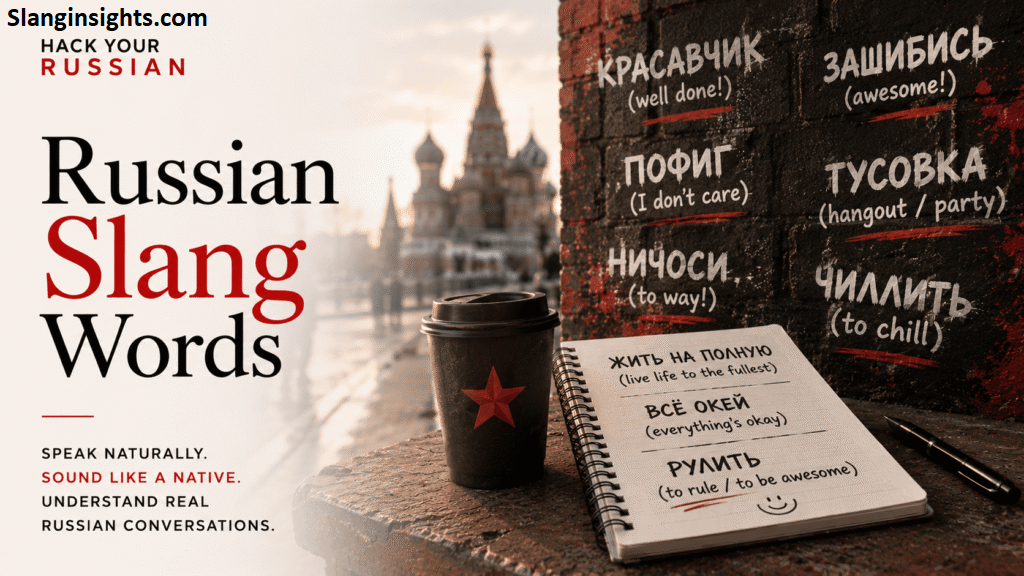
Why Russian Slang Matters More Than You Think
Here’s the thing most language apps don’t tell you: slang isn’t just “extra vocabulary.” In Russian, it’s practically a second language layered on top of the official one.
Russian people use slang constantly — in texts, in casual conversation, in social media captions, in memes. If you only know formal Russian, you’ll understand about 60% of what’s happening in any given group chat.
The other 40% will fly right over your head and you’ll just be sending confused emoji reactions hoping nobody notices.
I noticed this gap hard when I started using Telegram to chat with Russian friends. Half the messages looked like gibberish to me even though I “knew” the language.
So I started collecting slang. Obsessively. From conversations, from VK (Russia’s version of Facebook), from YouTube comments, from just… asking people point-blank: “What does that mean?”
Here’s what I found.
The Everyday Slang You’ll Hear Constantly
Норм (Norm)
This one is everywhere. It’s short for “нормально” (normally/fine) and it means something like “okay,” “decent,” or “it’ll do.” Not great, not terrible — just norm.
“How was the movie?” “Норм.”
It’s the Russian equivalent of a shrug. Use it when you don’t want to over-commit to an opinion. Russians use this constantly. Once you hear it, you’ll hear it everywhere.
Чел (Chel)
Shortened from “человек” (chelovek — person/human), “чел” just means “dude” or “guy.” It’s casual and friendly.
“Эй, чел, ты видел это?” — “Hey dude, did you see that?”
Super common in texts. The vibe is friendly and laid-back. If someone calls you “чел,” they’re being casual with you — that’s a good sign.
Жесть (Zhest’)
Oh, this one. “Жесть” literally means “tin” (like the metal), but in slang it means something is intense, crazy, brutal, or wild — in either a good or bad way depending on context.
“Traffic was insane today.” — “Жесть.” “That concert was insane.” — “Жесть!”
Same word, totally different emotions. You read the tone from the situation. I’ve heard this word used to describe everything from a horrific accident to an absolutely amazing meal. Context is king.
Красава (Krasava)
This is a shortened, informal version of “красавец” (krasavets — handsome/beauty) but it’s used to say “nice one,” “well done,” or “you legend.” It’s genuinely warm and affectionate praise.
Your friend fixes the WiFi: “Красава!”
It’s become so embedded in casual Russian that it doesn’t really have a gender anymore — you’d say it to anyone. I started using this and Russian people literally smiled bigger. It has good energy.
Тупить (Tupit’)
This verb means to “space out,” “act dumb,” or “not process something fast enough.” It comes from “тупой” (stupid/blunt), but it’s not as harsh as it sounds — it’s more self-deprecating or playful.
“Sorry, I was totally spacing out.” — “Прости, я тупил.”
You’ll also hear it used like: “Stop being slow! — Не тупи!”
When I started using this one about myself, Russians found it endearing. It’s the kind of word that signals you understand the vibe.
Кайф (Kayf)
This is one of my absolute favorites. “Кайф” means pleasure, bliss, enjoyment — that perfect feeling when everything is just right. It comes from Arabic via older Russian slang, and it’s been absorbed completely.
“The beach today was pure bliss.” — “На пляже сегодня — кайф.”
You can also use it as a verb — “кайфовать” — meaning to enjoy something deeply or vibe with it.
“I’m really vibing with this music.” — “Я кайфую от этой музыки.”
This one stuck with me because it’s such a warm word. It doesn’t have a sharp or ironic edge — it’s just pure good feeling.
Угар (Ugar)
“Угар” literally means “fumes” but in slang it means something hilarious, wild, or chaotic in a fun way. If something is “угар” it’s a riot.
“That video was hilarious.” — “Это был угар.”
You might also hear “угарать” (to crack up laughing) or “я угораю” (I’m dying laughing). Russians use this heavily in meme culture. Scroll through any Russian meme page and you’ll see “угар” in the comments constantly.
Чиллить (Chillit’)
Yes, Russians borrowed “chill” from English and made it their own verb. “Чиллить” means to relax, hang out, do nothing productive and feel great about it.
“What are you doing this weekend?” — “Просто чиллю дома.” (Just chilling at home.)
Russian is full of borrowed English words that have been “Russified” — given Russian verb endings, conjugations, the works. “Чиллить,” “лайкать” (to like on social media), “постить” (to post) — they’re everywhere, especially among younger Russians.
Движ (Dvizh)
“Движ” is shortened from “движение” (movement/action) but as slang it refers to a vibe, a scene, or a happening. It’s the social energy of a place or event.
“Is there a scene there?” — “Там есть движ?” “The party had good energy.” — “На вечеринке был движ.”
This one is very Gen Z Russian. If you want to sound current and under-35, drop “движ” into a sentence and watch people look mildly impressed.
Без базара (Bez Bazara)
This phrase literally means “without a market” (bazaar), but it’s used to mean “no problem,” “of course,” or “without question.” It’s a smooth, confident way to agree to something.
“Can you help me with this?” — “Без базара.”
It has a slightly cool, street-smart energy to it. Not rude at all — just confident. Russians use it the way we’d say “sure thing” or “absolutely.”
Mistakes I Made (So You Don’t Have To)
Using slang in the wrong context.
I once said “жесть” in response to a professor explaining a difficult academic concept. She looked confused. Slang has its place — it’s for friends, casual settings, texting. Save the formal Russian for formal moments.
Mispronouncing reduced vowels.
Russian has vowel reduction — unstressed vowels sound different from how they’re written. “Норм” sounds like “norm” with a very soft final consonant. If you’re learning from text alone, get onto YouTube and actually listen to native speakers. Channels like “Russian with Max” or podcasts on Spotify dedicated to Russian help enormously.
Assuming slang is universal.
Russia is huge. Slang varies by region, age group, and subculture. What sounds natural in Moscow might get a raised eyebrow in a smaller city. Ask locals which expressions they actually use.
Where to Actually Learn Russian Slang
- VK (vk.com) — Russia’s social network. Comments sections are a goldmine.
- Telegram channels — Follow Russian meme channels or interest groups.
- YouTube — Watch Russian vloggers (not just news). Real conversational Russian happens in vlogs.
- Language exchange apps — Tandem and HelloTalk connect you with real Russians who’ll correct you gently.
- Russian TikTok (or ВКонтакте Clips) — Slang evolves fast. Short video content keeps you current.
A Few More Worth Knowing
- Ладно (Ladno) — “Alright / okay / fine” — super casual agreement
- Чё (Che) — Slangy version of “что” (what) — think of it as “what?” or “huh?”
- Ваще (Vashche) — Short for “вообще” — used like “totally,” “actually,” or “at all”
- Прик (Prik) — A fun/weird person, an oddball (not offensive between friends)
- Зашквар (Zashkvar) — Something embarrassing or uncool; cringe
FAQ’s
What are Russian slang words?
Russian slang words are informal expressions used in everyday conversation, especially among young people, to sound more casual and expressive.
Is Russian slang different from formal Russian?
Yes, slang is much more relaxed, modern, and often includes shortened words, internet terms, and street expressions that are not used in formal writing.
Where is Russian slang commonly used?
It is mostly used in casual speech, social media, texting, and conversations between friends.
Are Russian slang words hard to learn?
Some are easy and similar to English internet slang, but others can be confusing because they depend on context and culture.
Should beginners learn Russian slang?
Yes, but after learning basic grammar. Slang helps you understand real conversations and sound more natural.
Conclusion
Russian slang words play a very important role in modern communication, especially among younger generations and in informal settings.
While standard Russian is used in education, media, and formal writing, slang is what people often use in daily life to express emotions, humor, and personality more freely.
These words and phrases help speakers communicate in a faster, more relaxed, and culturally rich way.
From simple greetings like “privet” and “poka” to expressive terms like “kruto,” “kapets,” and “krinzh,” Russian slang adds color and depth to conversations.
Learning slang also helps language learners understand movies, social media posts, and real-life conversations better.
However, it is important to use slang carefully, as some words can be rude, offensive, or context-dependent. Knowing when and where to use these expressions is just as important as learning their meanings.
Overall, Russian slang reflects modern culture, internet influence, and youth communication trends. It is constantly changing, with new words appearing every year.
For anyone interested in Russian language and culture, learning slang is a useful step toward sounding more natural and understanding how people really speak in everyday life.