Toronto Slang – Street, Hip-Hop & Everyday Terms 2026
Toronto slang is one of the most dynamic, culturally rich, and globally influential urban dialects alive today.
Born in the streets of Scarborough, Rexdale, and the Jane-Finch corridor, shaped by Jamaican Patois, Somali loanwords, and the boom of local hip-hop, Toronto’s dialect has been amplified worldwide by artists like Drake, The Weeknd, and PartyNextDoor.
In 2026, Toronto slang is not just a local curiosity — it echoes on TikTok, in rap lyrics, in group chats, and on the lips of people who have never set foot in the 6ix.
Table of Contents
Where Did Toronto Slang Come From?
Toronto slang — formally referred to by linguists as Multicultural Toronto English, or MTE — is a dialect that emerged from the unique demographic mix of Toronto’s inner suburbs.
Linguists attribute the development of MTE to societal factors that isolated Black Canadians in Toronto from normative Canadian English, such as the division of Toronto into ethnic enclaves and barriers to socioeconomic mobility for Black Canadians.
The dialect did not start with Drake. Toronto’s vernacular was well represented by hip-hop artists like Michie Mee, Kardinal Offishall, Choclair, Dream Warriors, and many others before Drake. Drake and his generation globalized a dialect that already had deep, decades-long roots.
The Cultural Origins of Toronto Slang
Toronto is one of the most multicultural cities in the world, and the Toronto Mans lingo is a combination of slang words from immigrants who came to Canada from the Caribbean, East Africa, and the Middle East.
Jamaican Patois contributed the highest volume of individual terms. The Somali community in Rexdale introduced specific loanwords that diffused outward. Caribbean communities across Scarborough and North York layered additional vocabulary that became common speech across the entire GTA.
Why Toronto Slang Went Global
The combination of streaming music, social media, and Toronto’s outsized cultural output pushed local slang onto the world stage.
Platforms like TikTok, Instagram, and YouTube created a pipeline from Toronto streets to global audiences. Today, people around the world recognize these phrases even if they have never visited Toronto. A term used in a Drake hook or a viral TikTok skit can enter everyday speech globally within days.
Toronto Slang: City Names and Identity Terms
Every real Torontonian knows the city’s nicknames. These are the identity markers that signal you are genuinely from the culture.
The 6ix
Drake came up with “the 6ix” from the last digit of Toronto’s primary 416 area code. Now it is the most globally recognized nickname for the city, appearing on merchandise, in lyrics, and in everyday conversation.
It also references the six original boroughs that make up the Greater Toronto Area: Toronto, Scarborough, Etobicoke, York, North York, and East York.
T Dot
T Dot is an older Toronto nickname that predates the 6ix. It is a variation of T.O. — itself a short form for Toronto. You will hear it from people over 30 who grew up with it as the dominant nickname.
Tdot, T.O., The 416, The 647
416 and 647 are Toronto’s two area codes, and both function as slang identifiers in rap and street conversation. Saying you are “from the 416” signals old-school Toronto roots. The 647 is associated with a newer generation.
Ronto
This is simply a pronunciation of Toronto — but it might as well be a word because it is how locals refer to the city. Sounding the first O and the second T is a dead giveaway that you are not from around here.
City Nickname Quick Reference Table
| Nickname | Meaning | Era | Who Uses It |
|---|---|---|---|
| The 6ix | Toronto (area code + 6 boroughs) | 2015–present | All ages, globally |
| T Dot | Toronto | 1990s–present | 30+ crowd, OG locals |
| T.O. | Toronto | 1980s–present | General use |
| Ronto | Toronto (local pronunciation) | Always | True locals |
| The 416 | Toronto (old area code) | 1990s–present | Hip-hop, street |
| The 647 | Toronto (new area code) | 2000s–present | Younger generation |
| GTA | Greater Toronto Area | Always | General, news media |
Toronto Slang: Essential Everyday Words
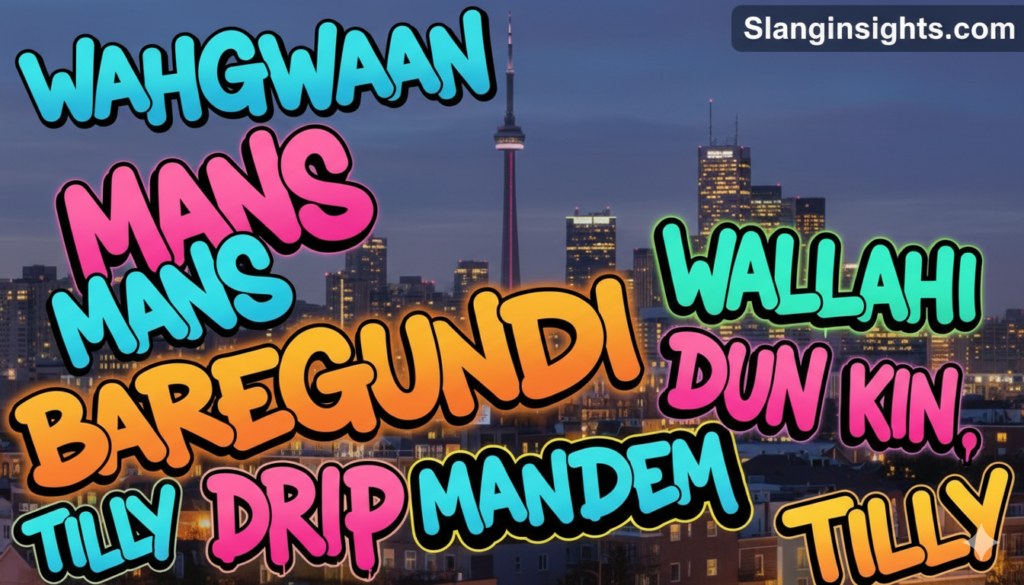
These are the terms you will hear constantly in any Toronto conversation — at school, at work, at the mall, or in a group chat.
Mans
Mans is a first-person singular pronoun unique to Toronto slang. Instead of saying “I” or “me,” a speaker refers to themselves as “mans.”
Example: “Mans just got back from the plaza.” This means “I just got back from the plaza.” It can also be used to refer to a third party — “that mans” meaning “that guy.”
Bare
Bare means the opposite of what you would expect — a lot. “There’s bare people at the mall today.”
It is one of the most frequently used Toronto slang words and appears in virtually every social setting from casual conversation to social media captions.
Peak
Peak means something unfortunate, unfair, or unlucky happened. “That’s so peak” is the equivalent of “that sucks” or “that is genuinely terrible.”
It is used for minor frustrations and major disappointments alike. The tone of delivery tells you how bad the situation actually is.
Dead
In Toronto slang, dead does not mean deceased. It means something is extremely funny. “Yo that’s dead” or “I’m dead” signals you find something hilarious, similar to “I’m deceased” in American internet slang.
It can also mean something is boring, irrelevant, or finished — context determines the meaning entirely.
Leng
Leng means extremely attractive or very impressive. “She’s leng” means she is beautiful. “That outfit is leng” means it looks incredible.
Rooted in Jamaican Patois, leng crossed into Toronto slang through the Caribbean community and is now used across age groups in the GTA.
Peng
Similar to leng but slightly broader in application, peng describes something that is excellent, attractive, or of high quality. Food, people, outfits, music — anything can be peng.
“That roti was peng” is one of the most Toronto sentences imaginable — slang word applied to the city’s beloved Caribbean staple food.
Blessed
Blessed is used as a general positive affirmation. It serves as a greeting, a farewell, or a response to good news. “You good?” — “Blessed, mans is good.”
Rooted in Rastafarian and Jamaican culture, it carries a warm, communal energy.
Wagwan
Wagwan is a direct import from Jamaican Patois meaning “what is going on?” It functions as a casual greeting identical in use to “what’s up.”
It is among the oldest Jamaican-origin terms in Toronto slang and remains in active daily use across the GTA.
Nize It
Nize it is a way to tell someone to be quiet or stop talking. It is pronounced like “nice” but with a Z and is the total opposite of the word nice.
“Nize it, I’m on the phone” is a common usage. It can be playful or genuinely firm depending on context.
Ahlie
Ahlie is a tag question meaning “right?” or “isn’t it?” placed at the end of a statement to seek agreement.
“That game was cold, ahlie?” is asking “that game was great, right?” It is one of the most distinctly Toronto ways to end a sentence.
Cheesed
Cheesed means annoyed, angry, or deeply upset. “I’m proper cheesed right now” signals genuine frustration.
The intensity varies by how it is delivered. “Mildly cheesed” and “absolutely cheesed” are both valid states, clearly communicated through tone.
Everyday Slang Master Table
| Term | Meaning | Usage Example | Origin |
|---|---|---|---|
| Mans | I / me / a guy | “Mans is tired today” | MTE / Jamaican |
| Bare | A lot / very | “There’s bare drama” | Jamaican Patois |
| Peak | Unfortunate / unfair | “That’s so peak bro” | UK / Caribbean |
| Dead | Hilarious / done | “I’m dead rn” | AAVE / MTE |
| Leng | Attractive / impressive | “She’s leng fr” | Jamaican |
| Peng | Excellent / high quality | “Food was peng” | Caribbean |
| Blessed | All good / greeting | “Blessed, how you?” | Rastafarian |
| Wagwan | What’s going on? | “Wagwan fam” | Jamaican Patois |
| Nize it | Be quiet / shut up | “Nize it please” | Caribbean |
| Ahlie | Right? / isn’t it? | “That’s hard, ahlie?” | Jamaican |
| Cheesed | Angry / annoyed | “Man’s cheesed rn” | Caribbean / MTE |
Toronto Slang: Street and Hip-Hop Terms
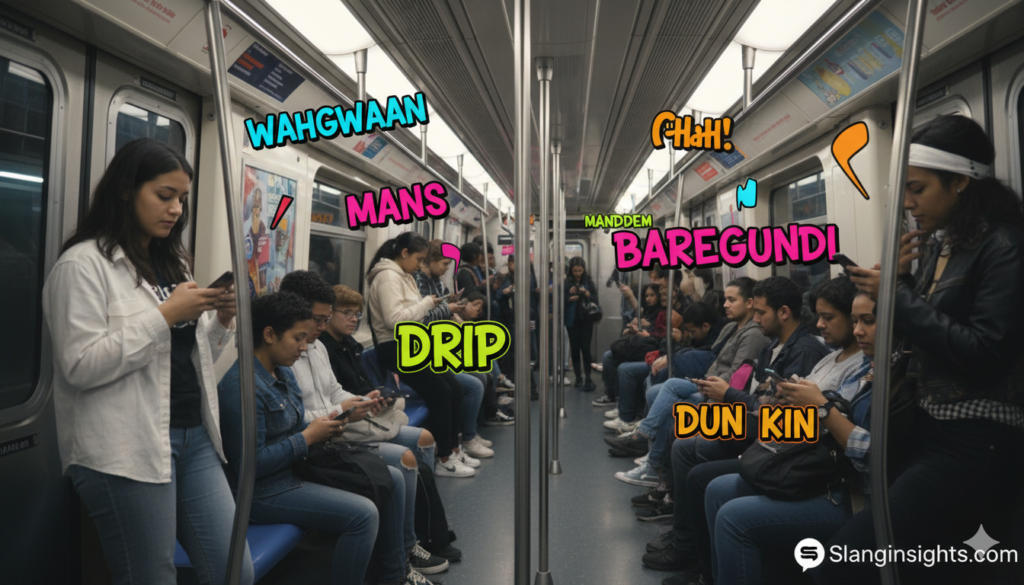
These are the terms that define Toronto’s street and music culture — used in lyrics, in rap battles, in cyphers, and in the vocabulary of anyone embedded in the scene.
Roadman
A roadman is typically a young person who spends a lot of time on the streets. They are often associated with the hip-hop and grime culture and have their own unique style.
In Toronto, being a roadman carries specific connotations of street knowledge, a particular fashion aesthetic — puffer jacket, fitted cap, tracksuit — and a certain way of speaking.
Mandem
Mandem means your crew, your group of close friends, or your people. “Link up with the mandem tonight” means meeting up with your close friend group.
It originates in Jamaican Patois, where “man dem” means “those men” or “my people.” In Toronto it is used broadly regardless of the gender makeup of the group.
Bredren
Bredren means close friend or brother. It is a term of deep affiliation. Calling someone your bredren signals a relationship of loyalty and trust above casual friendship.
Rooted in Rastafarian vocabulary, it entered Toronto slang through the Caribbean community and has been part of local speech for decades.
Linking
Linking means coming to or going to a place or event. “You reaching tonight?” “Imma reach.” In a specifically romantic context, “linking” means seeing or dating someone casually.
“Are you and her linking?” asks whether two people are dating or spending time together. Context makes the meaning clear.
Flex
Flex is used two ways. As a verb when you are showing off, otherwise known as stunting, and as an add-on to a noun when you are about to go somewhere or do something. If you are going to McDonald’s you would say “it’s a McDonald’s flex.”
A flex is both the act of showing off and the general activity you are engaged in. It is one of the most versatile words in Toronto slang.
Wassy
Wassy means foolish, stupid, or someone acting in an embarrassing way. Calling someone wassy is an insult — they are behaving without sense or dignity.
It derives from Jamaican Patois and carries mild to moderate severity as an insult depending on tone and context.
Dutty
Dutty means dirty — but not just physically. It extends to behavior, character, and attitude. A dutty move is a disloyal, underhanded action. Dutty can also be used positively in musical contexts, meaning raw or unfiltered in a way that commands respect.
Cold / Hard
Cold and hard are both used as strong compliments in Toronto street slang. Something that is cold is impressive, skillfully done, or particularly stylish. “That verse was cold” means the rap verse was excellent.
Hard carries the same meaning with slightly more intensity. “That fit is hard” means the outfit is impressive.
Wul / Wull
Wul means hold — as in “hold on” or “relax.” “Wul it” tells someone to pause, calm down, or wait before acting. It is often used to prevent escalation in tense situations.
Linking / Road / Ting
These three interconnected street terms deserve to sit together. Road means the street life and everything associated with it — the culture, the lifestyle, the reality of living in certain neighborhoods. Ting means a thing, a situation, a romantic interest, or a general noun placeholder with meaning provided by context.
“Ting’s been on road lately” means a person has been embedded in street life recently.
Street Slang Quick Reference Table
| Term | Meaning | Formality | Context |
|---|---|---|---|
| Roadman | Street-smart person | Street/Hip-Hop | Identity label |
| Mandem | Your crew / close friends | Street/Everyday | Social grouping |
| Bredren | Close brother / loyal friend | Street/Personal | Deep friendship |
| Linking | Meeting up / casually dating | Street/Social | Plans and romance |
| Flex | Showing off / any activity | Street/Everyday | Universal use |
| Wassy | Foolish / embarrassing | Street | Mild insult |
| Dutty | Dirty / disloyal / raw | Street/Music | Insult or praise |
| Cold / Hard | Impressive / excellent | Hip-Hop | Compliment |
| Wul / Wull | Hold on / calm down | Street | De-escalation |
| Ting | Thing / situation / person | Universal | Context-dependent |
Toronto Slang: Reaction Words and Expressions
Reaction words are the emotional vocabulary of Toronto slang — the terms used to express surprise, hype, approval, disapproval, and everything in between.
Hooooly
When you need to react to something or if someone is annoying you, you opt for a hooooly to let out all your feelings into an exaggerated reaction.
The elongation of the word scales with how intense the reaction is. A short “holy” is mild surprise. An extended “hoooooooly” is genuine shock or amazement.
Tings Are Moving
This expression means that things are progressing, something exciting is happening, or life is going in a good direction. “Tings are moving” signals momentum and positivity.
That’s Jarrin
Jarrin means something is annoying, irritating, or giving you secondhand embarrassment. “This is jarring” exists in standard English but “that’s jarrin” in Toronto slang is more casual and more intense.
Swiped / Gotten
Swiped or gotten means you have been caught out, deceived, or outsmarted. “Mans got swiped” means someone was tricked or embarrassed. It carries a mild comedic edge — being swiped is funny to everyone except the person it happened to.
No Cap / FR FR
While these terms originate in American AAVE, they are fully integrated into Toronto slang daily use. No cap means no lie, total honesty. FR FR (for real, for real) is an intensifier confirming sincerity.
“That show was cold no cap” means “that show was excellent and I mean it genuinely.”
Lit
Lit is a popular slang term in Toronto used to describe something that is exciting, cool, or trendy. It is often used to describe parties or events that are full of energy and fun.
While not uniquely Toronto in origin, lit is fully embedded in GTA youth vocabulary and appears consistently in Toronto social media content.
Toronto Slang: Relationship and Social Terms
Toronto’s romantic and social vocabulary is specific, layered, and requires context to decode correctly.
Ting (Romantic Use)
In romantic contexts, ting refers to a person you are interested in or casually seeing. “My ting” means my romantic interest or the person I am currently involved with.
It is a deliberately vague term — it does not specify the nature or seriousness of the relationship, which is partly why it is so widely used.
Sweeterman
A sweeterman is someone who is smooth and charming, especially when it comes to romantic pursuits. They know how to sweep people off their feet.
Being a sweeterman is broadly positive — it implies charisma, confidence, and success in romantic contexts without the negative connotations of manipulation.
Wifey / Wifed Up
Wifey refers to a serious romantic partner — the person someone treats with committed, long-term respect. Being wifed up means you are in a stable, acknowledged relationship.
“Man’s wifed up now” means someone has settled into a committed relationship.
Linking (Romantic)
As covered in the street terms section, linking in a romantic context means casually dating or spending time with someone. “We’re just linking” signals something informal and uncommitted.
Buff Ting
Buff ting means an attractive person. Buff means physically attractive, fit, or impressive in appearance. Ting provides the noun. Combined, it is a straightforward compliment about someone’s looks.
Toronto Slang: Money, Success, and Status Terms
Economic language is deeply embedded in Toronto slang culture, reflecting the aspirations and realities of growing up in the GTA.
Bread
Bread means money. Chasing bread means pursuing financial success. “Mans on his bread right now” means someone is focused and working hard toward financial goals.
Bands
Bands refers to large amounts of money, specifically thousand-dollar amounts. “Making bands” means earning significant money. The term derives from the rubber bands used to wrap stacks of bills.
Bag
Bag similarly refers to money or a financial opportunity. “Secure the bag” — widely popularized across North American slang — means locking down a profitable opportunity or making sure you get paid.
Drip / Dripping
Drip refers to a person’s overall style, fashion sense, and aesthetic presence. Someone with drip dresses with consistent, impressive style. “He’s dripping” means his fashion game is on point.
Level Up
Level up means to improve your situation, your skills, your income, or your lifestyle. It has crossed from gaming into general slang and is used regularly in Toronto to describe upward mobility.
Social Media and Text Slang Rooted in Toronto
Toronto slang has a significant digital life. These terms appear constantly across TikTok, Instagram, WhatsApp group chats, and texting.
| Digital Slang | Meaning | Where You See It |
|---|---|---|
| Sending me | Something is hilarious | TikTok comments |
| On sight | Immediately / without hesitation | Twitter, texts |
| It’s giving | Describing a vibe or impression | Instagram, TikTok |
| No cap | Honestly / for real | Everywhere |
| W (or W rizz, W move) | Win / positive | Social media |
| L (or L move, took an L) | Loss / negative | Social media |
| Lowkey | Secretly / understated | All platforms |
| Highkey | Obviously / intensely | All platforms |
| Slay | Excellent performance / look | TikTok, Instagram |
| Big man ting | Serious / adult business | Texts, group chats |
How to Use Toronto Slang Correctly
Knowing a term is only half the skill. Using it correctly requires understanding tone, audience, and cultural context.
Tip 1: Understand the Origin, Respect the Culture
Most Toronto slang originates in Black Canadian communities — specifically communities rooted in Caribbean, Somali, and broader African diaspora cultures. Using these terms without understanding their origin is cultural appropriation. Understanding where the language comes from makes you a more respectful and more credible user of it.
Tip 2: Let Context Drive Meaning
Many Toronto slang words change meaning entirely based on context. Ting can be a romantic interest, a general situation, or a noun placeholder. Dead can mean hilarious or boring. Cold can be a compliment or a literal temperature. Always read the context before interpreting.
Tip 3: Tone Carries as Much Weight as the Word
In Toronto slang, delivery matters enormously. “Cheesed” said flatly is mild annoyance. “CHEESED” with volume and sustained eye contact is serious anger. The same words express completely different intensities through tone and expression.
Tip 4: Not Every Term Is for Every Setting
Street slang belongs in casual social settings. Bringing heavy roadman vocabulary into a job interview or formal academic setting signals poor situational awareness. Know when the dialect serves you and when standard English is more appropriate.
Tip 5: Keep Up — The Language Moves Fast
Toronto slang evolves constantly. Terms that were fresh in 2020 may sound dated in 2026. Following Toronto-based content creators, local hip-hop, and GTA social media accounts is the most natural way to stay current with the language as it evolves.
Toronto Slang Difficulty Level Guide
| Term | Difficulty | Newcomer Risk | Notes |
|---|---|---|---|
| The 6ix / T Dot | Very Easy | Low | Universal, safe in all contexts |
| Wagwan / Blessed | Easy | Low | Warm, friendly, universally received |
| Bare / Peak / Dead | Easy | Low | Very common, context usually clear |
| Mandem / Bredren | Medium | Medium | Affiliation terms — use authentically |
| Roadman / Dutty | Medium | Medium | Identity/insult — context critical |
| Wassy / Jarrin | Medium | Medium | Can sound forced if overused |
| Mans (self-reference) | Medium | Medium | Specific grammatical use — practice first |
| Linking (romantic) | Medium | Medium | Ambiguity is intentional — own it |
| Bands / Bread | Easy | Low | Money terms, widely understood |
| Wul it | Hard | High | Very specific — wrong use sounds off |
Frequently Asked Questions (FAQs)
What is Toronto slang called by linguists?
Linguists formally call it Multicultural Toronto English or MTE. It is a distinct dialect shaped by Jamaican Patois, Somali loanwords, Caribbean communities, and Black Canadian vernacular developed primarily in Toronto’s inner suburbs.
Did Drake invent Toronto slang?
No. Drake popularized Toronto slang globally but did not create it. Artists like Kardinal Offishall, Michie Mee, and Choclair used and represented Toronto’s vernacular long before Drake’s rise to fame.
What does “mans” mean in Toronto slang?
Mans is a first-person pronoun used instead of “I” or “me.” It can also refer to a third-party male. “Mans is tired” means “I am tired.” It is one of the most distinctly Toronto-specific grammatical features in MTE.
What does “bare” mean in Toronto slang?
Bare means a lot or very much, opposite to its literal English meaning. “There’s bare people here” means there are a lot of people present. It is used as both an adjective and an intensifier.
What does “ting” mean in Toronto slang?
Ting can mean a thing, a situation, or a romantic interest depending on context. “My ting” usually refers to someone the speaker is romantically involved with. “The whole ting” refers to an entire situation or event.
Where did Toronto slang come from?
Toronto slang grew from the multicultural inner suburbs — primarily Scarborough, Rexdale, and Jane-Finch — where large Jamaican, Somali, and broader Caribbean diaspora communities developed a shared vernacular that blended their home languages with Canadian English.
Is Toronto slang the same as Canadian slang?
No. Toronto slang is specific to the Greater Toronto Area and rooted in Black Canadian and Caribbean diaspora communities. Canadian slang is broader — terms like “eh,” “toque,” “loonie,” and “toonie” are national and culturally distinct from MTE.
What does “peak” mean in Toronto slang?
Peak means something unfortunate, unfair, or genuinely bad happened. “That’s peak” is equivalent to “that sucks” or “that is really unfortunate.” It is used for everything from missing the bus to a major disappointment.
How has social media changed Toronto slang?
Social media — especially TikTok, Instagram, and YouTube — has accelerated the spread of Toronto slang globally. Terms that originated in specific GTA neighborhoods now appear in comments, captions, and conversations worldwide within days of gaining viral traction.
Is it disrespectful for non-Torontonians to use Toronto slang?
Using Toronto slang respectfully and with cultural awareness is generally accepted. Using it without understanding its roots — especially terms from Black Caribbean and African diaspora communities — risks cultural appropriation. Learning the origin of the language and the communities that created it is the foundation of respectful use.
Conclusion
Toronto slang is not just a list of cool words — it is a living linguistic record of one of the most diverse and culturally vibrant cities in the world.
Every term carries a history: the Jamaican communities of Scarborough who brought Patois to Canada, the Somali families of Rexdale whose loanwords wove into everyday speech, the local hip-hop artists who gave the dialect a platform, and the millions of young Torontonians who use it to express identity, humor, loyalty, and belonging every single day.
In 2026, Toronto slang reaches further than ever — streaming globally through music, TikTok, and digital culture in ways that would have been unimaginable a decade ago.
Whether you are a visitor trying to follow a conversation, a language learner fascinated by Canadian dialect, or a Torontonian wanting to appreciate what your city gave the world, this guide is your starting point. The 6ix speaks — now you know what it is saying.