W Meaning Slang Explained Win, Loss & Everything In Between
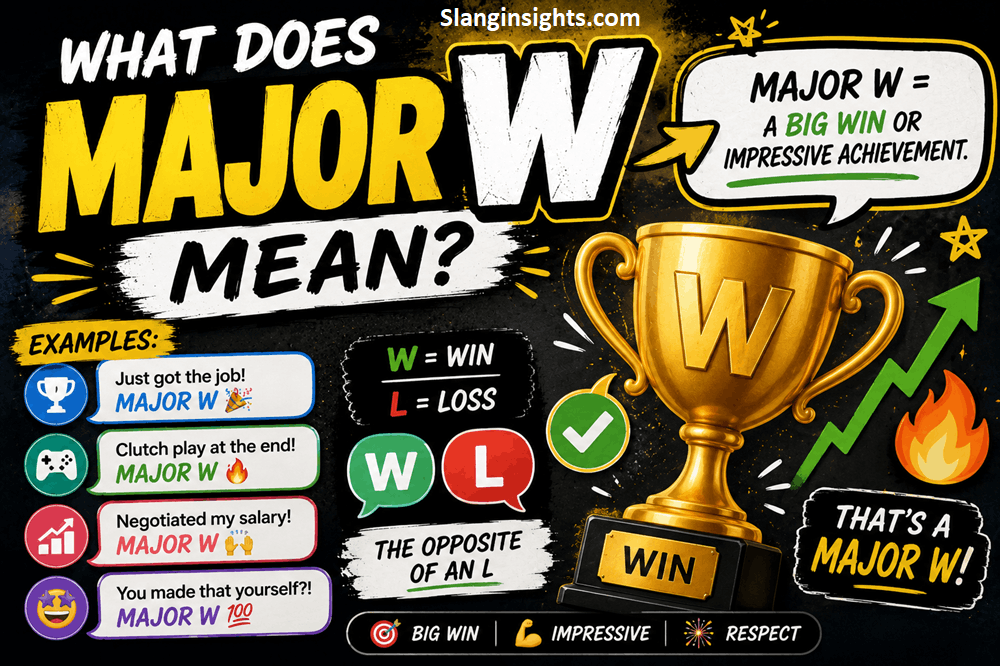
W Meaning Slang is internet slang for “win.” When someone calls something a “W,” they mean it’s a success, a good outcome, or something worth celebrating.
The term started in gaming and sports communities, where “W” naturally stood for a win on the scoreboard. Over time, it spread across TikTok, Twitter, and everyday texting.
You’ll often see it used alone — someone posts good news and the comments fill up with “W.” It’s also used in phrases like “Big W” for a major win or “take the W” meaning accept the victory.
Table of Contents
Quick Table
| erm | Meaning | Example | Type |
|---|---|---|---|
| W | Win / success / good outcome | “That exam was a W.” | Positive |
| L | Loss / failure / bad outcome | “Missed the bus. Big L.” | Negative |
| Big W | Major win or achievement | “Got the job — Big W!” | Positive |
| Small W | Minor but still positive win | “Free parking — small W.” | Positive |
| Take the W | Accept the victory / be proud | “You did great, take the W.” | Positive |
| Stack Ws | Keep winning consistently | “She’s just stacking Ws lately.” | Positive |
| W rizz | Great charm or social skill | “He’s got W rizz fr.” | Positive |
| W content | High-quality, engaging post/video | “This video is W content.” | Neutral |
| Ws in the chat | Type W to celebrate (streaming) | “Ws in the chat boys!” | Neutral |
What Does “W” Actually Mean in Slang?
One letter. A thousand contexts. Here’s how it really works — from Discord servers to your group chat.
Last summer, my little cousin texted me after his football match: “Bro we got the W “ and I — someone who has been online since the days of MSN Messenger — actually had to read it twice.
I knew what he meant, sort of. But it hit me how fast that single letter had jumped from sports commentary into literally every corner of the internet.
You see it on TikTok, Discord, Twitter/X, Reddit, WhatsApp, everywhere. And yet, I still get questions from people who aren’t sure whether “W” is a compliment, a reply, or something else entirely.
So let me give you the full breakdown — not the dictionary version, the real one, the kind you’d get if you asked someone who’s been deep in gaming communities, tech Twitter, and group chats for years.
The Short Answer First
In slang, W stands for “Win” (or “Winner”). When someone says “that’s a W,” they mean that’s a win — a success, a good outcome, a smart move. It’s the opposite of an L, which stands for “Loss.”
But here’s where people trip up: the word “win” is almost never literally attached to it in conversation. People don’t say “W win.” They just say W. The letter is the meaning.
W
= Win / Good
“That decision was a W”
“He’s a real W for doing that”
“Absolute W move bro”
“Take the W, you earned it”
L
= Loss / Bad
“That was a massive L”
“Taking an L on that trade”
“Biggest L of the year tbh”
“Ratio + L + no cap”
Where Did This Come From?
The W/L shorthand almost certainly started in sports. Scoreboards have used W (Wins) and L (Losses) forever — if you’ve ever looked at an NBA standings table, you’ve seen this your whole life.
Sports commentators, journalists, and fantasy league players have been typing “W” as shorthand for decades.
The jump to internet slang happened in the gaming community — specifically in competitive gaming culture around 2015–2018.
On Twitch, Discord servers, and YouTube comments, people started dropping “W” to celebrate clutch plays, good strategies, and overall wins in a match.
From there, it spread to Twitter (now X), and by around 2020–2021, it was fully mainstream on TikTok and in everyday texting.
I remember the first time I saw it used outside of sports was in a Discord server for a game I was playing.
Someone made a really good call in a match and the chat just filled up with “W W W W” — and even then it felt fresh and oddly satisfying to read. Fast-forward to today and it’s everywhere.
“The letter W does more work than most full sentences on the internet right now.”
How People Actually Use It
This is where it gets interesting, because “W” isn’t just used one way. It works as a noun, adjective, and sometimes just a standalone reaction. Let me break down the real-world usage:
As a Noun (“a W”)
Most common usage. You’re describing a result or outcome as a win.
Example — Group Chat
J
guys they finally fixed the wifi at the café
Y
THAT IS A W
J
absolute W for all of us who work there lol
As a Standalone Reply
Sometimes people just drop a single “W” as a response. It works like “nice,” “good,” or “well done” — short, punchy, and immediately understood by anyone under 30 who spends time online.
Example — Twitter / X Reply
R
Just got promoted after 2 years of grinding
Y
W
K
Massive W deserved
As an Adjective (“W move,” “W player”)
This is the evolved form. People now attach W to any noun to describe it as good, smart, or praiseworthy. “W CEO,” “W response,” “W season,” “W playlist” — you can stick it in front of basically anything.
In YouTube/TikTok Comment Culture
On YouTube, you’ll often see comments like “W vid” meaning the video was good. On TikTok, “W rizz” means someone has strong charisma or game. This usage has exploded in the last two years, especially with younger audiences.
The Full Slang Context: Platforms Where You’ll See It
Platform
Common Usage
Vibe
Twitter / X
“Ratio + L” or just “W post bro”
Very common
Discord
Spamming “W W W” in chat after a win
Daily usage
TikTok
“W or L?” polls, “W rizz,” “W energy”
Huge + evolving
“This is a W for consumers” in tech threads
Moderate use
YouTube
“W vid,” “W channel,” “W creator”
Common in comments
WhatsApp/iMessage
Casual: “bro that’s a W honestly”
Growing fast
What About “Ratio + L”?
If you’ve spent any time on Twitter/X, you’ve probably seen comments that just say “Ratio + L + [something]”.
This is the aggressive combination. “Ratio” means your reply got more likes/engagement than the original post (a social media humiliation); “L” is piled on top as an insult. Sometimes people add “W” sarcastically to mock someone:
“Taking the biggest L while thinking it’s a W.”
This kind of usage is very Twitter-specific and is basically a form of internet combat. It’s playful among friends but can be genuinely mean when directed at strangers. Worth knowing the difference.
Common Mistakes People Make
If you’re new to this slang, here’s where most people go wrong:
Using it too formally. Dropping “W” in a professional Slack channel or an email is going to land weird. This is casual language — keep it in casual spaces.
Overusing it. I’ve seen people respond to literally everything with “W” and it loses all meaning fast. Save it for genuine wins.
Confusing “W” with “win” out loud. In speech, people say “that’s a dubya” sometimes, but mostly they still say “that’s a win.” The W is primarily a text/screen thing. Saying “W” out loud (as the letter) in conversation outside of gaming circles can feel forced.
Thinking it’s always positive. Sarcastic use is everywhere. “Oh wow, a W for sure” dripping with irony is extremely common. Context and tone matter.
Quick Reference: How to Use W Without Looking Confused
01Use “W” or “that’s a W” to celebrate a good outcome — a win, a smart decision, good news, a compliment-worthy action.
02Use “W [noun]” as an adjective: “W move,” “W response,” “W season” — it means the thing in question is good or praiseworthy.
03A solo “W” as a reply = a thumbs-up, a “nice one,” or a “that’s great” — short form, high impact.
04Pair with L to contrast: “that was an L disguised as a W” means something looked good but turned out badly.
05Keep it casual — Discord, Twitter, TikTok, texting. Not for professional or formal communication.
W in Gaming: The Original Home
It’s worth spending a moment here because gaming is where this fully crystallized. In competitive games like League of Legends, Valorant, Call of Duty, or any team-based game, the end-of-match screen literally shows a “W” or an “L” — Win or Loss.
Players started carrying that into their chat language naturally.
On Twitch streams, when a streamer pulls off something impressive, the chat floods with “W” or “W player” almost instantly. It’s become the default celebration token.
Streamers themselves say “we got the W” to their audience after a victory, reinforcing the language loop between creators and community.
If you play games online at all and you’re not already using this casually, it’s going to show up constantly — in post-game lobbies, Discord servers, even in the names of YouTube highlight channels.
Does “W” Mean Anything Else?
A few edge cases worth knowing:
“Big W” — amplified version. A particularly great win. “Passing my driving test first try? Big W.”
“W rizz” — you’ve got charm and social confidence. “Rizz” itself is slang for charisma, so “W rizz” is peak charisma.
“Take the W and go” — means accept the win, don’t push your luck or overthink it. Similar energy to “quit while you’re ahead.”
“W for [group/person]” — used to say something is a victory specifically for that group. Example: “New EU data protection ruling — W for consumers, L for big tech.”
“W or L” polls — extremely popular on TikTok and Twitter. Someone shares a decision or situation and asks their audience to vote Win or Loss. It’s a quick engagement tool.
How It Sits Next to Other Slang
Understanding W in context means knowing its neighbors. You’ll often see it alongside words like:
No cap — meaning “for real, no lying.” So “W, no cap” = “That’s genuinely a win, I’m not joking.”
Fr fr — short for “for real for real.” Doubles down on sincerity. “That’s a W fr fr.”
Bussin — used for food mainly, meaning excellent. “W and bussin” can appear together when food is involved.
Slay — different energy but sometimes used interchangeably in fashion/beauty spaces. “That outfit is a W” and “that outfit slays” mean similar things.
The interesting thing is that W has a unique neutrality to it — it doesn’t carry the gender associations of “slay,” doesn’t feel as Gen-Z-exclusive as “rizz,” and works across sports, gaming, tech, and pop culture without feeling out of place. That’s probably why it’s stuck so hard.
My Honest Take After Years of Watching This Evolve
Here’s the thing about slang like “W” — it survives because it’s useful. It’s short, it’s clear, it’s emotionally satisfying to type (or read).
When something good happens and you want to acknowledge it without writing a paragraph, “W” does exactly what you need it to do.
I’ve watched plenty of internet slang rise and fall — some of it dated embarrassingly fast. But W/L has genuine staying power because it’s rooted in something real (actual sports records) and works across so many contexts without needing much explanation.
Even people who have never used it before immediately understand what “that’s a W” means from context alone.
That clarity is rare in slang, and it’s probably why your parents, your little cousins, and your coworkers are all going to encounter it at some point — if they haven’t already.
So next time someone drops a “W” in your chat or your comment section, you know exactly what they’re saying — and now you know how to use it back without it feeling awkward. That, honestly, is a W in itself.
FAQ’s
What does “W” mean in slang?
“W” stands for “win.” It’s used to describe a success, good outcome, or something worth celebrating in everyday texting and social media.
Where did the slang “W” come from?
It originated in gaming and sports communities where “W” naturally meant a win on the scoreboard. It later spread to TikTok, Twitter, and mainstream texting culture.
What is the opposite of “W” in slang?
The opposite is “L,” which stands for “loss.” If something goes wrong, people say it’s an “L” or a “Big L.”
Can “W” be used seriously or is it just for jokes?
Both. While it’s casual slang, people use it genuinely to celebrate real achievements — promotions, good grades, personal milestones, and more.
Is “W” still popular in 2026?
Yes. “W” remains one of the most widely used slang terms across TikTok, gaming, and texting, with no signs of fading out anytime soon.
Conclusion
Understanding slang like “W” is more than just keeping up with trends — it’s about speaking the language of the internet.
Whether you’re scrolling through TikTok, chatting with friends, or engaging with an online community, knowing what “W” means helps you connect, communicate, and respond naturally.
At its core, “W” is simple: it means win. But its real power lies in how much emotion it carries in just one letter.
From celebrating a promotion to reacting to a viral video, “W” captures that feeling of success without needing a long explanation.
Over the years, it has evolved beyond a single word into a whole family of expressions — Big W, Stack Ws, W content, Ws in the chat.
Each variation adds a layer of nuance, letting people express exactly how much of a win something really is.
As internet culture continues to shape everyday language, terms like “W” remind us that communication is always evolving.
The shorter, the sharper, the better. So next time something good happens — a raise, a goal, a perfect coffee order — you already know what to say.