Italian Slang Words 100 Popular Phrases Every Traveler Should Know
Italian slang words are the secret code that separates textbook learners from true insiders.
From the casual shrug of “boh” — meaning “who knows” — to the enthusiastic “figata” when something is genuinely cool, these expressions paint a vivid picture of how Italians really communicate.
Everyday phrases like “dai” (come on!) and “meno male” (thank goodness) pepper conversations with personality and flair. Greetings like “bella zio” or “come butta” instantly signal street credibility.
Even emotions get colorful treatment — “stanco morto” for exhausted or “incazzato” for furious. Mastering Italian slang transforms you from a tourist into someone who truly speaks the language of the streets.
Table of Contents
Quick Table
| Slang | Meaning |
|---|---|
| Boh | I don’t know |
| Dai | Come on! |
| Figata | Something really cool |
| Meno male | Thank goodness |
| Bella zio | Hey man! |
| Stanco morto | Dead tired |
| Incazzato | Very angry |
| Furbo | Cunning / sly |
Why Real Italians Don’t Speak Like Your Textbook
My first week in Rome, I said “buongiorno” to a café owner and he replied with something that sounded like “boh” and walked away. I stood there holding my cornetto wondering if I’d accidentally insulted his mother.
Turns out, boh just means “I don’t know” or “beats me.” He was answering someone else’s question. I was fine. But that moment made me realize — textbook Italian and spoken Italian are two completely different languages.
If you’ve ever tried to learn Italian through apps like Duolingo or watched Italian YouTube to practice, you’ve probably noticed that what people actually say bears very little resemblance to what the lessons teach.
Native speakers talk fast, clip words, swap proper vocabulary for slang, and express entire emotional states with a single syllable.
This guide is about that gap — the real, everyday Italian that nobody teaches you but everyone uses.
Why Italian Slang Trips Up Learners (And Even Tourists Who Think They Know Better)
Here’s the thing nobody tells you: Italian slang isn’t just vocabulary. It’s performance. The same word said flatly versus with an eyebrow raise means completely different things.
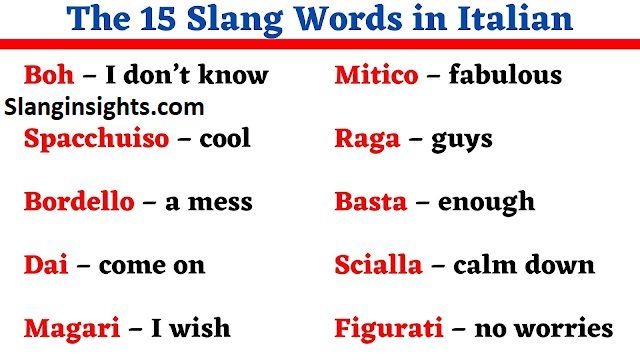
Dai can mean “hurry up,” “no way,” “okay fine,” or “come on, don’t be like that” — all depending on tone and body language.
I made the mistake of treating Italian slang like a vocabulary list. I’d memorize a word, drop it into conversation, and get a polite but clearly confused look in return. The word was right. The delivery was robotic. Italians noticed.
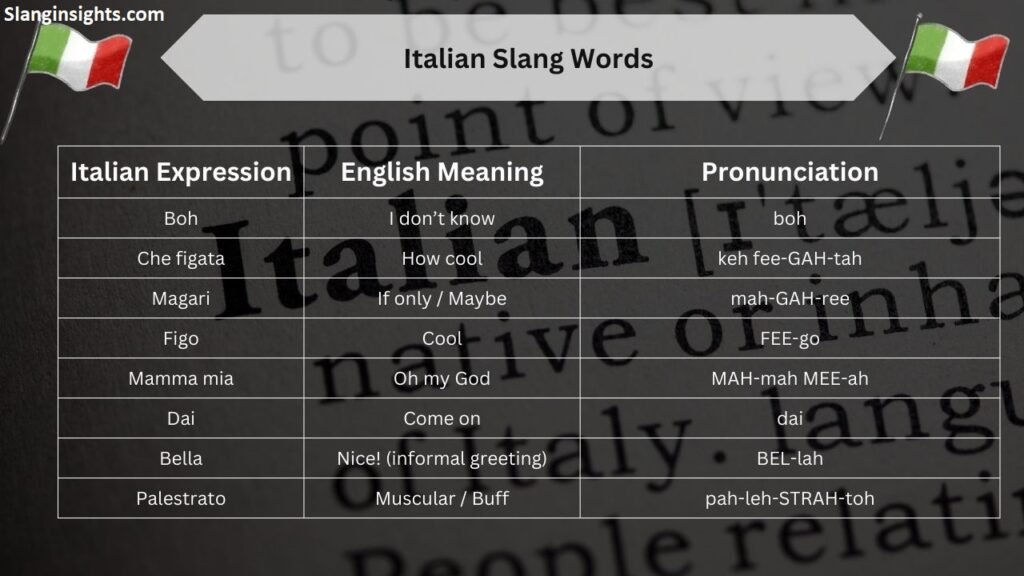
The interactive glossary above is useful for learning what words mean, but the real work happens when you start listening for them in context — in Italian films, in conversations at markets, in the way baristas argue about football.
The Words You’ll Hear Before You Understand Them
Some slang words hit you repeatedly before you ever look them up. Here are the ones that confused me most, and what they actually mean once you crack the code.
Boh — I’ve dedicated real mental energy to this one syllable. It means nothing and everything. Every Italian says it constantly.
It’s not rude, it’s not enthusiastic, it’s just the universal sound of “I genuinely don’t know and I’m okay with that.” If someone asks a Roman what time it is and they don’t have their phone, you’ll hear boh before they even fully turn around.
Tranquillo — This sounds like an instruction to relax, and it is, but in a warm way. Tranquillo, ci penso io is something an Italian friend might say as they wave your worries away and take charge of a situation. Romans especially use this. It’s less “calm down” and more “I’ve got it, stop stressing.”
Che casino — First time I heard this in a conversation, I thought someone was talking about gambling. They were not. Casino in everyday Italian speech means chaos, mess, or disorder.
A crowded train station? Che casino. Your colleague’s disorganized spreadsheet? Che casino. It’s one of the most-used expressions for any situation spiraling out of control.
The Emotional Range of a Single Italian Word
What genuinely surprised me, spending time around Italian speakers, is how much emotional precision exists in their slang. English-speaking cultures tend to layer on words. Italians compress everything into one punchy syllable or phrase.
Mamma mia is the classic example. It’s been so thoroughly exported and turned into a stereotype that many learners assume Italians don’t actually say it. They do. Constantly.
And it covers an enormous emotional range. Hearing bad news? Mamma mia. Tasting something incredible? Mamma mia. Stuck in traffic? Mamma mia. Walking into a hot summer street? Mamma mia.
The intonation does all the work — it rises for delight, falls heavy for frustration, and comes out as a long sigh for exhaustion.
Cavolo is the polite version of a much stronger expletive — one you definitely don’t want to use in casual company until you really, really know your audience.
Cavolo literally means cabbage, but nobody is thinking about vegetables when they say it. It’s a family-safe release valve for frustration. Italian grandmothers say it.
Kids stub their toe and say it. It’s the equivalent of “shoot” or “dang” in English — completely harmless and oddly satisfying.
The Slang That Reveals Italian Humor
Sfigato — This one made me laugh when I finally understood it.
It comes from sfiga, meaning bad luck, and it describes someone who is perpetually unlucky or a bit of a loser in an affectionate, teasing way.
Between friends, it’s the kind of word you throw at the person who misses the bus, drops their gelato, and then realizes they left their wallet at home — all in one afternoon. It’s ribbing, not cruelty. But tone matters enormously here.
Sorcio — Literally “rat,” and mostly a Roman thing. In Rome, slang tends to be rougher and more theatrical than in the north. Calling someone a sorcio can be an insult or, weirdly, a term of rough affection between close mates.
I’d steer clear of this one until you have strong enough friendships to know which register you’re operating in.
Youth Slang: Where Italian and English Collide
Modern Italian youth slang is fascinating because it absorbs English words and makes them sound completely Italian. Boomer is used exactly as you’d expect — to dismiss anything or anyone as out of touch with current life.
Fichissimo (extremely cool) comes from the older slang word fico and still sounds natural coming from a twenty-year-old.
This blending happens fast. If you learned Italian even five years ago from a textbook and then sat in on a group chat between teenagers in Milan, you’d recognize maybe half the vocabulary.
The other half has been borrowed, mutated, or invented.
The best way to stay current isn’t a dictionary — it’s Italian social media, Italian YouTube creators in casual settings, and Italian Netflix shows with Italian subtitles turned on (not translations — the original Italian captions, which often render slang differently than dubbed versions).
Common Mistakes When Using Italian Slang
Using it too formally, too fast. Slang sounds strange when someone’s Italian is otherwise very textbook-perfect. People notice the mismatch and it can feel like you’re performing rather than speaking. Better to pick up slang gradually, through immersion, than to copy-paste it from a list.
Ignoring regional differences. Italian is not monolithic. Rome has its own slang ecosystem. Milan sounds different. Naples is its own world entirely. Sorcio as casual insult is very Roman. Certain phrases you’ll hear constantly in the south won’t register at all in Turin. If you’re planning to spend time in one city, research slang from that region specifically.
Getting the register wrong. Some slang is fine between friends but weird in a shop or restaurant. Dai is universal enough to work almost anywhere. Sfigato is a bit more charged. Pay attention to when Italians around you use certain words before you start using them yourself.
Saying things without the right body language. This is the big one. Italian communication is embodied. Hands move. Eyebrows move. Shoulders shrug. If you say boh while standing perfectly still with no expression, it doesn’t land right. The word and the gesture are a package deal.
How to Actually Get Better at This
Honestly, the most effective thing I did was watch Italian crime dramas with Italian subtitles — not English ones. Shows set in Rome or Naples especially.
The characters speak fast, use heavy slang, and argue constantly, which means you get the tone variations alongside the vocabulary. Gomorra for Naples dialect. Suburra for Roman street speech.
Pairing that with a phrasebook like Italian Slang Dictionary (which does exist, though it’s a bit dated) or the Italian section of sites like WordReference, where native speakers debate nuances in comments, goes a long way.
The interactive guide at the top of this page is a good starting point for the most common, versatile words — the kind that you’ll actually encounter in daily conversation rather than obscure regional expressions.
Tap through the categories and read the example sentences out loud. Even that small habit of speaking the words rather than just reading them makes a difference.
FAQ’s
What are Italian slang words?
Italian slang words are informal expressions used in everyday conversation by native speakers that you won’t typically find in standard textbooks or formal Italian lessons.
Are Italian slang words used across all of Italy?
Not always. Some slang is regional — for example, “ganzo” is popular in Tuscany while “pirla” is more common in northern Italy. Context and location matter.
Can learning Italian slang help me sound more fluent?
Absolutely. Using natural slang expressions like “boh” or “dai” in the right moments makes you sound far more natural and connected to real Italian culture.
Is Italian slang appropriate in formal settings?
No. Slang is strictly casual. Avoid these expressions in business meetings, formal letters, or conversations with people you don’t know well.
Where is the best place to learn Italian slang?
Watching Italian films, listening to Italian podcasts, following Italian social media creators, and spending time with native speakers are the most effective ways to pick up authentic slang naturally.
Conclusion
Italian slang words are the heartbeat of the language — raw, expressive, and deeply tied to culture, region, and emotion.
While formal Italian will get you through a museum tour or a business meeting, it is slang that gets you invited to the dinner table, welcomed into conversations, and accepted as someone who truly understands Italy beyond its tourist surface.
From the dismissive shrug of “boh” to the enthusiastic burst of “figata,” every slang word carries a story, a mood, and a moment. These expressions reflect how Italians think, feel, and connect with one another in their daily lives.
They are spontaneous, warm, and often hilarious — much like the culture itself.
Learning Italian slang is not just about memorizing words. It is about understanding rhythm, tone, and the unspoken rules of when and how to use them.
A well-timed “dai!” or a knowing “meno male” can break the ice, earn a laugh, or turn a stranger into a friend.
Whether you are planning a trip to Rome, studying the language seriously, or simply fascinated by Italian culture, mastering these slang words will open doors that no phrasebook ever could.
Start small, listen carefully, and let the language surprise you.