Irish Slang Words Common Phrases, Meanings, and Real-Life Examples
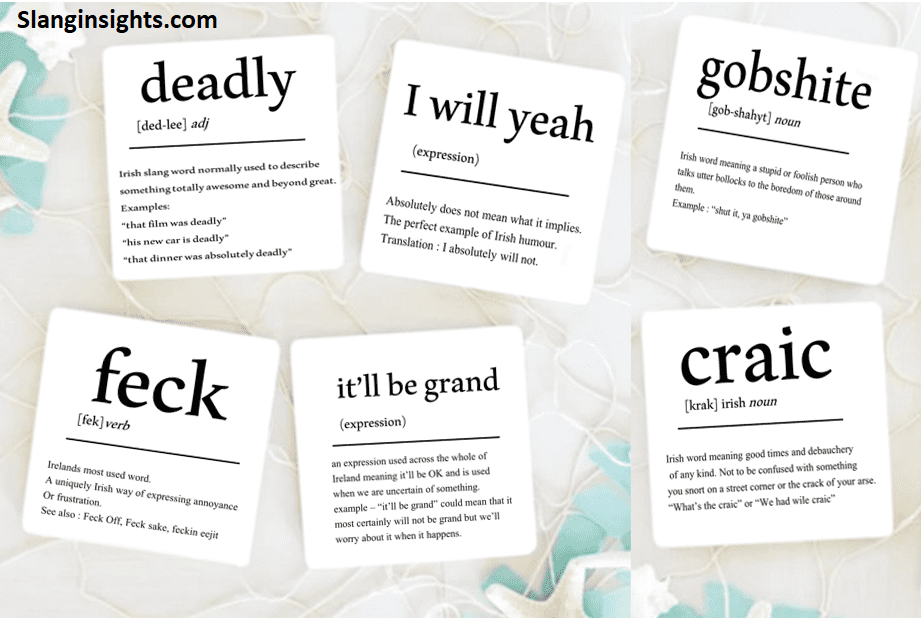
Irish Slang Words If you’re heading to Ireland, brush up on the lingo before you land. When an Irish person says something is deadly, they mean it’s brilliant — not dangerous.
Grand means fine or okay, and craic is the word for fun or good times. Call someone an eejit and you’re calling them a fool.
A gobshite is someone who talks nonsense. Fierce means very, as in “fierce cold today.” A culchie is someone from the countryside, while a jackeen is a Dublin city slicker.
If someone tells you “she’s a gas woman,” they mean she’s hilarious. Jaysus expresses shock, sound means a person is decent and trustworthy, and away with the fairies describes a daydreamer. Now you’re sorted — go have the craic!
Table of Contents
Quick Table
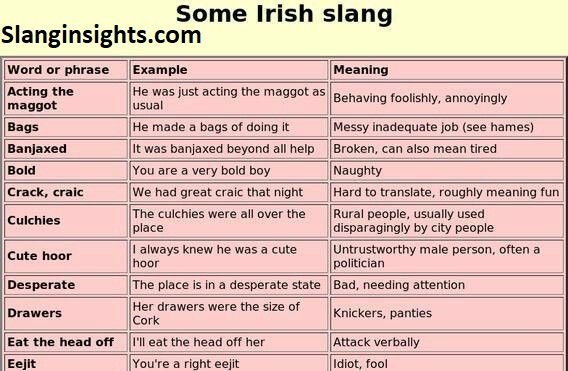
| Slang Word | Meaning |
|---|---|
| Craic | Fun, good times |
| Grand | Fine, okay |
| Deadly | Brilliant, amazing |
| Eejit | Fool, idiot |
| Sound | Decent, trustworthy |
| Fierce | Very, extremely |
| Banjaxed | Broken, ruined |
| Scarlet | Deeply embarrassed |
A Practical Guide to Irish Slang
The first time someone called me a “gobshite” in a pub in Dublin, I genuinely did not know whether to laugh or apologize. I stood there with my pint, smiled awkwardly, and nodded — like an absolute eejit.
That was my third day in Ireland. By the end of the first week, I was firing back with “sound out” and “grand so,” and people were looking at me like I’d grown a second head. But by the end of the month? I was grand. Proper grand.
If you’re heading to Ireland, have Irish mates, watch shows like Derry Girls or Love/Hate, or just find yourself spiraling down an Irish TikTok rabbit hole at 2am — this guide is for you.
Real Irish slang, explained the way it’s actually used, with none of the “charming Irish phrases!” tourist-blog fluff.
“Grand” — The Word That Does Everything
Let’s start here, because this one will genuinely confuse you.
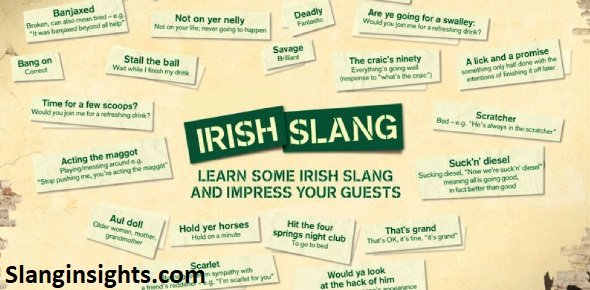
In most English-speaking countries, “grand” means impressive, large, or spectacular. In Ireland, it basically means fine or okay — and it’s wildly versatile.
- “How are ya?” “Ah, grand.” → I’m okay, nothing special, life goes on.
- “Is that okay for you?” “Grand, yeah.” → Yes, that works.
- “Grand so.” → Alright then. Deal done. Conversation over.
The first time an Irish colleague said “that’s grand” about my work, I thought I’d absolutely nailed it. Turns out I’d just done an acceptable job. Lesson learned. Temper your excitement when you hear “grand.”
The Essential Starter Pack
These are the ones you’ll hear constantly. Get comfortable with them fast.
“Sound”
Means cool, reliable, good. “He’s very sound” = he’s a solid, decent person.
“Sound out” is an enthusiastic version — more like “brilliant, cheers.” You’ll hear it at the end of phone calls, after someone does you a favor, after a solid pint. Just throw a “sound” in and you’re already halfway to fitting in.
“Craic” (pronounced “crack”)
This is the big one. Craic means fun, news, banter, atmosphere, the vibe — all rolled into one word. “What’s the craic?” = What’s going on?
“The craic was mighty” = We had an absolute blast. “Any craic?” = Anything happening / how are things?
Fair warning: if you’re not Irish, do not try to use this one too aggressively in the first week. You’ll overdo it. I said “the craic is ninety” to a shopkeeper on day four and she looked at me like I had three heads.
“Gas”
Nothing to do with fuel. “That’s gas” or “you’re gas” means something is funny or someone is hilarious. “Ah she’s gas craic” — she’s really funny and good fun to be around.
“Deadly”
Another one that sounds alarming and means the opposite. “Deadly” = amazing, fantastic. “That film was deadly.” “Ah she’s deadly, isn’t she?” It’s high praise. Embrace it.
“Gobshite”
Back to where we started. This is someone foolish, idiotic, or full of nonsense. It can range from light-hearted slagging to genuine insult depending on tone.
Context is everything here. Among friends, it’s basically a term of endearment. From a stranger? Maybe less so.
“Eejit”
A gentler version of gobshite. An idiot, but not a malicious one. More like someone who just did something daft. “Ah you big eejit” is almost affectionate.
Slang You’ll Need in a Pub
The pub is basically a classroom for Irish slang. Here’s your cheat sheet.
“Are ya getting a round in?” — Are you buying drinks for the group? Rounds are serious business in Ireland. Do not skip your round. It’s basically a social contract.
“Suckin’ diesel” — Things are going well. “We’re suckin’ diesel now” = we’re on the right track, everything’s working out.
“The session” — A long, great night of drinking and music. “It turned into a session” means nobody went home at a reasonable hour.
“On the tear” — Going out for a big night. “We’re on the tear this Friday.”
“Locked” or “twisted” — Very drunk. “He was absolutely locked last night.” Not something you want said about you by someone sober.
“The fear” — That dreadful next-morning anxiety after a big night. Also called “the morbs.” If you’ve experienced it, you already know. The Irish just gave it a name.
Slagging: An Art Form You Need to Understand
Here’s something that genuinely threw me off for weeks: Irish people express affection through merciless slagging.
If an Irish person is constantly taking the piss out of you, making fun of your accent, or calling you an eejit — congratulations, they like you.
“Taking the piss” means making fun of someone or something, usually lightly and without malice. It’s not mean-spirited; it’s social glue.
“Slag” can be a verb or noun — to slag someone is to mock them playfully. “He’s getting a great slag” means everyone’s having a good laugh at his expense and he’s probably fine with it.
The unwritten rule: if someone slags you, you slag back. If you can’t take it and give it back, you’ll have a harder time.
If someone can’t be slagged at all — they’re described as “taking themselves too seriously,” which in Ireland is a fairly damning verdict.
Regional Stuff Worth Knowing
Ireland is a small island, but the slang shifts around a bit.
Dublin slang is its own beast. “Howiya” (how are ya), “bleedin'” (as an intensifier — “that’s bleedin’ deadly”), and “your man” or “your woman” (used to refer to anyone — “your man over there” just means that guy over there, regardless of whether you know him).
Cork people have their own musical accent and slang, and they’re proud of it. “Like” appears at the end of sentences constantly. “Boy” is used as a general term of address for anyone.
Northern Irish slang (especially Belfast) is a whole other level. “Wee” appears everywhere — “a wee minute,” “wee buns” (meaning easy, a piece of cake). “Bout ye” = how are you. “Awk” is an all-purpose filler sound that conveys mild resignation or sympathy.
The Phrases That Tripped Me Up
“I will yeah” — This means no. Delivered with a flat tone, it’s pure sarcasm. “Will you do that report by Friday?” “I will yeah.” = Absolutely not happening.
“Not the worst” — This is a compliment. Genuinely. “He’s not the worst” means they actually quite like the person. Irish understatement is a skill.
“I’m in bits” — Exhausted, devastated, or just rough. “I’m in bits after that match.” Can apply to emotional distress or physical tiredness equally.
“We’ll see” — This one’s not unique to Ireland, but Irish people use it as a soft no more consistently than anywhere else I’ve been. If an Irish mammy says “we’ll see” — that’s a no.
“Come here to me” — Not a physical invitation. It’s a way to get someone’s attention or start a new topic. “Come here to me, did you hear what happened?”
A Few More Worth Pocketing
- “Acting the maggot” — Messing around, not taking something seriously. “Stop acting the maggot.”
- “Thick” — Stupid or slow-witted. “Ah don’t mind him, he’s thick as a plank.”
- “Mitch” — To skip school or avoid something. “We mitched off last period on Fridays every week.”
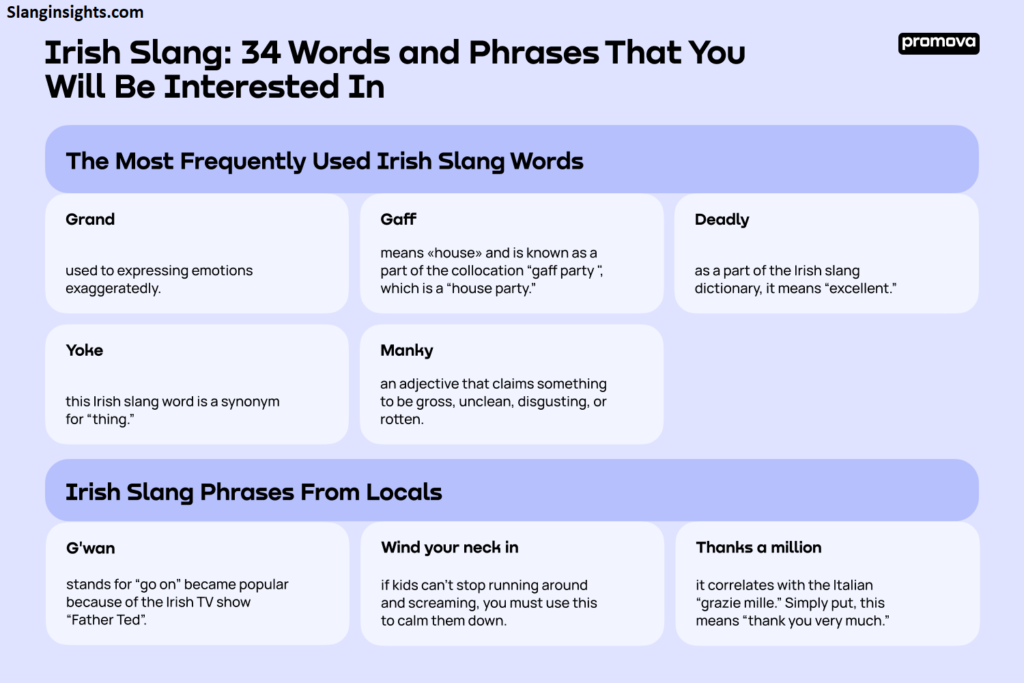
- “Manky” — Disgusting, dirty, or gross. “That kitchen is manky.”
- “Banjaxed” — Broken, ruined, or exhausted. “The car’s banjaxed.” “I’m absolutely banjaxed.”
- “Knackered” — Also exhausted. The Irish have many ways to say they’re tired, and they use all of them.
- “Pure” — Used as an intensifier. “That’s pure class” = that’s absolutely excellent.
Common Mistakes to Avoid
Don’t fake the accent while using the slang. It comes across as mockery rather than appreciation. Use the words naturally in your own voice — Irish people will love that you know the slang, not that you’re doing a bad Brendan Gleeson impression.
Don’t overuse “craic” immediately. There’s a tourist version of Ireland that clings to the word craic like a life raft, and locals can smell it. Earn it.
Don’t take slagging personally at first. This is genuinely the biggest one. If you react badly to being slagged, it will be remembered. Roll with it.
Don’t confuse “deadly” and “grand.” One is high praise, one is mild acknowledgement. Calling someone’s wedding speech “grand” is not the compliment you think it is.
FAQ’s
What does “craic” mean in Irish slang?
Craic means fun, good times, or lively conversation. You’ll often hear “what’s the craic?” which simply means “what’s going on?”
Is Irish slang the same as British slang?
No. While Ireland and Britain share the English language, Irish slang has its own unique words and expressions rooted in Irish culture and the Gaelic language.
Can tourists use Irish slang without offending locals?
Absolutely. Irish people generally love it when visitors make an effort to use local slang. It’s seen as friendly and respectful rather than offensive.
What is the most commonly used Irish slang word?
“Grand” is probably the most frequently used. It simply means fine or okay and is used dozens of times a day in everyday Irish conversation.
Do different parts of Ireland have different slang?
Yes. Dublin, Cork, Galway, and rural areas all have their own regional expressions and variations, so slang can differ quite a bit from county to county.
Conclusion
Irish slang is one of the most colorful and charming aspects of Irish culture. It reflects the warmth, humor, and wit that the Irish people are famous for around the world.
Whether you’re planning a trip to Dublin, moving to Cork, or simply fascinated by the way language evolves, learning Irish slang words gives you a genuine window into the Irish way of life.
From calling something “deadly” when you mean it’s brilliant, to describing a broken appliance as “banjaxed,” Irish slang turns everyday conversation into something far more entertaining.
These words and phrases have been passed down through generations, shaped by history, the Irish language, and a culture that has always valued storytelling and sharp wit.
What makes Irish slang so special is how naturally it flows in conversation. Locals use these expressions without a second thought, and once you start picking them up, you’ll find yourself reaching for them too.
There’s something deeply satisfying about saying “sure it’s grand” instead of “it’s fine,” or calling a confusing gadget a “yoke” instead of a “thing.”
So whether you’re a curious learner, a traveller packing your bags, or an Irish diaspora reconnecting with your roots, embracing these slang words will make you feel a little more at home on the Emerald Isle.
Go on — give it a go. You’ll be deadly at it in no time.