Why Gen X Slang Words Still Matter Today 100 Classic Terms Explained
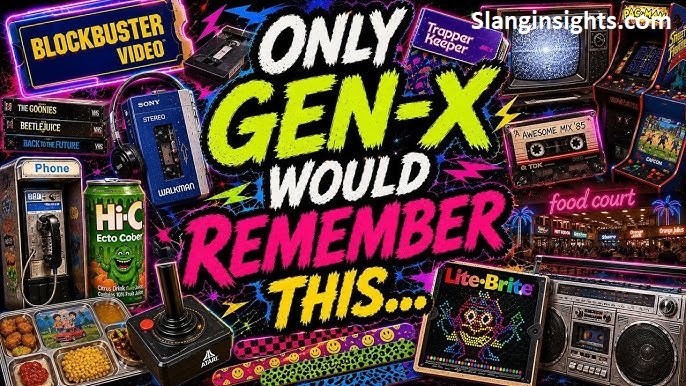
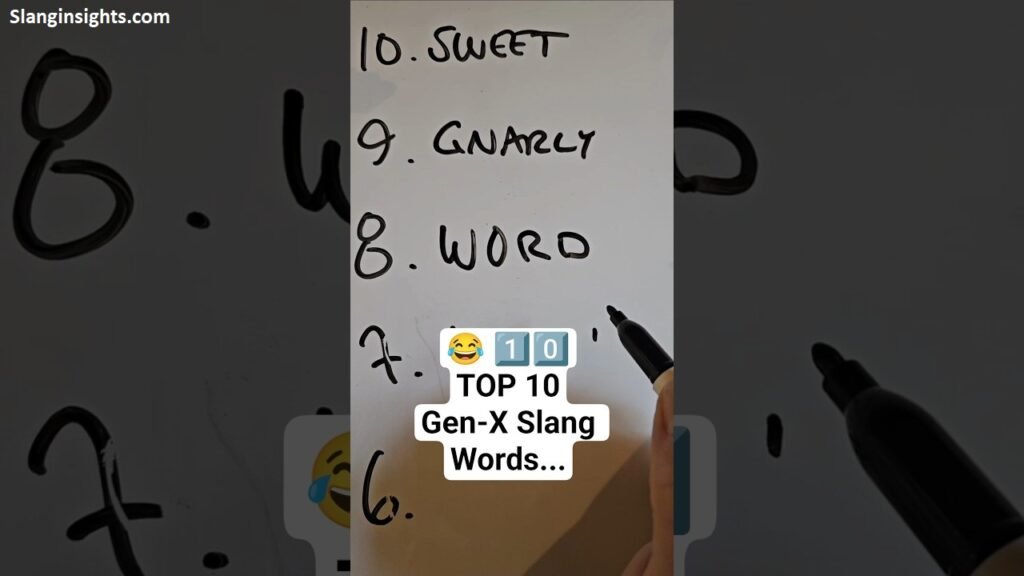
Why Gen X Slang Words having a massive comeback, and Gen Z is leading the charge.
Words like “gnarly,” “rad,” and “totally” are flooding TikTok feeds and Instagram reels as younger generations rediscover the effortlessly cool language of the 80s and 90s.
Gen Z, obsessed with vintage aesthetics and retro culture, finds Gen X slang refreshingly authentic compared to today’s overused internet speak.
There is something raw and rebellious about the way Gen X communicated — no filters, no algorithms, just pure street credibility. What was once considered outdated is now the definition of cool all over again.
Table of Contents
Quick Table
| Slang Word | Meaning | Example Usage |
|---|---|---|
| Gnarly | Awesome / intense | “That trick was gnarly” |
| Rad | Cool / impressive | “Your jacket is so rad” |
| Totally | Absolutely / yes | “Totally agree with you” |
| Bogus | Unfair / fake | “That’s totally bogus, man” |
| Dude | Friend / anyone | “Dude, did you see that?” |
| Gag Me | Disgusting / gross | “Gag me, that’s nasty” |
| Tubular | Amazing / excellent | “That wave was tubular” |
| Grody | Gross / disgusting | “That food looks grody” |
| Psych | Just kidding | “I passed… psych!” |
| Bail | To leave / ditch | “Let’s bail from this party” |
| Chill | Relax / calm down | “Just chill out, man” |
| Wicked | Very / extremely cool | “That was wicked awesome” |
| No Duh | Obviously | “No duh, everyone knows that” |
| Burn | A comeback / insult | “Ooh, major burn right there” |
| Fly | Stylish / attractive | “She looks so fly today” |
| Diss | To disrespect someone | “Don’t diss me like that” |
| Whatever | I don’t care | “Whatever, do what you want” |
| Homeboy | Close friend | “That’s my homeboy for life” |
| Trippin | Overreacting / acting crazy | “You’re trippin right now” |
| All That | Full of yourself | “She thinks she’s all that |
My Journey into the World of Gen X Slang
My older cousin came to visit last summer, and somewhere between arguing about what to watch on Netflix and debating whether cereal is a soup, she called something “totally tubular.” She said it with zero irony. Completely straight-faced.
My teenager looked at her like she’d just spoken in tongues.
That moment sent me down a rabbit hole. I started digging through my own vocabulary, asking myself — how much Gen X slang do I actually use without even noticing?
Turns out, a lot. And the more I dug, the more I realized how rich, weird, and weirdly resilient this generational vocabulary really is.
Whether you’re a Gen Xer who grew up in the ’80s and ’90s, a millennial who absorbed it through osmosis, or a Gen Zer trying to decode what your parents are saying — this deep dive into Gen X slang is for you.
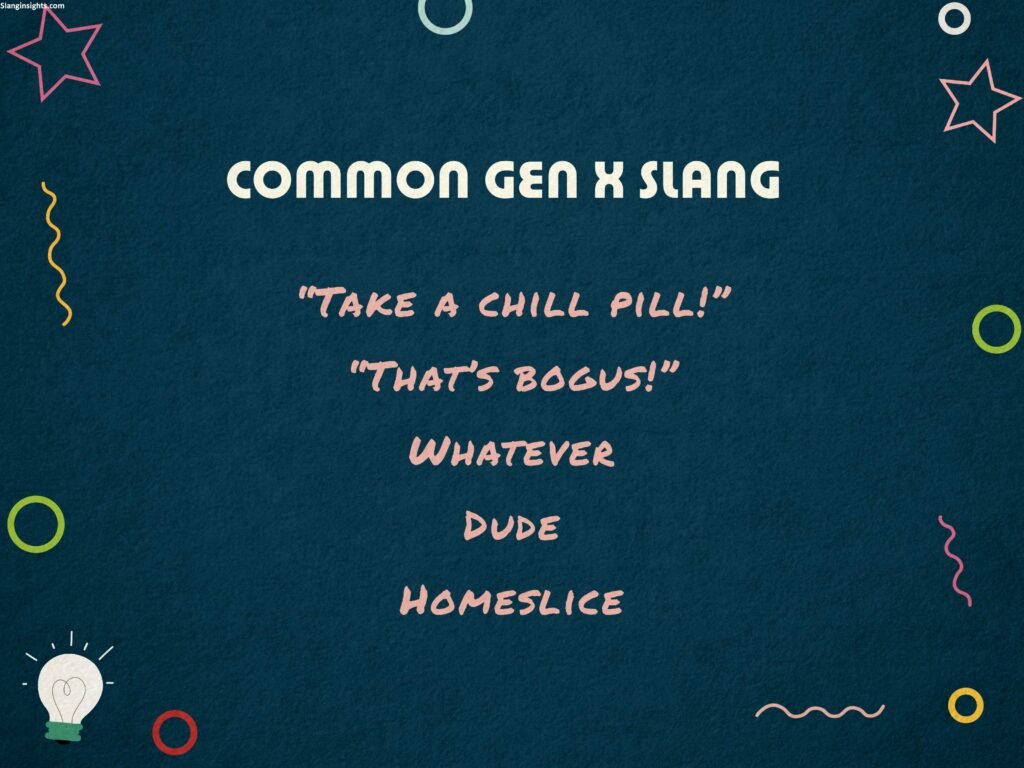
What Even Is Gen X Slang?
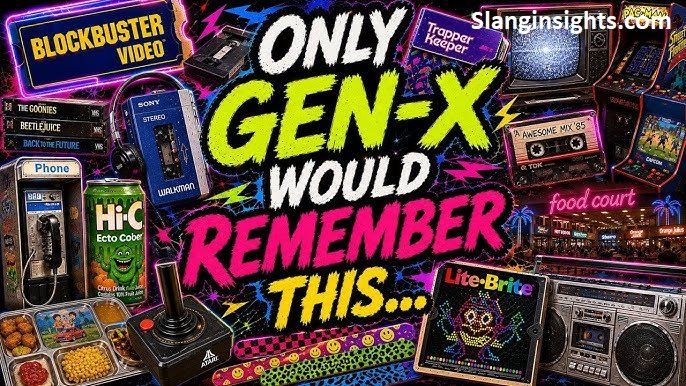
Gen X refers to people born roughly between 1965 and 1980. They grew up with MTV, mall culture, Saturday morning cartoons, VHS tapes, and a whole lot of cynicism about the world adults had handed them.
Their slang reflects all of that — it’s equal parts cool, sarcastic, and oddly philosophical.
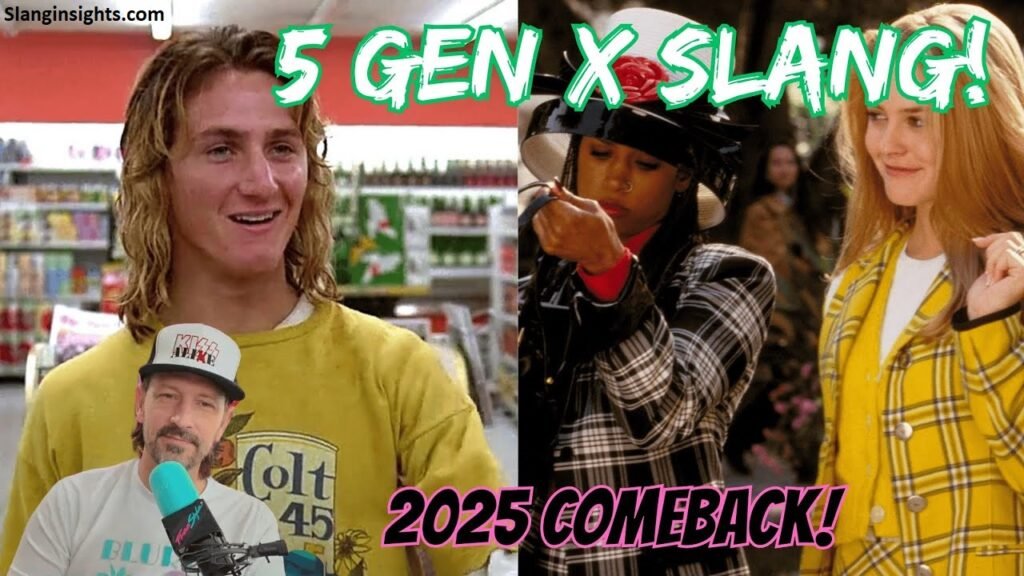
A lot of it came from surf and skate culture in California, then got beamed across America via music videos and movies like Fast Times at Ridgemont High, Clueless, and Wayne’s World. It spread faster than you’d think for a pre-internet era.
Some of it died with the decade. But a surprising chunk of it? Still kicking around.
The Core Gen X Slang Dictionary
Let’s go through the big ones. Not just definitions — but where they came from and how they actually got used in the wild.
Rad
Short for “radical.” If something was rad, it was impressive, exciting, or just plain awesome. Skate culture gave us this one, and it spread everywhere. You’d hear it on playgrounds, in arcades, and screamed at concerts.
People still use “rad” today, and it’s had a genuine resurgence among younger generations who use it semi-ironically (and then ironically enough, it becomes sincere again). Cycle of language.
Bogus
Bogus meant unfair, fake, or just plain wrong. “That’s totally bogus” was the Gen X version of “that’s not it, chief.” It showed up everywhere — Bill and Ted made it iconic, but it existed well before them.
I still drop “bogus” when something genuinely frustrates me. My coworkers under 30 give me a look. Worth it.
Gnarly
Originally surf slang for dangerous or difficult waves. It evolved to mean anything intense, impressive, or shocking — good or bad depending on context. A gnarly trick on a skateboard = impressive. A gnarly fall = painful but somehow still kind of impressive.
Context was everything with gnarly. And that ambiguity is part of what made it so useful.
Tubular
Peaked in the early ’80s. Meant something was awesome or excellent. This one did NOT survive the decade in any practical sense — it became a parody of itself almost immediately. Today it exists mainly as shorthand for “yes, I am definitely doing a Gen X impression right now.”
My cousin’s use of it, as I mentioned, was either peak nostalgia or she had genuinely lost track of time.
Dude
Okay, technically “dude” predates Gen X, but this generation supercharged it into a universal address term. Dude could be used for anyone — male, female, a group, a dog, a situation. “Dude, no.” “Dude, YES.” “Dude, I can’t even.”
Millennials and Gen Z absorbed this one fully. You’ll still hear “dude” constantly. Credit where it’s due.
Psych!
Said immediately after tricking someone into believing something. You’d set up a believable lie, let them accept it, then yell “Psych!” The level of betrayal this caused on playgrounds was significant.
Also written “Sike” — the internet argument over which spelling is correct is a whole thing.
Bitchin’
Gen X recycled this one from earlier decades and made it their own. It meant impressive, cool, or excellent. Despite its edge, it was used casually enough that even parents sometimes let it slide.
Grody
Gross. Disgusting. Something that made you physically recoil. “That’s so grody” was a perfectly acceptable response to finding a weird thing in a cafeteria lunch. Heavily associated with Valley Girl speech, immortalized in the 1982 Frank Zappa / Moon Unit Zappa song “Valley Girl.”
To the Max
Intensifier. Everything got pushed to the max. “That’s gnarly to the max.” “That was radical to the max.” You stacked descriptors on top of each other like a linguistic layer cake. It was excessive. It was perfect.
Chillin’
Relaxing, hanging out, not doing much. “What are you doing?” “Just chillin’.” This one didn’t just survive — it thrived across every generation since. Millennials use it. Gen Z uses it. It’s effectively timeless at this point.
Barf Me Out
Expression of disgust. Valley Girl staple. If something was truly revolting or embarrassing, you barfed out. In social media terms, it was the original emoji. It did not survive past 1992 in regular use, which is probably for the best.
Totally
Used as an enthusiastic affirmation. Not just “yes” — TOTALLY. Complete, enthusiastic, no-reservations agreement. Ironically, this one also got absorbed so thoroughly into general American English that most people don’t even register it as a Gen X thing anymore.
Whatever
This is arguably the most Gen X word that ever existed. Dismissive, sardonic, loaded with exhausted detachment. It wasn’t just a word — it was a philosophy. A worldview. Gen X watched the Cold War, watched economic uncertainty, watched political disappointment, and responded with: whatever.
Alanis Morissette could have called her album “Whatever.” It would have been equally on-brand.
Wicked
Predominantly a New England thing (especially Boston) that spread into Gen X culture. Wicked = very, extremely. “That was wicked cool.” “She was wicked smart.” It layers geography and generation in a way that’s oddly charming.
Fer Sure / For Sure
Valley Girl origin. Enthusiastic agreement. Often stretched out — “Feeeer suuure.” If Psych was the betrayal, Fer Sure was the solidarity. You used it when you genuinely aligned with something someone said.
Word
Agreement. Acknowledgment. Respect. One syllable, maximum impact. “We should go get pizza.” “Word.” It crossed over from hip-hop into broader Gen X vocabulary and stayed there. Still used today, still lands exactly the same way.
Spaz
Meant someone who was clumsy, hyperactive, or acting out of control. It was used casually in Gen X youth, though it’s worth noting that the word has been recognized as ableist — it derives from “spastic,” which is a medical term. Most style guides and style-conscious writers now avoid it, and that’s the right call.
Language evolves, and part of that evolution is recognizing which words cause real harm and retiring them.
Poser
Someone who pretended to be part of a subculture without actually living it. If you wore a skateboard shirt but couldn’t skate, you were a poser. If you claimed to love a band but couldn’t name three songs, poser. It was a serious social accusation in Gen X subcultures. Authenticity mattered immensely.
Gen Z has their own version of this concept — they just call it being “performative.”
Harsh
When something was unnecessarily cruel, unfair, or disappointing. “That’s harsh, man.” A teacher who gave a pop quiz on Friday? Harsh. A friend who spilled your secret? Also harsh. Simple, versatile, and still occasionally useful.
The Words That Snuck Into the Present Day
Here’s what surprised me most when I started mapping this out: a lot of Gen X slang didn’t die. It just got absorbed into the general American vocabulary so thoroughly that we stopped associating it with a generation.
“Cool” — not invented by Gen X, but they were the stewards of it for a long time. Still going strong.
“Lame” — meaning uncool or boring. Still in wide use.
“Chill” — as both a verb and an adjective. Everywhere.
“Dude” — as discussed. Universal.
“Whatever” — if anything, it’s gained power with age.
The ones that really dated themselves are the ones tied to specific cultural moments — tubular, gnarly (in its ’80s sense), barf me out. The ones that expressed general human feelings — dismissal, agreement, disgust, coolness — those persisted because the feelings persist.
A Note on Valley Girl Slang
A significant chunk of ’80s Gen X slang came from the “Valley Girl” phenomenon centered around the San Fernando Valley in California.
It was partly mocked, partly imitated. Words like “like” as a verbal filler, “totally,” “fer sure,” “grody,” “gag me with a spoon” — all Valley Girl exports.
What’s interesting is that “like” as a filler got so thoroughly absorbed into American speech that researchers have studied it for decades. It’s not going anywhere. And its origin is squarely in the slang culture of Gen X youth.
Mistakes People Make When Using Gen X Slang Ironically
If you’re going to reach into this vocabulary bin — whether for humor, nostalgia, or to connect with someone from that generation — a few things to keep in mind:
Don’t over-stack. Using “that was totally rad to the max, dude” in one sentence isn’t clever; it’s a cartoon. Real usage was more scattered and natural.
Know your regional differences. “Wicked” is Boston. “Gnarly” started in California surf culture. “Word” has hip-hop roots. Context matters.
Don’t use words that have since been identified as harmful. Language evolves and so should we. Some casual Gen X slang terms are now understood to be ableist or otherwise harmful. There’s no reason to resurrect those ones.
Commit or don’t. Half-ironic use of old slang reads as awkward. Either say “rad” like you mean it (which is charming) or skip it. The middle ground is where embarrassment lives.
Why This Slang Matters Beyond Nostalgia
Language is a time capsule. Gen X slang tells you something real about who that generation was — skeptical, ironic, heavily influenced by pop culture and subcultures, deeply invested in authenticity, and weirdly cool about everything even when things weren’t cool at all.
They grew up being told they were the “forgotten generation” sandwiched between the massive cultural footprint of Boomers and Millennials. Their slang reflected a certain shrug — a detached confidence that didn’t need external validation.
And maybe that’s why “whatever” became the defining word of the generation. Not nihilism, exactly. More like… hard-won perspective.
There’s something genuinely useful in that. In a world currently drowning in outrage and performative urgency, the Gen X “whatever” starts to sound less like defeat and more like wisdom.
The Living Legacy
My cousin still says “tubular.” My coworkers under 30 don’t know what “bogus” means in this context. My own vocabulary is a mix of everything that came before me — Gen X slang included — without me ever consciously choosing it.
That’s how language works. It moves through time inside the mouths of people who don’t even notice they’re carrying it.
So whether you’re dusting off “rad” for a laugh, using “whatever” in absolute earnest, or just trying to understand what your Gen X boss means when they say something was “totally gnarly” — you’re now equipped.
FAQ’s
What exactly is Gen X slang?
Gen X slang refers to the unique words and expressions used by people born between 1965 and 1980, heavily influenced by 80s pop culture, MTV, skateboarding, hip-hop, and the grunge music scene of the early 90s.
Why is Gen X slang coming back?
Gen Z has developed a deep obsession with retro and vintage culture, discovering Gen X expressions through TikTok, thrift shopping, and 80s and 90s nostalgia content, making these old-school words feel fresh and cool again.
Is Gen X slang different from Millennial slang?
Yes. While there is some overlap, Gen X slang is rawer, more rebellious, and rooted in street and skate culture, whereas Millennial slang was more influenced by early internet culture and reality television.
Did movies and TV shows influence Gen X slang?
Absolutely. Films like Clueless, Fast Times at Ridgemont High, and TV shows like Saved by the Bell and Beverly Hills 90210 played a massive role in spreading and popularizing Gen X slang across the country.
Will Gen X slang ever fully die out?
Unlikely. Many Gen X words like “chill,” “diss,” and “whatever” have already permanently entered everyday English and continue to be used across all generations without people even realizing their origins.
Conclusion
Gen X slang is not just a relic of the past — it is a cultural time capsule that captures the rebellious, carefree, and authentically cool spirit of an entire generation.
Born in the era of boomboxes, VHS tapes, and Saturday morning cartoons, these words carried the voice of young people who grew up between two worlds — analog and digital, optimistic and cynical, mainstream and underground.
What makes Gen X slang so enduring is its raw authenticity.
Unlike today’s fast-moving internet slang that fades within weeks, words like “gnarly,” “rad,” and “bogus” had staying power because they were born on real streets, skate parks, and school hallways — not on social media feeds chasing trends.
Today, as Gen Z dives headfirst into vintage aesthetics and 90s nostalgia, Gen X slang is experiencing a remarkable second life.
TikTok creators, fashion influencers, and music artists are breathing new energy into expressions that once seemed destined for the history books.
In many ways, Gen X slang represents something every generation secretly craves — language that feels real, rebellious, and completely its own. And that kind of cool never truly goes out of style.
As the saying goes, what is old is new again, and Gen X knew that long before it was trendy.