Aussie Slang Words Funny Australian Expressions with Real-Life Examples
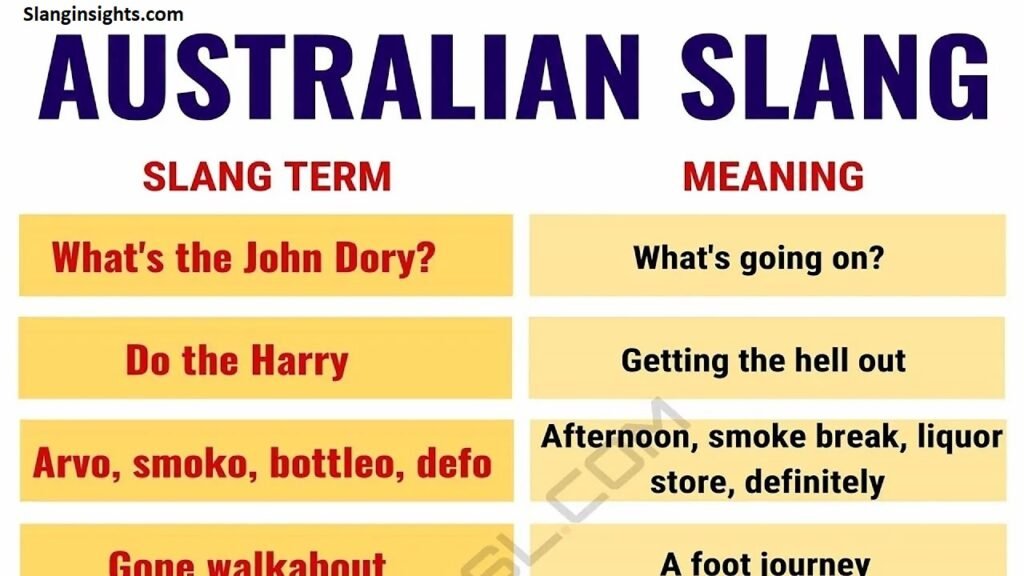
Aussie slang words are informal expressions commonly used in Australia and are known for being friendly, humorous, and unique. Australians often shorten words or create nicknames, making everyday conversations more relaxed.
Popular terms include mate (friend), arvo (afternoon), brekkie (breakfast), servo (gas station), and barbie (barbecue). You might also hear bogan for an uncultured person or fair dinkum, which means genuine or true.
These expressions are deeply rooted in Australian culture and help visitors understand locals better. Learning Aussie slang words can make conversations easier and more enjoyable while visiting Australia.
Table of Contents
Quick Table
| Aussie Slang | Meaning |
|---|---|
| Mate | Friend or buddy |
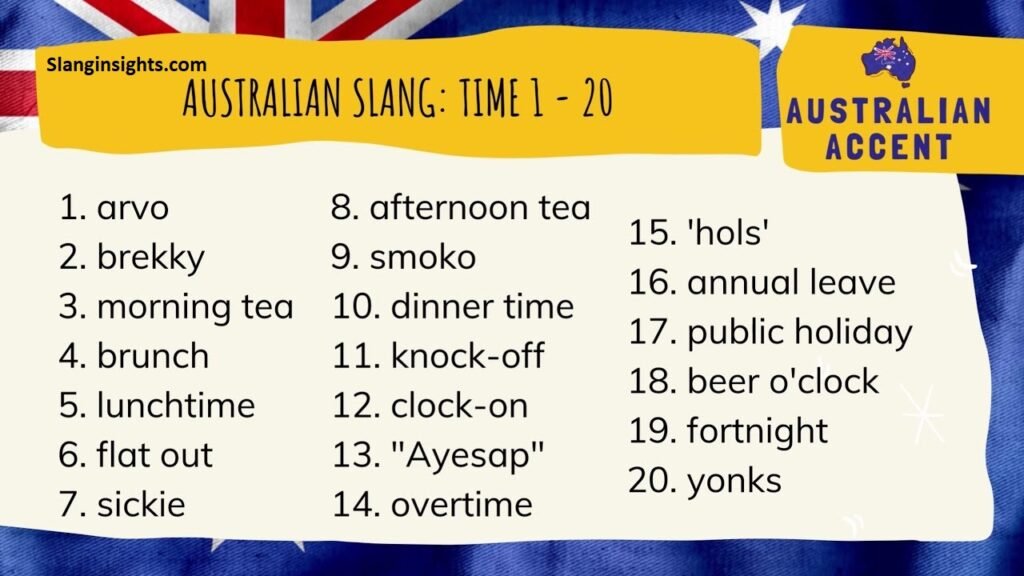
| Arvo | Afternoon |
| Brekkie | Breakfast |
| Barbie | Barbecue |
| Servo | Gas station |
| Bogan | Uncultured or unsophisticated person |
| Fair Dinkum | Genuine or true |
| G’day | Hello |
| Macca’s | McDonald’s |
| No Worries | It’s okay / No problem |
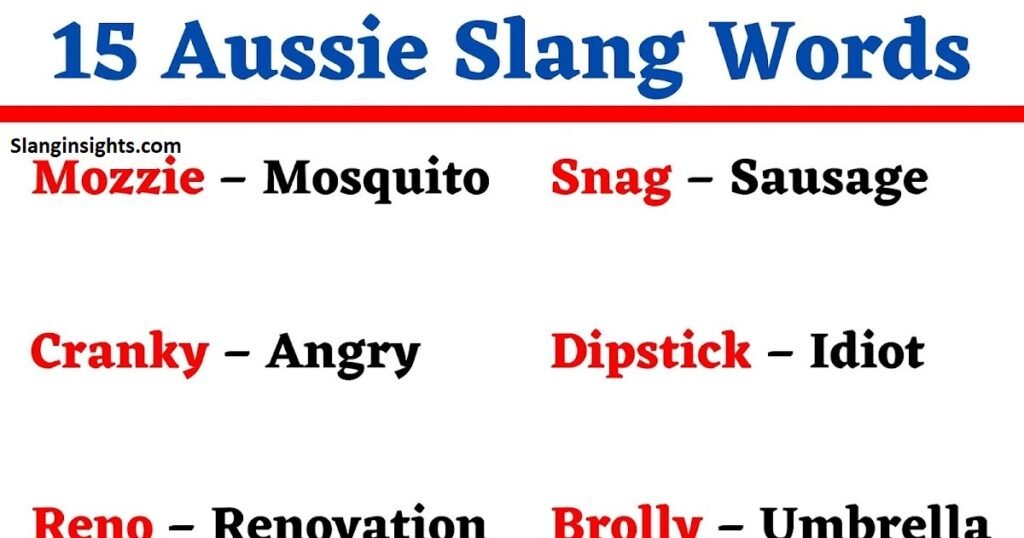
| Mozzie | Mosquito |
| Esky | Portable cooler |
| Snag | Sausage |
| Chook | Chicken |
| Ripper | Excellent or great |
| Sickie | Day off work due to illness |
| Dunny | Toilet |
| Tucker | Food |
| Thongs | Flip-flops |
| Uni | University |
How I Learned Australian Slang the Hard Way
I pulled into a roadhouse outside Cairns, low on fuel and lower on sleep, and asked the guy behind the counter how far it was to the next town with a campsite.
“Ah, not far at all, mate. Maybe forty clicks down the road, straight as, can’t miss it, just past the old fella’s servo near the bend.”
I stood there nodding, paid for my fuel, got back in the van, and genuinely had no idea what I’d just been told. Forty what? Straight as… what? Whose servo?
Turns out “clicks” just means kilometers, “straight as” means the road doesn’t really curve so you can’t get lost, and he was just describing a petrol station owned by someone he knew. None of it was complicated. I just hadn’t built up the dictionary yet.
I spent four months driving a converted van down the east coast, from Cairns to Melbourne, picking up campsites through an app called WikiCamps Australia, occasionally swapping it for a hostel bed booked through.
Hostelworld when I needed a proper shower and wifi.
Along the way I had more conversations with roadhouse staff, fellow campers, and pub regulars than I ever expected, and every single one of them taught me something new about how Australians actually talk, which is very different from how Australians talk in movies.
Distance and driving slang that genuinely changes your plans
This category mattered more than any other, because getting distance wrong on Australian roads has real consequences — towns are far apart, and “not far” means something completely different out here than it does back home.
- Clicks – kilometers. “It’s about sixty clicks to the next town.”
- Straight as – a road with basically no turns, easy to follow
- The scenic route – usually means longer, sometimes much longer, not a quick detour
- The back way – an alternate route, can be shorter or a total time trap depending who’s telling you
- A stone’s throw – close by, though I learned this is relative; one guy’s “stone’s throw” turned into a 25-minute drive
- Give us a bell / give us a tinkle – call me on the phone
- Out bush / the bush – rural, undeveloped land, away from towns
- The outback – the remote interior, often used loosely for “really far from anywhere”
The big lesson here: Australians genuinely don’t think distance the way most other countries do, because the country is enormous. “It’s not far” from a local can still mean over a hundred kilometers. I learned to always ask for an actual number, not just a vibe.
Pub and social slang you’ll need within your first week
Pubs and caravan parks are where most of my actual slang education happened, usually after a long driving day when everyone’s chatting near the communal kitchen or at the bar.
- Shout – to buy a round of drinks. “I’ll shout this one.” If it’s announced as “your shout,” that means it’s your turn to pay, not a suggestion.
- BYO – bring your own, usually alcohol, common at restaurants that don’t have a liquor license
- Having a yarn – having a chat, usually relaxed and unhurried
- Give it a burl – give it a try. “Never tried fishing, might give it a burl.”
- Rapt – really pleased or thrilled about something
- Spewing – upset or disappointed, not literally about being sick. “I missed the sunset tour, I’m spewing.”
- Chuck a sickie – take a sick day from work when you’re not actually sick
- Rack off – go away, get lost. This one can be playful between mates or genuinely sharp depending entirely on tone, so I learned to just watch the room before trying it myself.
I got the “shout” thing wrong exactly once. Someone said “I’ll shout this round,” and I still insisted on paying for my own drink, which apparently came across as a bit of a knock-back rather than politeness. Once someone offers to shout, you just say thanks and let it happen — you can return the favor next round.
People and everyday phrases that came up constantly
- Old fella / old man – dad, sometimes used affectionately for any older bloke
- Missus – wife or girlfriend
- Ankle biters – young kids
- Reckon – think or believe (“reckon it’ll rain tonight”)
- She’ll be right – it’ll be fine, don’t stress about it
- Flat out like a lizard drinking – extremely busy (this one made me laugh the first time I heard it and I still don’t fully understand the lizard part)
Step by step: how I actually built up my slang vocabulary on the road
This wasn’t something I studied beforehand. It built up naturally once I had a system for catching new words instead of just nodding along confused.
Carry an actual notebook, not just your phone. Mobile signal between towns on the east coast is patchy at best, especially once you’re past the bigger cities, so I kept a small paper notebook in the van and jotted down anything I didn’t understand to look up once I had signal again.
Ask roadhouse and caravan park staff directly. These conversations are short, low-pressure, and happen constantly when you’re traveling. I treated every fuel stop as a tiny slang lesson and just asked when something didn’t make sense.
Use campsite and hostel reviews as a resource, not just for bookings. Reviews on WikiCamps and Hostelworld are full of other travelers mentioning local terms and quirks about each area, which ended up teaching me regional differences I wouldn’t have picked up otherwise.
Listen to local radio while driving between towns. Regional radio stations talk the way locals actually talk, way more than any tourism video does, and it’s free entertainment for long stretches of driving anyway.
Don’t try to use new slang the same day you learn it. I noticed it landed way more naturally when I waited until I’d heard a phrase two or three times from different people before trying it myself, rather than immediately repeating something I’d just picked up.
Confirm distance and directions with numbers, not just slang. If someone gives you driving directions full of slang and vague distance terms, politely ask for an actual kilometer count or a place name you can punch into a map. It saves you from a much longer detour than expected.
Real exchanges from the trip
A caravan park host checking me in: “You’re rapt to be heading down, eh? Weather’s been a bit ordinary but should clear up. Showers are just past the camp kitchen, can’t miss ’em.”
A guy at a roadhouse giving directions: “Take the scenic route if you’ve got time, otherwise straight as down the highway, maybe ninety clicks to Byron.”
Someone at a pub offering a round: “Nah don’t worry about it, I’ll shout this one, you got the last one at the bottle-o anyway.”
Mistakes I’d skip if I did this trip again
The biggest one was trusting vague distance descriptions without asking for a number. “Not far” and “just down the road” mean wildly different things depending on who’s saying it and how used they are to Australian distances.
I once treated a “quick drive” as genuinely quick and ended up two hours later than planned.
The second mistake was misreading “she’ll be right” as dismissive. The first time someone said it to me about a flat tyre situation, I thought they were brushing off a real problem.
They weren’t — it’s just a relaxed way of saying things will work out, and it usually does.
The third was trying out “rack off” before I’d actually heard enough context to know when it’s playful versus genuinely sharp. Tone matters enormously with that one, and I’d recommend just listening for a while before using it yourself.
FAQ’s
What are Aussie slang words?
Aussie slang words are informal expressions and abbreviations commonly used in Australia. They make conversations sound more relaxed and friendly.
What does “G’day” mean in Australia?
“G’day” is a common Australian greeting that simply means “hello” or “good day.”
Why do Australians use so much slang?
Australians use slang as part of their culture. Many words are shortened to make speech quicker and more casual.
What does “No worries” mean?
“No worries” means “it’s okay,” “no problem,” or “don’t worry about it.” It is one of the most popular Australian expressions.
Is Aussie slang difficult for foreigners to understand?
Some expressions may be confusing at first, but learning common Aussie slang words can help visitors communicate more easily and understand Australian culture better.
Conclusion
Aussie slang words are a fun and important part of Australian culture. From greetings like “G’day” to everyday terms such as “brekkie,” “arvo,” and “barbie,” these expressions give Australian English its distinctive character.
Many Aussie slang words are shortened versions of common words, making conversations sound relaxed, friendly, and easygoing.
Understanding these terms can be especially helpful for travelers, students, and anyone interested in Australian culture.
Knowing what locals mean when they say “mate,” “fair dinkum,” or “no worries” can make interactions smoother and more enjoyable. It also provides insight into the humor and laid-back attitude that Australians are known for.
Whether you’re planning a trip to Australia or simply expanding your English vocabulary, learning Aussie slang words is both entertaining and practical.
By familiarizing yourself with these popular expressions, you’ll be able to communicate more naturally and appreciate the unique charm of Australian English. With a little practice, you’ll soon be speaking like a true Aussie mate!