Gun Slang from the Streets to the Screen The Ultimate Guide (2026)
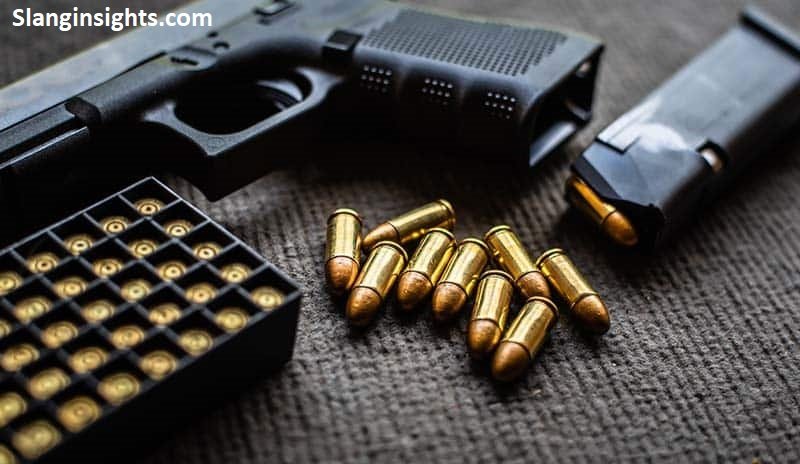
Gun slang has deep roots in street culture, hip-hop, and Hollywood. Terms like “strap,” “heater,” and “piece” are among the most recognized slang words for guns used today.
A “gat” traces back to the Gatling gun era, while “burner” implies a disposable or untraceable firearm. “Chopper” refers to high-powered automatic weapons, and “boomstick” is a classic slang term for a shotgun.
Whether you hear “rod,” “hammer,” “heat,” or “blicky” in a rap lyric or crime drama, each term carries its own cultural weight.
Understanding gun slang helps decode the language of music, film, and urban conversation more clearly.
Table of Contents
Quick Table
| Slang Term | Meaning |
|---|---|
| Strap | A gun carried on the body for protection |
| Heater | A handgun, implies power and heat from firing |
| Piece | General casual term for any firearm |
| Gat | Shortened from “Gatling gun,” any handgun |
| Burner | Disposable or untraceable firearm |
| Chopper | Automatic or high-powered weapon |
| Boomstick | Shotgun, popularized by Army of Darkness |
| Blicky | Street slang for a compact handgun |
What Is Gun Slang?
The first time I walked into a gun store, I felt like I’d stepped into a foreign country.
The guy behind the counter asked if I was looking for something in a “striker-fired platform” or if I preferred a “DA/SA.” I nodded like I understood. I did not understand.
I left that day without buying anything, slightly embarrassed, and spent the next two weeks going down a YouTube rabbit hole just to decode what he was saying.
That was a few years ago. Now I shoot regularly at my local range, I’ve taken a couple of safety courses, and I’ve picked up enough firearm vocabulary to hold my own in a conversation.
More importantly, I’ve learned how confusing — and honestly a bit gatekeep-y — the gun community can be with its language.
So this is the guide I wish I’d had on day one.
Whether you’re a first-time buyer, a curious person who wants to understand the news, a writer doing research, or someone who just wants to know what their gun-owning family member is talking about at Thanksgiving — this is for you.
Why Gun Slang Even Exists
Firearm culture has its own vocabulary for a few reasons. Some terms are technical shorthand that makes it faster to communicate. Some come from military and law enforcement slang that filtered into civilian use.
Others are regional, brand-specific, or just things the internet invented.
And then there’s a whole layer of slang that’s not about firearms themselves — it’s about the culture around them. The range talk, the competitive shooting world, the collector community.
Let’s break it all down.
The Basics: Terms That Sound Simple But Aren’t
“Piece” / “Iron” / “Heater” These are old-school informal words for a handgun. You’ll hear “piece” a lot in older crime dramas. “Iron” was big in Western slang. “Heater” is mostly vintage at this point, but you’ll still see it in books and movies. Nobody at the gun range calls their Glock a “heater,” just to be clear.
“Roscoe” / “Rod” / “Gat” More slang for handgun, mostly urban slang or old gangster-era terms. “Gat” still pops up in music and street slang. These aren’t technical terms — they’re cultural shorthand.
“Banger” / “Blower” British slang, mainly. In American firearm culture you don’t really hear these, but if you’re watching UK crime content or reading British thrillers, now you know.
“Steel” / “Hardware” Generic informal references to firearms as a category. “He was carrying steel” means he was armed. “Hardware” sometimes refers to accessories too (scopes, suppressors, etc.), so context matters.
Handgun Slang You’ll Hear at the Range
Once you’re around shooters regularly, you realize they love abbreviations and nicknames.
“Nine” / “45” / “40-cal” These refer to calibers — the size of the bullet. A “nine” is a 9mm, which is one of the most popular handgun calibers in the world. The “45” is .45 ACP, a big heavy round with a devoted fan base. “40-cal” is .40 S&W, which was big with law enforcement in the 90s and 2000s.
Caliber debates are basically the gun world’s version of Android vs. iPhone arguments. Just nod and smile.
“Striker-fired” vs. “Hammer-fired” This is what the guy in the gun store was asking me about. Striker-fired pistols (like a Glock, Sig P320, or Smith & Wesson M&P) don’t have an external hammer.
They’re simpler, lighter trigger pulls, and very popular. Hammer-fired pistols (like a Beretta 92 or a 1911) have that visible hammer at the back. Neither is objectively better — it’s preference.
“DA/SA” Double-action/single-action. On these guns, the first trigger pull is heavier (double-action, which both cocks and releases the hammer), and follow-up shots are lighter (single-action, since the slide already cocked the hammer).
It’s a learning curve. I personally found it tricky when I first shot a DA/SA pistol and yanked the first shot way off target.
“Wheel Gun” A revolver. Because the cylinder spins like a wheel. Revolver fans are a specific kind of passionate.
“Tupperware Gun” Affectionate (and sometimes mildly insulting) slang for polymer-framed pistols — i.e., guns with plastic frames. Glock gets called this a lot. Old-school 1911 guys say it to tease. Glock owners don’t care; they’re too busy being reliable.
Long Gun Lingo (Rifles and Shotguns)
“Black Rifle” / “Evil Black Rifle” Semi-humorous slang for AR-15 style rifles. The “evil” version was actually coined sarcastically by gun owners to mock the perception that black rifles are inherently more dangerous than other semi-automatic firearms. You’ll see “EBR” in online forums.
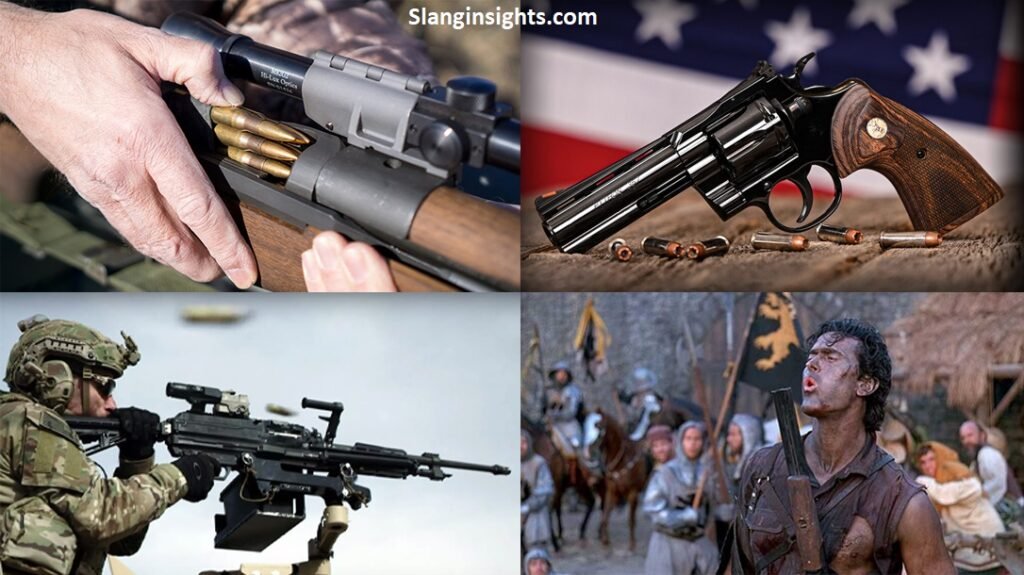
“Boomstick” A shotgun. Made famous by Army of Darkness (“This is my BOOMSTICK”), but used genuinely by shotgun enthusiasts. It’s a term of endearment.
“Scattergun” Also a shotgun — referring to the spread of pellets when fired. Old-fashioned but still used.
“Poodle Shooter” Sarcastic slang for the AR-15 platform in 5.56/.223 caliber, implying it’s underpowered. Said by big-bore rifle guys who think anything under 6.5mm is for beginners. It’s mostly banter.
“Truck Gun” A firearm (usually a rifle or shotgun) kept in your vehicle. Practical in rural areas. The truck gun is usually something rugged and not precious — nobody keeps their collector-grade rifle in the truck.
Carry Culture Slang
Concealed carry (CCW — Carrying a Concealed Weapon) has its own vocabulary.
“EDC” Everyday Carry. This refers to everything a person carries daily — their gun, their holster, their knife, their flashlight, their wallet. There’s an entire subreddit dedicated to people photographing their EDC setups. It’s a hobby within a hobby.
“Appendix Carry” / “AIWB” Carrying your firearm in the appendix position — basically in front, near your waistband. AIWB stands for Appendix Inside Waistband. It’s popular because it’s fast to draw from and easier to conceal under a t-shirt. Also nerve-wracking when you first try it because the muzzle is pointed at parts of yourself you’d prefer to keep.
“Deep Cover” / “Deep Concealment” Carrying in a way that makes the gun completely invisible — under multiple layers, in a belly band, or in an ankle holster. Slower to access, but better for concealment.
“Printing” When the outline of your concealed firearm shows through your clothing. Every CCW holder’s minor anxiety. Usually caused by a gun that’s too big for the holster, the wrong holster, or just a tight shirt. I ruined a perfectly good polo shirt’s silhouette for years because I was using the wrong holster.
“Mexican Carry” Carrying a pistol inside the waistband without a holster. Universally considered unsafe and not recommended. Just mentioned here because you’ll hear the term.
Range and Shooting Slang
“Mag Dump” Firing your entire magazine as fast as possible. Fun at the range. Not practical in most real-world scenarios. The guys who do mag dumps at every visit are easy to spot — and so is their wasted ammo budget.
“Brass” Spent shell casings. After shooting, you’ll often hear “police your brass,” meaning pick up your spent casings. At some ranges they keep the brass; at others you can take it home (useful if you reload your own ammo).
“Squib” A squib load is a round that doesn’t generate enough pressure to send the bullet all the way out of the barrel. The bullet gets stuck. If you fire another round behind it, you’ll damage the barrel — or worse. Signs of a squib: a pop that sounds different, reduced recoil, no hole in the target. Stop shooting immediately and check the barrel.
“FTE / FTF” Failure to Eject and Failure to Feed — types of malfunctions. FTE means the spent case didn’t eject properly. FTF means the next round didn’t feed into the chamber. Both are common topics when people are evaluating gun reliability.
“Stovepipe” A specific type of malfunction where a spent case gets partially ejected and stands straight up in the ejection port, looking like a little stovepipe. Quick fix: tap the top of the slide to knock it clear.
“Running the gun” Just means using it, testing it, putting rounds through it. “I ran 500 rounds through it this weekend with zero malfunctions” — that’s a reliability test.
Common Mistakes New Shooters Make With This Lingo
Mixing up “clip” and “magazine.” This is the one that makes gun people twitch. A magazine is the device that feeds ammunition into the firearm. A clip is a device that holds rounds for loading into a magazine or firearm. They’re different things. Using “clip” when you mean “magazine” will get you corrected — every time.
Calling a semi-automatic rifle “automatic.” Semi-automatic means one round per trigger pull. Fully automatic means the gun keeps firing as long as you hold the trigger. Most civilian firearms are semi-auto. Getting this wrong in a conversation — or in a news article — signals you don’t know the basics.
Assuming all slang is universal. Regional differences are real. Southern range culture talks differently than competitive IPSC shooters in the Northeast. Military veterans use different shorthand than hunters.
A Few Terms That Show Up in News Coverage (And What They Actually Mean)
“High-capacity magazine” — Usually refers to magazines holding more than 10 rounds. “Standard capacity” is the firearm-community counter-term, since many pistols come factory-standard with 15-17 round magazines.
“Assault weapon” — A legal and political term, not a technical one. Definitions vary significantly by jurisdiction. Firearm enthusiasts often push back on this term because it’s not a consistent technical category.
“Ghost gun” — Unserialized, privately made firearms. Legal in many states under federal law, but a growing topic in policy discussions.
FAQ’s
What is the most common gun slang term?
“Strap” and “piece” are among the most widely recognized gun slang terms used across street culture, music, and film.
Where does gun slang come from?
Gun slang originates from urban street culture, hip-hop music, classic crime films, and early 20th-century detective fiction.
What does “strapped” mean in gun slang?
“Strapped” means a person is currently carrying a firearm on their body for protection or intimidation.
Is gun slang used in mainstream media?
Yes, gun slang appears heavily in rap lyrics, crime dramas, action movies, and social media conversations worldwide.
What is the oldest gun slang term?
“Gat” is one of the oldest, dating back to the Prohibition era and derived from the historical Gatling gun.
Conclusion
Gun slang is far more than just casual street language. It is a living, evolving part of cultural expression deeply embedded in music, film, and everyday conversation.
From old-school terms like “gat” and “rod” that trace back to the early 20th century, to modern street phrases like “blicky” and “drac” popularized through hip-hop and social media, gun slang reflects how communities reshape serious topics through creative language.
Understanding these terms gives you a sharper eye when watching crime dramas, listening to rap lyrics, or reading urban fiction. Each word carries its own tone, history, and cultural identity. “Heater” sounds intense and powerful.
“Boomstick” feels almost playful. “Burner” implies urgency and disposability. The meaning behind every term goes deeper than the word itself.
As language continues to evolve rapidly through platforms like TikTok, YouTube, and streaming services, new gun slang terms will emerge while older ones fade into history.
Staying informed about this vocabulary helps decode modern culture more effectively.
Whether you are a writer, researcher, music lover, or simply curious, knowing your gun slang gives you a genuine understanding of the language shaping streets, screens, and speakers around the world today.