Pittsburgh Slang Words The Complete Dictionary of Yinzer Slang and Pittsburgh Expressions
Pittsburgh slang words are unique expressions commonly used in and around Pittsburgh. These terms reflect the city’s culture, history, and friendly community spirit.
One of the most famous words is “Yinz,” which means “you all” or “you guys.” Other popular expressions include “Nebby” (nosy), “Jagoff” (annoying person), “Gumband” (rubber band), and “Red Up” (clean up or tidy).
Locals may also say “Slippy” instead of slippery and “Dippy Eggs” for eggs with runny yolks. Learning Pittsburgh slang words can help visitors better understand local conversations and experience the authentic charm of the Steel City.
Table of Contents
Quick Table
| Pittsburgh Slang Word | Meaning |
|---|---|
| Yinz | You all; you guys |
| Jagoff | Annoying or foolish person |
| Nebby | Nosy or overly curious |
| Red Up | Clean up or tidy |
| Gumband | Rubber band |
| Slippy | Slippery |
| Dippy Eggs | Eggs with runny yolks |
| Sweeper | Vacuum cleaner |
| Jumbo | Bologna lunch meat |
| Crick | Creek |
| Redd | To put things in order |
| N’at | And that; and so on |
| Buggy | Shopping cart |
| Chipped Ham | Thinly sliced ham |
| Stillers | Pittsburgh Steelers |
| Pop | Soft drink or soda |
| Gum Bander | Someone who collects rubber bands |
| Jag | To bother or tease |
| Warsh | Pronunciation of “wash” |
| Pixburgh | Informal pronunciation of Pittsburgh |
The Day I Realized Pittsburgh Has Its Own Language
The first time my mother-in-law told me to “redd up the kitchen n’at before yinz leave,” I just smiled, nodded, and quietly panicked.
I’d been dating a Pittsburgh girl for about eight months at that point and I still had no idea what half her family was saying to me at Sunday dinner. I caught “kitchen.”
I caught “leave.” Everything in between sounded like a different language wearing a Steelers jersey.
That was almost six years ago. I live in Pittsburgh now, and I’ve made every embarrassing mistake a transplant can make with this dialect — corrected people who didn’t need correcting, ordered food wrong, completely missed jokes at family parties. So this isn’t a textbook rundown.
This is what I actually learned by living here, getting things wrong, and slowly catching on.
Why Pittsburgh even has its own slang
Before the words themselves, it helps to know where they came from, because it actually explains a lot.
Pittsburgh was built by steel mills and the immigrants who worked them — Scots-Irish settlers, then waves of Polish, Italian, German, and Eastern European workers packed into neighborhoods like Polish Hill and Bloomfield.
All those accents and speech patterns got mashed together over a century in a city boxed in by three rivers and a bunch of hills, which kept it more isolated than you’d think for a major city.
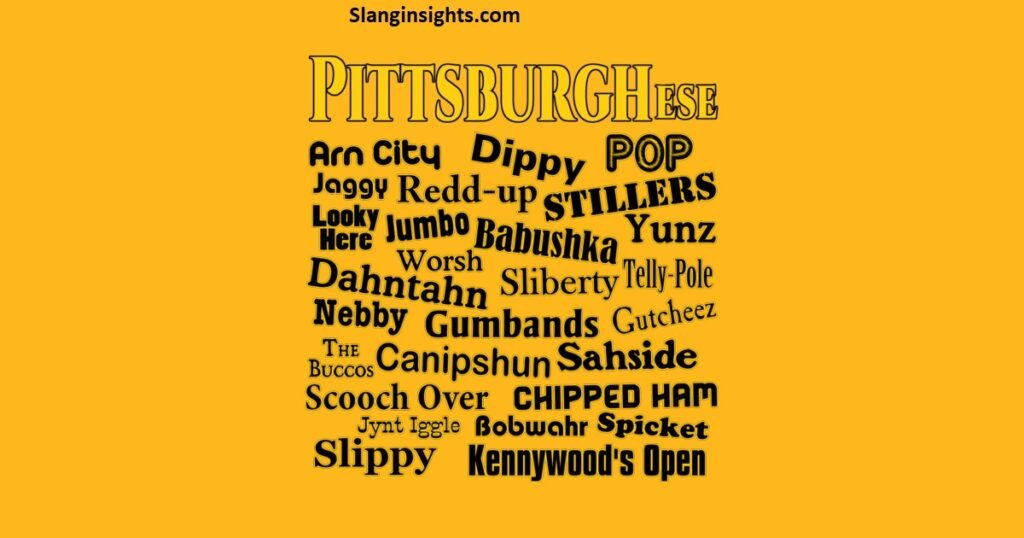
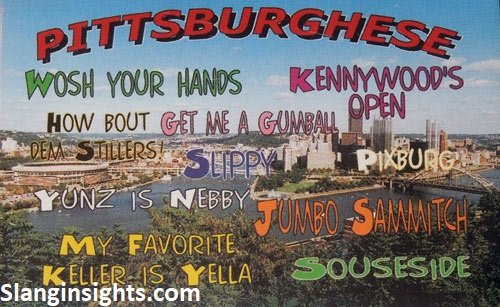
The result is “Pittsburghese” — a real, documented dialect that linguists actually study, not just a few funny words.
That context matters because it means this stuff isn’t a joke locals are playing on tourists. People here genuinely talk this way, especially anyone over 50 or anyone from a blue-collar family that’s been here a few generations.
The word you’ll hear within five minutes of arriving
Yinz. This is the big one. It’s Pittsburgh’s version of “y’all” — a plural form of “you” that English technically doesn’t have anymore, so this region just made one. “Are yinz coming to the game?”
“What do yinz want for dinner?” It gets used constantly, and you’ll see it on t-shirts at the airport gift shop before you even leave baggage claim.
I made the mistake early on of assuming it was a tourist gimmick, something dreamed up for merchandise. I actually said that out loud to a guy at a hardware store.
He looked at me like I’d insulted his grandmother, because to him, it was just how you talk. Lesson learned: don’t assume the local dialect is fake just because it shows up on a coffee mug.
There’s also yinzer, which is what people call someone who fully embodies Pittsburgh culture — Steelers gear, the accent, the works. It can be said with pride or with a little gentle teasing, depending on the tone.
“N’at” and other filler words
N’at is short for “and that,” and it gets tacked onto the end of sentences kind of like “etc.” or “and stuff.” “We’re gonna grill burgers n’at this weekend.”
It doesn’t really mean anything specific, but once you notice it, you’ll hear it constantly in casual conversation, especially from anyone born and raised here.
The accent does half the work
A lot of “Pittsburgh slang” isn’t actually new words — it’s the same English words pronounced with a vowel shift that turns “ow” sounds into “ah” sounds. So downtown becomes dahntahn.
Out becomes aht. House becomes hahs. My father-in-law once told me he was going “dahn the street to worsh the car,” and it took me a solid three seconds to translate that into “down the street to wash the car.”
That’s another real one: worsh instead of wash, with an extra R sound that shows up in words like Worshington for Washington. It’s tied to the same Scots-Irish roots as a lot of this dialect.
Words that confused me at first
A few that genuinely tripped me up when I moved here:
- Redd up — to clean or tidy something. “Redd up your room before company gets here.”
- Nebby — nosy, or someone who’s being a busybody. “Don’t be so nebby, that’s not your business.”
- Slippy — slippery. “Careful on the steps, they’re slippy after the rain.”
- Gumband — a rubber band. I genuinely thought my coworker was inventing a word the first time she asked if I had a gumband for her hair.
- Spicket — a faucet or outdoor spigot. “Turn the water on at the spicket.”
- Crick — creek. As in a small stream, not your neck.
- Buggy — a shopping cart. The first time someone told me to grab a buggy at Giant Eagle, I stood there waiting for a horse-drawn carriage.
- Jagoff — this is the famous one, and it confused me the most. It basically means jerk or idiot, but it’s used so casually here that it barely registers as an insult. The mayor’s office once put out a tweet using it. Someone cutting you off in traffic is a jagoff. Your buddy doing something dumb at a cookout is a jagoff. It’s almost affectionate in the right context, which took me way too long to understand. I genuinely thought I’d been insulted the first time a friend called me one, when really he was just teasing me.
Food words you actually need to know
Pittsburgh has its own food vocabulary, and this is the part that’ll actually come in handy if you’re eating your way around the city.
Chipped ham is thin-sliced lunch meat, originally an Isaly’s product, and it’s the backbone of the classic Pittsburgh BBQ chipped ham sandwich (which has nothing to do with barbecue sauce on a grill — it’s more like a sloppy joe made with ham). Ask for it at any old-school deli and they’ll know exactly what you mean.
Jumbo isn’t a size — it’s the local word for bologna. “Get me a jumbo on white with mustard” is a completely normal sandwich order here.
Gobs are a Pittsburgh dessert: two round chocolate cake-like cookies with sweet icing sandwiched in between, similar to a whoopie pie but locals will absolutely tell you they’re not the same thing, so don’t make that comparison out loud unless you want a debate.
And then there’s Primanti’s, the famous sandwich shop where the fries and coleslaw go inside the sandwich, not on the side. I made the rookie mistake of asking for fries on the side on my first visit.
The guy behind the counter just said, “They’re already in there,” like I’d asked something genuinely strange. Order it the way it comes. It works.
Pop is what people call soda here, not “soda” or “Coke” as a catch-all. It’s not exclusive to Pittsburgh, but it’s the regional default, so ordering a “soda” won’t confuse anyone, but you’ll sound more local saying pop.
A driving habit, not a word, but you need to know it
This isn’t slang exactly, but it trips up out-of-towners just as much as the vocabulary does: the Pittsburgh left.
When a light turns green, the car turning left at the intersection gets to go first, before oncoming traffic, even though they technically don’t have the right of way.
Everyone here just accepts it as an unwritten rule. The first time I sat at a light waiting o go straight and three cars turned left in front of me, I genuinely thought I was being scammed. I wasn’t.
That’s just how it works here, and if you don’t let the left-turner go, you’ll probably get honked at.
How I’d actually learn this stuff if I were starting over
If you’re moving here, dating someone from here, or just visiting and want to keep up with conversations, here’s the order I’d tackle it in:
- Tune your ear to the accent first. Once you can hear “dahntahn” and “aht” without translating in your head, half the dialect clicks into place on its own.
- Learn yinz and use it sparingly at first. Locals notice when someone’s trying too hard versus when it comes naturally. It’ll start slipping out on its own after a few months.
- Eat at a few classic spots. Primanti’s, an old-school deli for a chipped ham or jumbo sandwich, a bakery for gobs. Food vocabulary sticks faster than abstract words because you’re using it to order something you actually want.
- Watch a few “Pittsburgh Dad” videos online. It’s a long-running comedy web series built almost entirely around an exaggerated Pittsburgh accent and these slang words, and it’s a genuinely fun, low-effort way to get your ear trained.
- Ask people what things mean. Every single person I’ve asked has been happy to explain a word, usually with a story attached. Nobody here gets offended by the question.
- If you really want to go deep, pick up a copy of Sam McCool’s “New Pittsburghese.” It’s a small, funny local reference book that’s been sold around the city for decades, and it covers way more words than I have room for here.
Mistakes worth avoiding
A few things I’d tell my past self, looking back:
Don’t assume the dialect is fake or performative just because you see it on merchandise.
It’s a real, documented regional accent with actual linguistic roots, and treating it like a costume locals put on for tourists comes across as condescending, even if you don’t mean it that way.
Don’t lump it in with other regional dialects you already know. Yinz isn’t y’all, even though they do the same job. Pittsburghese has its own separate history tied to Scots-Irish and Eastern European immigration, not Southern English roots.
Don’t overcorrect people, like I did at that hardware store. If someone says “yinz” or “n’at,” that’s just how they talk, not a mistake for you to fix.
And don’t expect every Pittsburgher to talk this way.
The accent and slang are strongest in older generations and certain neighborhoods, and plenty of younger people or transplants barely use any of it. It’s a spectrum, not a uniform.
FAQ’s
What does “Yinz” mean in Pittsburgh slang?
“Yinz” is a popular Pittsburgh expression meaning “you all” or “you guys.” It is one of the most recognizable features of the local dialect.
What is a “Jagoff” in Pittsburgh?
A “Jagoff” refers to an annoying, rude, or foolish person. While it can be insulting, it is often used jokingly among friends.
Why is Pittsburgh slang unique?
Pittsburgh slang developed from the city’s history and the influence of immigrant communities, creating a distinctive dialect known as “Pittsburghese.”
What does “Nebby” mean?
“Nebby” describes someone who is overly curious or nosy about other people’s business.
What is “Red Up” in Pittsburgh slang?
“Red Up” means to clean, organize, or tidy up a room or area. Parents in Pittsburgh often tell their children to “red up” their rooms.
Conclusion
Pittsburgh slang words are an important part of the city’s identity and culture. Often referred to as “Pittsburghese,” these expressions have been passed down through generations and continue to be used by locals today.
Famous terms such as “Yinz,” “Jagoff,” “Nebby,” and “Red Up” may sound unusual to outsiders, but they help create a strong sense of community among Pittsburgh residents.
Learning Pittsburgh slang can be both entertaining and useful, especially if you are planning to visit the Steel City or simply want to understand the language used by native Pittsburghers.
These words provide insight into the city’s history, traditions, and everyday life.
Whether you hear someone ask you to “red up” the house or greet a group with “Yinz,” understanding these phrases will help you connect with locals and appreciate the unique character that makes Pittsburgh and its people so memorable.