Slang Word for Gun Popular Street Terms You Should Know
Slang Word for Gun refers to informal terms people use instead of the standard word “gun.”
These slang expressions often appear in movies, music, online conversations, and fiction, and their meanings can vary depending on context, region, and culture.
Some are widely recognized, while others are specific to certain communities or periods. Because slang changes over time, a word that is common today may become outdated in the future.
Understanding these terms can help you better interpret dialogue, song lyrics, or social media posts.
However, it’s important to remember that recognizing slang is for comprehension, not endorsement or encouragement of violence or illegal activity.
Table of Contents
Quick Table
| Feature | Details |
|---|---|
| Keyword | Slang Word for Gun |
| Meaning | Informal words or nicknames used instead of the word “gun.” |
| Common Contexts | Movies, TV shows, music, books, online discussions, and everyday conversations. |
| Purpose | To understand slang used in different cultural and media contexts. |
| Usage | Varies by region, age group, and social setting. |
| Formal Term | Gun or firearm |
| Common in | Pop culture, storytelling, entertainment, and social media. |
| Important Note | Meanings depend on context and should not be interpreted as encouraging violence or illegal activity. |
The Conversation That Helped Me Understand Gun Slang
A few years ago, I was watching an American crime drama with a friend who speaks excellent English.
Halfway through the episode, one of the characters said, “Grab the piece,” and my friend looked at me and asked, “What piece? A piece of what?”
That simple question turned into a surprisingly interesting conversation. It reminded me that English slang isn’t always obvious, especially when it comes to words related to weapons.
Movies, rap music, video games, books, and social media often use slang instead of the actual word “gun,” and if you’re learning English, it’s easy to misunderstand what’s being said.
I’ve run into this more times than I can count while reading novels, watching action films, and browsing online discussions. At first, I assumed every slang word meant the same thing. Later, I realized that context matters. Some terms are common, some are outdated, some are regional, and others belong to specific communities or time periods.
If you’ve searched for a slang word for gun because you heard one in a movie or online, this guide will help you understand what people actually mean without the confusion.
Why People Use Slang Instead of Saying “Gun”
People don’t always use the official word because slang often sounds more natural in casual conversations or entertainment.
You’ll notice slang being used in:
- Action movies
- Crime dramas
- Hip-hop lyrics
- Detective novels
- Video games
- TV series
- Social media posts
- Comedy sketches
Sometimes it’s used to sound authentic. Other times it’s simply part of a character’s personality or the culture being portrayed.
Understanding the meaning doesn’t mean you need to use these expressions yourself. It’s mostly helpful for improving your English comprehension.
Common Slang Words for Gun
Here are some of the most common expressions you’ll encounter.
Piece
“Piece” is probably one of the most recognizable slang terms.
Example:
“He kept a piece in the glove compartment.”
This term appears frequently in crime fiction and older action films.
Heat
“Heat” usually refers to a firearm, especially in movies and rap lyrics.
Example:
“They found heat during the search.”
The word creates an image of danger rather than describing the object itself.
Strap
You’ll often hear younger characters in movies or television use “strap.”
Example:
“He said he was carrying a strap.”
This expression has become more common in music and online slang over the past decade.
Burner
Originally associated with inexpensive, easily disposable firearms in crime stories, “burner” still appears in movies and television.
Example:
“He tossed the burner after leaving.”
Outside fictional crime settings, many people never use this word.
Iron
This is an older expression that still appears in Western films and classic detective novels.
Example:
“The sheriff reached for his iron.”
Modern everyday conversations rarely use it, but it’s still recognizable.
Roscoe
If you enjoy older detective stories or classic crime films, you may hear “Roscoe.”
Example:
“He pulled out a Roscoe.”
Today, it sounds old-fashioned and is mostly used for historical flavor.
Slang Changes Over Time
One thing I learned while reading older novels is that slang has an expiration date.
A word that sounded cool in the 1970s may sound outdated today. Likewise, expressions popular on social media today may disappear within a few years.
That’s why it’s important not to memorize every slang word as if it’s standard English.
Instead, focus on understanding them when you encounter them.
How Context Changes the Meaning
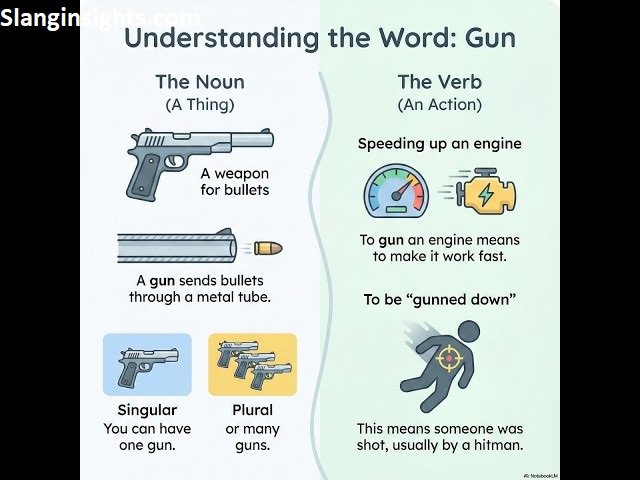
One mistake I made early on was assuming every unusual word referred to a firearm.
That isn’t always true.
For example:
- “Piece” can mean artwork.
- “Heat” can literally refer to hot weather.
- “Iron” usually means the household appliance.
- “Strap” often refers to a bag strap or watch strap.
The surrounding sentence tells you which meaning is correct.
For example:
“I forgot my strap at home.”
Without context, you can’t know whether someone means a backpack strap, a camera strap, or something else entirely.
This is why reading the whole conversation matters more than focusing on a single slang word.
Where You’ll Hear These Words Most Often
If you’re learning English through entertainment, you’ll probably encounter these terms in predictable places.
Movies
Crime thrillers and police dramas often avoid repeating the word “gun” over and over.
Instead, characters naturally switch between different expressions.
TV Shows
Detective series frequently mix formal police language with street slang depending on which characters are speaking.
Music
Hip-hop and rap lyrics have introduced many slang expressions into popular culture.
Keep in mind that lyrics often prioritize rhythm and style over everyday speech.
Video Games
Action games frequently include slang during dialogue between characters.
However, the language in games doesn’t always reflect how people speak in normal life.
Books
Modern crime novels often include realistic dialogue filled with slang.
Historical detective novels may use expressions that sound unusual today.
Should English Learners Use These Words?
From my experience, it’s better to recognize these terms than actively use them.
Here’s why.
Native speakers usually know which expressions fit naturally in certain situations. Language learners don’t always have that instinct yet.
Using outdated or highly regional slang can sound awkward, even if the word is technically correct.
If you’re writing an essay, speaking in class, or communicating at work, simply saying “gun” is almost always the safer choice.
Understanding slang is useful.
Using it isn’t always necessary.
Practical Tips for Understanding Slang
If you’re trying to improve your English through movies or online videos, these habits helped me a lot.
Turn on subtitles
Watching with English subtitles makes unfamiliar words much easier to catch.
Pause and check the context
Instead of immediately searching one word, read or watch the surrounding dialogue first.
Many meanings become obvious once you know what’s happening.
Use reliable dictionaries
Some dictionaries now include slang meanings alongside standard definitions.
This helps you see whether a word is common, informal, old-fashioned, or limited to certain regions.
Read multiple examples
Don’t rely on one sentence.
Reading several examples shows how native speakers naturally use the expression.
Common Mistakes People Make
One mistake is believing every slang word is widely accepted.
Some expressions are extremely regional.
Others belong mainly to movies or music rather than everyday conversation.
Another mistake is copying dialogue from films without understanding the tone.
Movie characters often exaggerate their speech to make scenes more dramatic.
Real conversations are usually much simpler.
Finally, don’t assume that every English-speaking country uses the same slang.
American, British, Canadian, and Australian English each have their own vocabulary.
Real-Life Example
I remember helping a cousin improve his English before traveling abroad.
He had learned most of his vocabulary from action movies.
One day he confidently used a slang expression from a gangster film while talking about a completely unrelated topic.
Everyone laughed—not because his English was bad, but because the expression sounded so out of place.
That experience taught both of us an important lesson.
Entertainment is excellent for learning English, but it’s equally important to understand when certain words are appropriate and when standard vocabulary works better.
When Standard English Is the Better Choice
There are plenty of situations where slang simply isn’t necessary.
For example:
- Academic writing
- News articles
- Business communication
- Job interviews
- School assignments
- Professional presentations
In these settings, using the standard word “gun” is clearer and more appropriate than informal slang.
Knowing the slang can improve your listening and reading skills, but clear communication should always come first.
FAQ’s
What is a slang word for gun?
A slang word for gun is an informal nickname people use instead of the standard word “gun.” These terms are commonly found in movies, music, books, and online conversations, and their meanings often depend on the context.
Why do people use gun slang?
People use gun slang for many reasons, including casual conversation, storytelling, artistic expression, or to reflect the language used within a particular community or culture.
Are gun slang words the same in every country?
No. Gun slang varies by country, region, and even local communities. A term that is common in one place may be unfamiliar or have a different meaning elsewhere.
Is it important to understand gun slang?
Yes. Knowing common slang can help you better understand song lyrics, films, novels, and social media posts. However, context is essential because some words can have multiple meanings.
Does learning gun slang encourage violence?
No. Learning slang is simply about understanding language and communication. Recognizing these terms can improve comprehension of media and conversations without promoting harmful or illegal behavior.
Conclusion
Understanding slang word for gun can make it easier to follow conversations, interpret movie dialogue, understand song lyrics, and read online content where informal language is common.
Slang constantly evolves, and new expressions appear while older ones fade from everyday use. Because of this, the meaning of a particular term often depends on the speaker, the region, and the situation in which it is used.
It’s also important to remember that slang is highly contextual. Some words may have multiple meanings, while others are only common within specific groups or forms of entertainment.
Rather than assuming every slang term refers to a firearm, consider the surrounding conversation before drawing conclusions.
Whether you’re learning English, researching modern slang, or simply curious about the language you hear in popular culture, understanding these informal expressions can improve your communication and comprehension.
By focusing on context and staying aware of how language changes over time, you’ll be better equipped to recognize and interpret slang accurately.
The goal is not to encourage harmful behavior but to help readers understand how language is used in everyday life, media, and online conversations.