Spanish Slang Words Common Phrases, Meanings, and Real-Life Examples
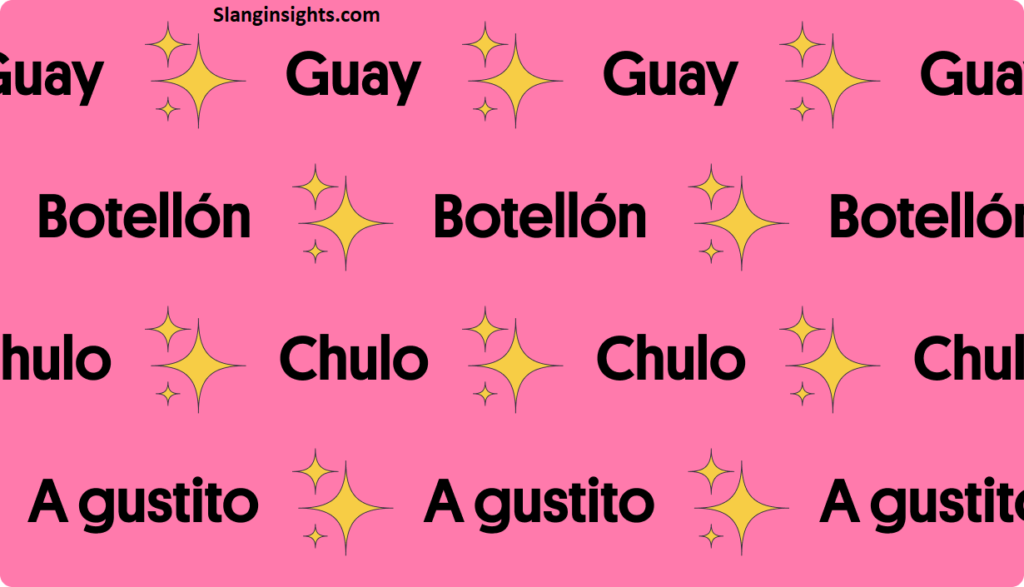
Spanish Slang Words is as vibrant and diverse as the cultures that speak it. In Spain, “tío” and “tía” mean “dude” and “girl,” while “guay” means cool and “mola” means something is awesome.
Latin America adds its own flavor — Mexicans say “chido” for cool and “órale” to express agreement or excitement. Colombians use “bacano” for something great, while Argentinians say “che” to get someone’s attention, much like “hey.”
Across the Spanish-speaking world, “chaval” means a young person, “flipar” means to be amazed, and “mogollón” means a lot of something. Spanish slang is colorful, passionate, and endlessly expressive — just like the language itself.
Table of Contents
Quick Table
| Slang Word | Meaning |
|---|---|
| Tío / Tía | Dude / girl (Spain) |
| Guay | Cool (Spain) |
| Mola | That’s awesome (Spain) |
| Chido | Cool (Mexico) |
| Órale | Okay / let’s go / wow (Mexico) |
| Bacano | Great / awesome (Colombia) |
| Che | Hey / mate (Argentina) |
| Chaval | Young person / kid (Spain) |
| Flipar | To be amazed (Spain) |
| Mogollón | A lot / tons of something (Spain) |
| Chévere | Cool / great (Venezuela / Colombia) |
| Pana | Friend / buddy (Venezuela) |
| Parcero | Close friend (Colombia) |
| Wacho | Dude / guy (Argentina) |
| Copado | Cool / awesome (Argentina) |
| Buena onda | Good vibes / cool person (Mexico) |
| Fresa | Preppy / snobby person (Mexico) |
| Neta | Truth / for real (Mexico) |
| Caña | Fun / a great time (Spain) |
| Tronco | Close friend / buddy (Spain) |
The Day I Learned Textbook Spanish Wasn’t Enough
The first time I tried to sound “cool” in Spanish, I told a group of Argentinian friends that I was feeling very embarazada. I meant embarrassed. What I actually said was that I was pregnant. The table erupted. I didn’t speak for the rest of the meal.
That was ten years ago, somewhere between my third year of Spanish classes and my first solo trip to Buenos Aires. My teachers had given me solid grammar, a polished accent, and zero useful slang.
I could conjugate the pluperfect subjunctive. I couldn’t order a beer at a bar without sounding like a robot from 1987.
This guide is everything I’ve picked up since then — through embarrassing silences, wrong turns in conversation, and eventually, actual friendships. I’m writing it like I wish someone had handed it to me: honest, regional, and real.
“Textbook Spanish will get you understood. Slang will get you trusted.”
Why Slang Actually Matters (More Than You Think)
Let me be direct: if you’re learning Spanish only to pass an exam or order food on vacation, you can skip slang and survive fine.
But if you want to connect — actually connect — with Spanish speakers from Mexico City, Madrid, Bogotá, or Buenos Aires, slang is the handshake that opens the door.
Native speakers switch registers constantly. They’ll talk formally in one sentence and drop into full street dialect in the next. If you can follow that switch, they relax. They start talking to you like a person, not like a language student they need to be careful around.
Also — and this matters — knowing slang helps you avoid accidentally saying something offensive.
Spanish slang varies wildly by country, and what’s a harmless joke in Mexico can land weirdly in Spain, or worse, be genuinely rude in Colombia. More on that in a bit.
Pro Tip Apps like Tandem and HelloTalk are fantastic for learning regional slang from actual native speakers. Pair them with watching Spanish Netflix shows (turn on Spanish subtitles, not English) and you’ll absorb slang passively.
Universal Spanish Slang — These Work Almost Everywhere
These are the words that travel well. You might get a slight regional accent variation, but no one’s going to stare at you blankly if you use them.
Guay Universal
[gwy]
Cool, awesome, great. One of the most versatile positive words in the modern Spanish vocabulary.
“¡Qué guay!” — “How cool!”
Mola Spain
[MOH-lah]
It rocks, it’s great. Younger Spaniards use this constantly. If someone in Madrid tells you mola mucho, they’re giving you a genuine compliment.
“Esa canción mola un montón.” — “That song is really great.”
Tío / Tía Spain
[TEE-oh / TEE-ah]
Dude, man, guy / girl. Technically means uncle/aunt, but in Spain it’s the most common casual way to address anyone, similar to “dude” or “mate” in English.
“Tío, no te lo vas a creer.” — “Dude, you’re not going to believe this.”
Chido / Chida Mexico
[CHEE-doh / CHEE-dah]
Cool, awesome. Mexico’s equivalent of guay. You’ll hear this constantly in Mexico City especially. Can describe anything positive — a person, a place, a situation.
“Tu mochila está bien chida.” — “Your backpack is really cool.”
Qué onda MexicoColombia
[keh ON-dah]
What’s up? What’s going on? Literally “what wave,” but used as a casual greeting or check-in. One of the most essential Mexican slang phrases you’ll ever learn.
“¿Qué onda, wey?” — “What’s up, dude?”
Wey (Güey) Mexico
[wey]
Dude, man, bro. Possibly the most used word in all of Mexican Spanish. Used between friends constantly, sometimes as punctuation.
Origins are actually a bit crude (it originally referred to a castrated ox), but today it’s almost entirely neutral in meaning between friends.
“No, wey, eso no fue así.” — “No, dude, that’s not how it happened.”
Watch OutWey is very casual. Using it with someone you’ve just met, someone significantly older, or in a professional context is like calling your boss “bro” on the first day of work. Read the room.
Argentine Slang — A World of Its Own
I have to be honest: Argentine Spanish was the biggest shock of my life. T
hey speak lunfardo, a slang dialect that evolved from Italian immigrant communities in Buenos Aires, mixed with Rioplatense Spanish.
Italians, Spaniards, indigenous languages — it all blended into something that sounds nothing like what Duolingo taught you.
Che Argentina
[cheh]
Hey, mate, buddy. Used to get someone’s attention or as a filler. This is actually where Ernesto “Che” Guevara got his famous nickname — he was Argentine and used the word constantly. It’s warm and familiar.
“Che, ¿sabés dónde está el baño?” — “Hey, do you know where the bathroom is?”
Boludo Argentina
[bo-LOO-doh]
This one’s complicated. Literally it’s a mild insult (relating to anatomy), but between close Argentine friends it’s used affectionately — like “idiot” said with a smile. With strangers it’s offensive. Context is everything here. I learned this the hard way by using it too early with someone I’d just met.
“Che, boludo, ¿cuándo llegás?” — (Between close friends) “Hey man, when are you getting here?”
Copado Argentina
[co-PAH-doh]
Cool, awesome, down for it. When an Argentine says qué copado, they’re genuinely excited or impressed. It’s one of the best things someone can call you or your idea.
“¡Qué copado ese lugar!” — “That place is so cool!”
Colombian Slang — Warm, Colorful, and Utterly Charming
Colombians are often described as some of the warmest, most expressive Spanish speakers in Latin America — and their slang reflects that.
It’s vivid, playful, and deeply emotional. When I spent time in Medellín, I became obsessed with how creative the language was.
Parce / Parcero Colombia
[PAR-seh / par-SEH-roh]
Friend, buddy, pal. Used constantly among young Colombians, especially in Medellín and Bogotá. It’s affectionate and signals real friendship.
“Ese parce es lo mejor que me ha pasado.” — “That friend is the best thing that’s happened to me.”
Bacano Colombia
[ba-KAH-noh]
Cool, great, excellent. Colombia’s version of chido or guay. It can describe a person (someone who’s generous and cool) or a situation.
“Ese tipo es muy bacano.” — “That guy is really cool.”
Chimba Colombia
[CHEEM-bah]
Awesome, fantastic. One of those words that feels a little crude in formal contexts but is just regular enthusiastic speech between friends. If a Colombian says ¡qué chimba!, something genuinely delighted them.
“¡Qué chimba de concierto!” — “What an amazing concert!”
“The richness of Spanish slang isn’t a barrier — it’s an invitation.”
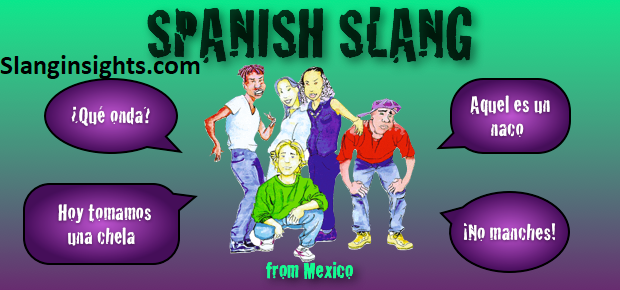
Mexican Slang Deep Dive — Because It Deserves Its Own Section
Mexico has
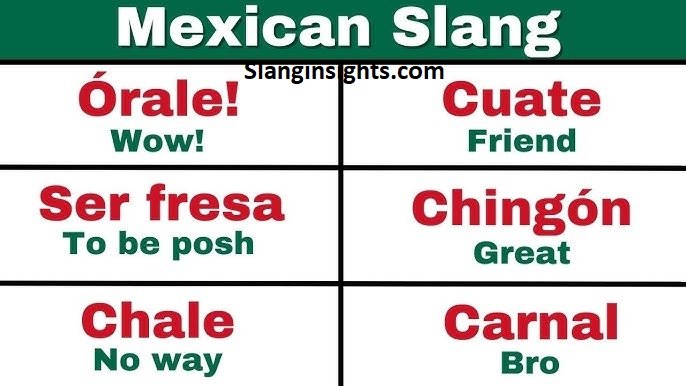
Oh come on! / No way! A mild expletive equivalent. Clean enough for TV.
Ahorita
Right now — but actually it could mean soon, later, or maybe never. Probably the most culturally nuanced word in Mexican Spanish.
Chale
Dang, bummer. Expressing disappointment or disbelief. “¡Chale, ya se cerró!” — “Dang, it’s already closed!”
Órale
Okay! / Let’s go! / Alright! One of the most versatile words in Mexican slang. Agreement, encouragement, surprise — all in two syllables.
Cuate
Best friend, twin, close buddy. Comes from the Nahuatl word for twin. One of those words that shows how indigenous languages shaped Mexican Spanish.
Jale
Work, gig, hustle. “Tengo jale” means you’ve got work to do or a job to get to.
Common Mistakes I Made (So You Don’t Have To)
Beyond my pregnancy announcement, I’ve made plenty more mistakes. Here are the lessons that stuck.
Using Spain slang in Latin America (and vice versa)
I once used the word tío constantly when hanging out with Mexicans. It confused people — “why does he keep calling us uncles?” Similarly, Spanish people find some Latin American slang unfamiliar or even funny. Don’t mix your regional dialects until you know both well.
Treating slang like a costume
There’s a cringe factor when someone forces slang unnaturally. I went through a phase where I stuffed wey into every sentence. My Mexican friends finally sat me down. “You don’t have to prove you know the word,” one of them said. “Just talk normally.” Good advice.
Not asking what words mean
Spanish speakers genuinely appreciate when you ask about slang. It opens conversations. “Hey, what does bacano actually mean?” is a better icebreaker than most things you could say. People light up explaining their own language.
Looking words up without checking the region
Google Translate is a trap with slang. It’ll give you a translation, but not the regional context, the tone, or whether the word is considered mild or very strong in a given country. Use SpanishDict, WordReference forums, or just ask a native speaker.
Best Resources I Actually Use • SpanishDict — Far better than Google Translate for nuance and regional notes
• WordReference forums — Real native speakers argue about exact meanings. Gold.
• Dreaming Spanish (YouTube) — Comprehensible input with real vocabulary
• Extra Spanish (YouTube) — Older but charming, good for basics
• Cuéntame (Netflix) — Spanish family drama with rich colloquial dialogue
A Quick Guide to Using Slang Without Looking Weird
Here’s a simple approach that’s worked for me, roughly in order:
Listen first. Before trying to use any slang, spend a week just noticing it. What do the people around you keep saying? What words get repeated? Passive absorption is your friend.
Pick one or two words and stick to them. Learn qué onda properly. Use it a few times. See how it lands. Don’t try to use twenty new words at once.
Verify the regional flavor. Before you use something you heard, make sure you know where it’s from and whether it fits where you are. A quick check on WordReference saves embarrassment.
Ask, don’t assume. When you hear something unfamiliar, ask. “Oye, ¿qué significa eso?” (“Hey, what does that mean?”) is always welcome.
Let go of perfection. You’re going to get it wrong sometimes. That’s part of it. Native speakers are usually delighted, not offended, when a learner tries. The effort signals respect.
The One Thing Nobody Tells You
Here’s the part that took me the longest to learn: Spanish slang isn’t just about vocabulary. It’s about energy, rhythm, and relationship.
You can know every word on this page and still sound stiff if you’re not watching how people talk — the timing, the volume, when they pause, when they laugh before finishing a sentence. Slang lives in the texture of conversation, not just the words.
The best thing I ever did was stop trying to learn Spanish and start trying to connect with people in it. The slang followed naturally.
I still mess things up sometimes. Last month I used a Mexican expression to a Cuban friend and she stared at me like I’d arrived from another dimension. But she also laughed, explained the difference, and ended up teaching me three new Cuban expressions I’d never heard before.
That’s the real reward. Not sounding fluent — but building the kind of moments where language becomes a bridge instead of a barrier.
FAQ’s
What is Spanish slang called?
Spanish slang is commonly referred to as “jerga” or “argot” in Spanish. It refers to informal, colloquial expressions used in everyday conversation that differ from standard textbook Spanish. Each Spanish-speaking country has its own unique set of slang words rooted in local culture and history.
Why is Spanish slang so different from country to country?
Spanish is spoken across 20+ countries, each with its own history, indigenous influences, and cultural identity. A word that means something friendly in one country can mean something completely different — or even offensive — in another. This regional variety is what makes Spanish slang so rich and fascinating to explore.
Can learning Spanish slang help you sound more fluent?
Absolutely. Native speakers use slang constantly in daily conversation, music, and social media. Learning informal expressions like “órale,” “chévere,” or “buena onda” helps you connect more naturally with native speakers and move beyond the stiff, formal Spanish taught in classrooms.
What is the most widely understood Spanish slang word?
“Chévere” is widely recognized across Latin America and understood by most Spanish speakers regardless of their country. Similarly, “tío” from Spain and “órale” from Mexico have gained international recognition thanks to music, TV shows, and social media.
Is Spanish slang used on social media?
Yes, heavily. Spanish-speaking communities on TikTok, Instagram, and Twitter are filled with slang expressions, memes, and informal language. Platforms like these have actually accelerated the spread of regional slang across borders, making words from Mexico, Colombia, and Spain recognizable to Spanish speakers worldwide.
Conclusion
Spanish slang is not just a collection of informal words — it is a living, breathing reflection of the cultures, histories, and personalities of the more than 500 million people who speak the language around the world.
Every region, every country, and every community has contributed its own flavor to one of the world’s most widely spoken languages.
From the laid-back “guay” of Spain to the expressive “órale” of Mexico, and from the warm “bacano” of Colombia to the iconic “che” of Argentina, Spanish slang tells a story that no textbook ever could.
It reveals how people truly think, feel, and connect with one another in everyday life.
Learning Spanish slang is more than a linguistic exercise — it is a cultural journey. It opens doors to deeper friendships, more authentic conversations, and a genuine understanding of what it means to live and breathe the Spanish language.
Whether you are a student, a traveler, or simply a lover of language, embracing Spanish slang will transform your relationship with Spanish entirely.
Because when you speak the way the people speak, you do not just communicate — you truly connect.