Tennis Slang Terms 30 Words Every Fan Should Know (2026 Guide)
Tennis slang terms are the colorful shorthand players and fans use to describe the game’s quirks, moments, and moods on court.
A “bagel” means winning a set 6-0, while a “breadstick” refers to a 6-1 scoreline. An “ace” is an unreturnable serve, and a “let” is a serve that clips the net but still counts for a replay.
Players call a weak shot a “dink,” and a powerful smash a “winner.” Fans shout “deuce” when the score ties at 40-40, and “love” simply means zero.
Learning these tennis slang terms helps newcomers follow matches confidently and sound like true fans when chatting about the sport.
Table of Contents
Quick Table
| Slang Term | Meaning |
|---|---|
| Ace | An unreturnable serve that the opponent doesn’t touch |
| Love | A score of zero |
| Deuce | Tied score at 40-40 |
| Bagel | Winning a set 6-0 |
| Breadstick | Winning a set 6-1 |
| Let | Serve clips the net but is still legal; replayed |
| Dink | A soft, weak shot |
| Winner | A shot the opponent can’t reach |
| Unforced Error | A mistake made without pressure from the opponent |
| Rally | A extended back-and-forth exchange of shots |
| Break | Winning a game on the opponent’s serve |
| Choke | Losing composure/performance under pressure |
| Hot Dog | A flashy, risky trick shot |
| Moonball | A shot hit with a very high, slow arc |
| Nutmeg | Hitting the ball between an opponent’s legs (rare) |
My First Experience With Tennis Slang
I still remember standing on a public court in my second month of playing, and my doubles partner turned to me after a rally and said “nice get, but that was a total moonball, don’t do that on break point.”
I just nodded like I understood. I did not understand. I went home and googled “moonball tennis” like a rookie, which, well, I was.
That’s kind of the thing with tennis. You can learn the rules in an afternoon, but the actual language players use on court takes months to pick up naturally — usually through mild embarrassment.
Nobody hands you a glossary before your first match. You just get thrown into it.
So this is the glossary I wish someone had given me back then. Not the dictionary-definition kind, but the “here’s what it actually sounds like when someone says it to you mid-match” kind.
Why tennis has its own language in the first place
Tennis is old. Older than basically every other major sport played today. A lot of the scoring terms (love, deuce) come from French origins that got mangled over centuries.
But the slang — the stuff players actually say to each other — that’s newer, and it’s constantly evolving with the sport itself.
Some of it comes from pros and gets absorbed into everyday club tennis. Some of it is just regional court talk that spreads because it’s fun to say.
Either way, if you play regularly, or even if you just watch a lot of matches on Tennis Channel or stream the Grand Slams, you’ll hear these constantly.
The terms you’ll hear on any given Saturday at the courts
Moonball A shot hit with a ton of topspin and height, arcing way up before landing deep. It’s not elegant, but it’s annoyingly effective against players who like pace. My old partner was right to call it out — moonballs mess with your rhythm and timing more than any hard-hit ball ever could.
Dink / Dinker A soft, short shot with little pace, usually used to pull someone out of position or just to survive a point. If someone calls you “a dinker,” they’re not exactly complimenting your power game, but honestly, dinkers win a lot of matches by frustrating bigger hitters.
Bagel Winning a set 6-0. Because the zero looks like a bagel. If you’ve ever lost a set 6-0, you know the sting of hearing “you got bageled” from the sideline.
Breadstick Winning a set 6-1. Less humiliating than a bagel, but still not something you want on your record.
Hack / Hacker Someone who plays ugly, inconsistent tennis but somehow still wins points. Every club has one. They shouldn’t be winning, and yet they are.
Pusher A player who doesn’t hit with any real pace, just gets everything back and waits for you to make an error. Playing against a pusher is one of the most mentally frustrating experiences in tennis, because you feel like you’re beating yourself.
Unforced error A mistake you make that wasn’t caused by your opponent hitting a great shot — you just missed an easy ball. Commentators say this constantly. It’s the tennis equivalent of an own goal.
Winner The opposite of an unforced error — a shot so good your opponent had no chance to touch it, let alone return it.
Ace A serve your opponent doesn’t even get a racquet on. Every player remembers their first real ace against someone decent.
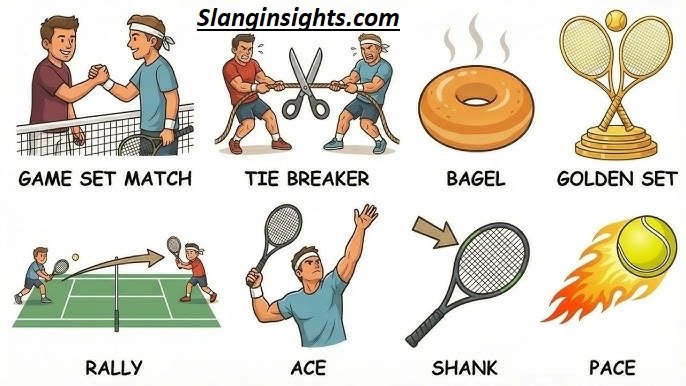
Let When the ball clips the net but still lands in on a serve, you replay the point. Confusingly, “let” also gets used casually to mean any weird net-cord bounce during a rally, even though technically that’s just play.
Choke / Choking Losing your nerve at a crucial moment, usually a match point or break point, and playing tight or making a dumb error you wouldn’t normally make. Everyone chokes at some point. It’s not fun to admit, but it happens to pros on Centre Court just as much as it happens to you on court 4 at your local club.
Bread and butter shot Your go-to, most reliable shot — the one you fall back on when you’re nervous or the point matters. Mine is a cross-court backhand slice. I hit it when I don’t trust anything else.
Tweener A shot hit between your legs, usually after you’ve been lobbed and you’re running back to the baseline. Extremely flashy, occasionally results in you eating dirt.
Hot dog Similar to a tweener but usually implies you’re facing away from the net when you hit it. Pure showboating.
Down the line A shot hit parallel to the sideline instead of cross-court. Higher risk because there’s less margin for error, but it can catch an opponent completely flat-footed.
Approach shot A shot you hit while moving forward, usually setting up to come to the net. If you play doubles at all, you’ll hear this term constantly.
Poach In doubles, when you cross over from your side of the court to intercept a shot that was technically headed toward your partner’s side. Good poaching wins doubles matches. Bad poaching gets you yelled at by your partner.
Rally The back-and-forth exchange of shots during a point. Not slang exactly, but you’ll hear “good rally” a lot.
Deuce When the score is tied 40-40. Comes from the French “à deux,” meaning “to two,” referring to needing two more points to win the game.
Bagel job / bageling someone Sometimes people use this as a verb, like “I bageled him in the first set.” It sounds harsher than it needs to be, but that’s tennis talk for you.
Some mistakes I made learning this stuff
I once told a guy after a match that he “got broken” when actually his serve held — I had the score wrong and just used the term because it sounded right.
He corrected me pretty quickly. Lesson learned: don’t use slang you don’t fully understand just to sound like you belong. People notice.
I also used to confuse “let” and “net” constantly, calling every stray shot that clipped the net cord a “let” even during regular rallies, when it’s really only an official “let” during a serve.
Small distinction, but it matters if you’re playing anything competitive.
And for a solid year, I thought “unforced error” meant literally any mistake. It doesn’t — a great passing shot that forces you into a bad volley isn’t an unforced error, it’s a forced one.
The difference matters when you’re actually analyzing your own game after a loss.
How to actually pick this stuff up faster
If you’re new to tennis and want to sound like you know what you’re talking about (or, more usefully, actually understand what’s happening around you):
- Watch matches with commentary on. ESPN+, Tennis Channel, or even YouTube highlights from tournaments like Wimbledon or the US Open — commentators use this vocabulary constantly and explain it in context.
- Play doubles before singles if you’re a beginner. You’ll hear terms like “poach” and “approach shot” used live, by real people, in real situations, way faster than you’d pick them up solo.
- Don’t be afraid to ask what something means mid-match. I promise you, every player has been in your shoes. Nobody is going to think less of you for asking what a “moonball” is.
- Follow a couple of tennis accounts on social media. Places like Tennis TV’s YouTube channel or even casual tennis meme accounts throw this slang around a lot, and seeing it repeated in different contexts helps it stick.
- Keep a little mental list after each match. Anytime someone says a term you don’t recognize, jot it down later and look it up. Took me about two seasons before most of this became second nature.
FAQ’s
What does “bagel” mean in tennis?
A bagel refers to winning or losing a set by a score of 6-0, so named because the zero looks like a bagel.
Why is zero called “love” in tennis?
“Love” likely comes from the French word “l’oeuf” (egg), which resembles a zero, symbolizing no points scored.
What’s the difference between a let and a fault?
A let occurs when a serve touches the net but still lands in the correct service box, and it’s simply replayed. A fault happens when a serve is illegal or lands outside the box, counting against the server.
What is an unforced error in tennis?
An unforced error is a mistake a player makes without being pressured by a great shot from their opponent, usually due to poor technique or focus.
What does it mean to “break” in tennis?
Breaking means winning a game where your opponent was serving, which is significant since servers usually have the advantage.
Conclusion
Understanding tennis slang terms transforms how you watch and talk about the game. Once you know that a “bagel” means a 6-0 set, or that “love” simply means zero, commentary starts to make a lot more sense.
These expressions aren’t just fun quirks — they’re the shared language that connects players, coaches, and fans across the sport.
Whether you’re chatting courtside, watching a Grand Slam on TV, or picking up a racket for the first time, knowing terms like ace, deuce, rally, and unforced error helps you follow the action and engage more confidently in conversations about tennis.
Slang also reflects the culture and history of the game, blending French origins, playful nicknames, and modern commentary style.
As tennis continues to grow in global popularity, new slang terms may emerge, especially among younger fans and social media communities.
Keeping a mental glossary of these tennis slang terms ensures you’re always in the loop, whether you’re a casual viewer or an aspiring player. The next time you watch a match, these words will make every point feel a little more familiar.