90s Slang Words Nostalgic Phrases, Origins, and Meanings Explained (2026)
90s Slang Words the 1990s introduced many slang words that became part of everyday conversations and pop culture.
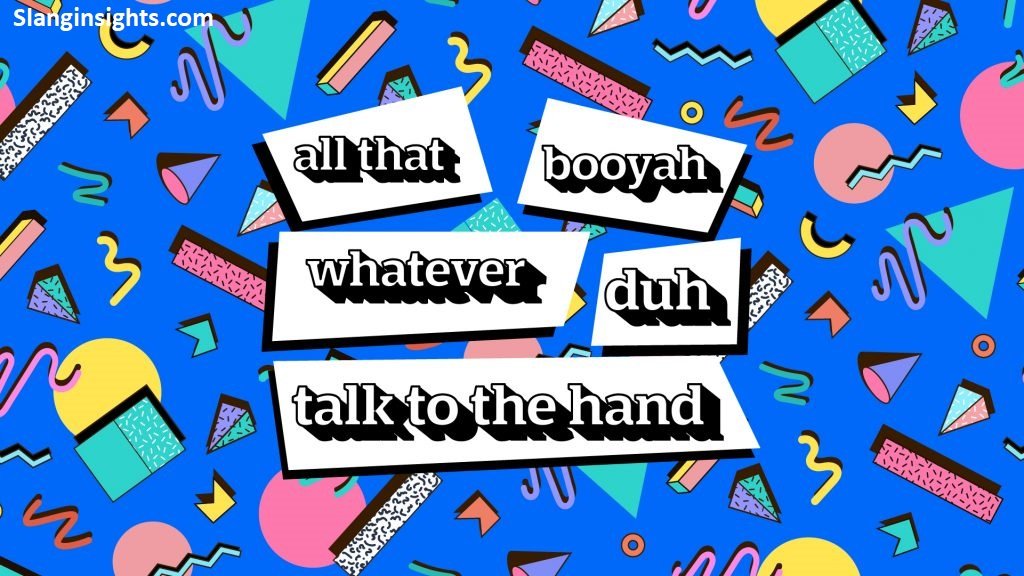
Popular expressions like “cool beans,” “talk to the hand,” “all that,” “da bomb,” “phat,” and “whatever” were widely used by teens and young adults.
People often said “as if!” to show disbelief, while “home skillet” referred to a close friend. Terms like “fly” meant stylish or attractive, and “scrub” described someone undesirable.
Many of these 90s slang words were influenced by music, movies, and television. Even today, some of these classic phrases are remembered fondly and occasionally used for nostalgia.
Table of Contents
Quick Table
| 90s Slang Word | Meaning |
|---|---|
| Cool Beans | Great or awesome |
| Talk to the Hand | Expression used to dismiss someone |
| All That | Very impressive or popular |
| Da Bomb | Something excellent or amazing |
| Phat | Cool, attractive, or stylish |
| As If! | Used to show disbelief or rejection |
| Home Skillet | A close friend |
| Fly | Fashionable or good-looking |
| Scrub | An undesirable or unsuccessful person |
| Whatever | Expression showing indifference |
| Boo-Yah! | Exclamation of excitement or victory |
| Psych! | Said after joking or tricking someone |
| No Duh | Used when something is obvious |
| Word | Means “I agree” or “That’s true” |
| Chill | Relax or calm down |
The Day I Rediscovered 90s Slang
I was cleaning out my childhood bedroom last summer when I found a stack of notes my friends and I used to pass in class.
Actual paper notes, folded into little triangles. Reading them back, I could not stop laughing — not because the drama was funny (though it was), but because of how we were talking.
“He’s totally buggin.” “She thinks she’s all that.” “That party was da bomb.”
It hit me that a whole generation of us was basically speaking a different dialect from 1990 to 1999. If you handed those notes to a 15-year-old today, they’d think it was a foreign language.
So I went full nostalgia mode. I dug up my old yearbooks, called some friends, and rewatched Clueless twice (no regrets). Here’s a real, lived-in guide to 90s slang — how people actually used these words in the wild.
The Words That Defined How We Talked
“All That” (and “All That and a Bag of Chips”)
This meant someone was extremely impressive — or thought they were. Depending on tone, it could be a compliment or pure shade.
Real use: “She walks around like she’s all that, but her scrunchie game is weak.”
The “bag of chips” addition was just emphasis. Not only are you great, you come with a bonus snack. It made no logical sense, and that was the whole point.
“Buggin'”
To be “buggin'” meant you were overreacting, freaking out, or being irrational. It came from Black culture and got turbocharged by movies like Clueless, where Alicia Silverstone used it constantly.
Real use: “Don’t be buggin’, it’s just a little rain.”
I personally used this one about 4,000 times between 1995 and 1998.
“Da Bomb”
Something “da bomb” was excellent, top-tier, amazing. The extended version — “da bomb diggity” — existed, and yes, we used it unironically.
Real use: “That new Spice Girls album is da bomb diggity.”
We were extra like that.
“Talk to the Hand”
Peak 90s dismissal. You’d hold your palm toward someone’s face and say “talk to the hand, ’cause the face ain’t listening.” It was rude, dramatic, and everywhere. Middle school arguments were basically settled with this phrase.
“As If!”
Popularized hard by Clueless (1995), “as if!” was a sharp rejection of any ridiculous idea. The delivery mattered enormously — you needed full eye-roll energy.
Real use: Someone asks if you did the homework. “As if!”
“Whatever” (with the Hand Gesture)
Form a W with your fingers — thumbs touching, index fingers pointing up — and deliver “whatever” with complete indifference. This was the 90s version of a mic drop. Done. Conversation over.
“Fly”
“Fly” meant cool, stylish, impressive. It had roots in 70s and 80s hip-hop but the 90s kept it very alive, especially in fashion.
Real use: “Those Air Maxes are so fly.”
“Phat”
Not to be confused with anything else it sounds like. “Phat” meant excellent, desirable, top quality. You could have a phat beat, phat shoes, a phat car. It worked wherever “cool” worked, just with more energy.
“Bounce”
To “bounce” was to leave. Simple, decisive, effective.
Real use: “This party’s weak. Let’s bounce.”
Nobody used “leave” when “bounce” was available.
“Peace Out”
A goodbye. You’d say it while flashing a peace sign. The full version — “peace out, homie” — required a certain social confidence not all of us had in seventh grade.
“Tight”
“Tight” meant impressive, well-executed, or very close (like a tight friendship). Always positive.
Real use: “His handles are tight” (basketball) or “Those two are tight” (close friends).
“Janky”
This one deserves more appreciation. “Janky” meant something was broken, sketchy, low quality, or unreliable.
Real use: “That’s a janky bike — the brakes barely work.”
We still need this word. Some things are simply janky and no other word captures it.
“Trippin'”
If someone was being dramatic or completely out of touch with reality, they were trippin’.
Real use: “You think he likes you? You’re trippin’.”
“No Doubt”
Absolute agreement — like “absolutely” but with more attitude. Gwen Stefani’s band literally took this name, which tells you everything about how embedded it was.
Where This Slang Actually Came From
A lot of 90s slang didn’t just materialize out of nowhere.
Hip-hop culture gave us “fly,” “phat,” “bounce,” “no doubt,” and most of the good stuff. Artists like Notorious B.I.G., TLC, Snoop Dogg, and Salt-N-Pepa were essentially setting the linguistic agenda for American youth.
Movies and TV turbocharged the spread. Clueless alone launched “as if,” “buggin’,” and “whatever” into the mainstream. Fresh Prince of Bel-Air and In Living Color were massive contributors too.
Skate and surf culture brought in “gnarly,” “shred,” and “bail” (to leave or wipe out).
Understanding the origins matters — because a lot of this language came from Black communities that didn’t always get credit when their slang went mainstream. Worth knowing.
Common Mistakes When Trying to Revive This Stuff
Mixing eras. “That’s totally da bomb, no cap” is going to confuse everyone. Those phrases are a decade apart.
Trying too hard. 90s slang worked because it was casual. One “bounce” lands naturally. Three in a single conversation is exhausting.
Wrong tone. “Talk to the hand” was sharp and dismissive. Say it gently, it loses everything. Say it aggressively in 2025 and you just look unhinged.
Professional settings. Your Zoom meeting does not need the word “phat.”
Why 90s Slang Still Matters
Slang is a time capsule. The words people invent and spread tell you what they cared about, who held cultural power, and what they wanted to celebrate.
The 90s slang boom tracked a specific moment: hip-hop going mainstream, early internet spreading language faster than ever, and a generation of kids raised on MTV and BET developing a shared vocabulary that crossed — though imperfectly — race and class lines.
Some of these words survived. “Bounce” still works. “Janky” is still used. “Tight” never fully went away. Others — “talk to the hand” — belong firmly in their decade.
And every now and then, one gets revived on TikTok with zero irony by someone who wasn’t even born yet. The cycle starts over.
Reading Those Old Notes Again
There’s something beautiful about how intensely a decade stamps itself on language.
Reading those notes from my childhood bedroom, I can hear the voices of 13-year-old me and my friends — the cadence, the attitude, the specific brand of dramatic that only middle school produces.
If you grew up in the 90s, this probably hit somewhere nostalgic.
If you didn’t, hopefully it gives you a real sense of what it was like to actually talk to people then — not from a textbook, but from the cafeteria, the school bus, the basketball court, the mall food court.
FAQ’s
What are 90s slang words?
90s slang words are informal expressions that were popular during the 1990s. They were commonly used in everyday conversations, TV shows, movies, and music.
What does “da bomb” mean in 90s slang?
“Da bomb” was a popular phrase used to describe something amazing, exciting, or excellent. If something was “da bomb,” it meant it was the best.
Is 90s slang still used today?
Yes, some 90s slang words are still used today. Terms like “cool,” “chill,” and “whatever” remain common, while others are mostly used for nostalgic purposes.
What does “phat” mean?
In the 1990s, “phat” meant cool, stylish, or impressive. It was often used to describe music, fashion, or something considered excellent.
Why are 90s slang words becoming popular again?
Many 90s slang words are making a comeback because of social media, retro fashion trends, and nostalgia. Younger generations are discovering these phrases through old TV shows, movies, and music.
Conclusion
The 1990s were a memorable decade filled with unique trends, unforgettable music, and plenty of colorful expressions.
From phrases like “cool beans” and “talk to the hand” to iconic terms such as “da bomb” and “phat,” 90s slang words helped define an entire generation.
These expressions reflected the culture, humor, and attitudes of the time and became deeply connected with popular television shows, movies, and artists.
Even though decades have passed, many of these words still bring a sense of nostalgia. Some have remained part of everyday language, while others are remembered fondly by those who grew up in the era.
Thanks to social media and the growing popularity of retro culture, younger generations are also discovering and using some of these classic phrases.
Whether you’re reminiscing about the past or simply curious about how people spoke in the 1990s, learning these slang terms offers a fun glimpse into the decade’s culture.
The influence of 90s slang continues to live on, proving that great expressions never truly go out of style.