Italian Slang Words Funny, Regional, and Modern Italian Slang Explained
Italian Slang Words are a fun and colorful part of everyday communication in Italy. Locals often use expressions like “figo” (cool), “boh” (I don’t know), “che palle” (how annoying), and “casino” (mess or chaos) in casual conversations.
These informal words help speakers sound more natural and expressive, especially among friends. Italian slang can change by region, so meanings may vary from north to south.
Learning these terms helps you understand real-life conversations beyond textbook Italian.
Whether you are traveling or studying the language, slang gives you a deeper cultural connection and makes your speech sound more authentic and relaxed.
Table of Contents
Quick Table
| Slang Word | Meaning (English) | Usage Example |
|---|---|---|
| Figo | Cool / awesome | Quel ragazzo è figo! (That guy is cool!) |
| Boh | I don’t know | Boh, non lo so. (I have no idea.) |
| Che palle | How annoying / boring | Che palle questo film! (This movie is boring!) |
| Casino | Mess / chaos | La stanza è un casino. (The room is a mess.) |
| Tipo | Like / kind of | È tipo strano. (He is kind of weird.) |
| Sfigato | Loser / unlucky person | Non fare lo sfigato! (Don’t act like a loser!) |
| Mitico | Amazing / legendary | Sei mitico! (You are awesome!) |
| Dai | Come on / let’s go | Dai, andiamo! (Come on, let’s go!) |
How I Learned Italian Slang the Hard Way
Let me paint you a picture. It’s 2019, I’m standing in a tiny trattoria in Naples, trying to negotiate with a waiter over a wrong order.
I thought I was being confident, assertive even — using the few Italian words I’d picked up from Duolingo and YouTube. The waiter’s eyes went wide.
The old couple at the next table started laughing. My Italian friend grabbed my arm and whispered, “You just called him a goat. A specific kind of goat.”
That was the day I realized Italian slang is a whole different universe — and if you’re going to travel, connect with Italian speakers, or even just watch Italian films without subtitles, you need to actually understand what’s being said between the lines.
This isn’t your typical “learn to say grazie and prego” guide. This is the stuff they don’t put in textbooks.
Why Italian Slang Hits Different
Italian isn’t just a language — it’s theater. Italians talk with their hands, their eyebrows, and their entire chest. Insults and slang phrases aren’t just words, they’re performances.
And here’s the thing: the same word can be a term of endearment between friends and a serious offense when used with a stranger. Context is everything. Tone is everything.
And if you’re not Italian, you’ll probably get it wrong the first few times — and that’s actually okay, as long as you’re not in Naples calling waiters farm animals.
Common Italian Slang Words You’ll Actually Hear
Cazzo
Technically it refers to male anatomy, but in practice it functions almost like “damn,” “what the hell,” or just an expression of frustration. You’ll hear it constantly — dropped casually in conversation the way some English speakers drop the f-word without even thinking.
“Cazzo, ho perso le chiavi!” = “Damn, I lost my keys!”
It’s very common, especially in central and southern Italy. Don’t use it with grandmas or in formal settings. That’s a lesson learned by basically every exchange student who’s ever visited Rome.
Vaffanculo (or just “vaffan”)
This is the big one. It means “go f*** yourself” and is very much not safe for polite company. But here’s the cultural twist — between close friends, especially younger Italians, it can be tossed around in a joking way, similar to how English speakers might playfully say something rude to a close friend.
The comedian and politician Beppe Grillo literally built a political movement (the Five Star Movement) around the phrase — he used it in speeches aimed at corrupt politicians, and millions of Italians cheered.
Context, again. Always context.
Stronzo / Stronza
Literally means a piece of excrement, but functions like “a**hole” in English. You might hear it in traffic, during football matches, or in an argument.
“Quello stronzo mi ha tagliato la strada!” = “That a**hole cut me off on the road!”
Men use the masculine form, women use the feminine. Italian is very gendered that way, even with insults.
Figlio di puttana
Son of a [you know what]. Used exactly like its English equivalent. Heavy, not casual. If you hear someone say this slowly and deliberately, the situation has escalated.
Deficiente
This one actually sounds almost polite but it’s not. It means something like “idiot” or “moron” — someone who lacks mental capacity. The interesting thing is it’s used pretty casually, kind of like calling someone a dummy in a frustrated tone.
“Ma sei deficiente?” = “Are you an idiot?”
Regional Slang That’ll Confuse You (Even if You Speak Italian)
One thing most people don’t realize is that Italian slang varies wildly by region. What’s a normal expression in Milan might get blank stares in Palermo.
In Rome, you’ll hear:
- “Ammazza!” — an expression of surprise, like “No way!” or “Wow!” (literally means “kill” but nobody’s actually threatening anyone)
- “Aò!” — a very Roman way to get someone’s attention, kind of like “Hey, you!”
- “È na cifra” — means “it’s a lot” or “it’s very much of something”
In Naples, the dialect (Neapolitan) is basically its own language:
- “Uagliò” — means “dude” or “guy” — very casual
- “Marò” — expression of disbelief or shock, like “Oh my god”
In Milan, you’ll hear more modern slang that’s been influenced by English:
- “Figo / Figa” — cool, attractive, awesome (be careful though — in different contexts this word has very explicit meanings, so read the room before using it)
The Art of Italian Insult Culture
Here’s something fascinating that took me a while to appreciate: Italians are often genuinely creative with their insults. There’s an almost poetic quality to them.
Instead of just calling someone stupid, an Italian might say “Sei una testa di cazzo” (you have a d*** for a head) or get elaborate about your ancestry, your intelligence, and the quality of your upbringing all in one breath.
Some classic insults that are more funny than offensive:
- “Pezzo di merda” — piece of [excrement], used when really angry
- “Testa di cazzo” — see above, literally “d***head”
- “Cornuto” — one of Italy’s most classic insults, means someone whose partner is cheating on them; famously accompanied by a hand gesture with the index and pinky fingers extended (the “horns”). It’s actually considered one of the worst things you can call an Italian man
- “Rompicoglioni” — someone who’s a pain in the backside, a nuisance (literally “ball-breaker”)
- “Faccia di culo” — literally “ass face,” used like “you’ve got a lot of nerve”
Slang That’s Not an Insult (But Sounds Like It Could Be)
This is where non-Italian speakers really get confused.
- “Madonna!” — This is an exclamation of surprise or frustration, like saying “Oh my God!” It’s the equivalent of “Jesus!” in English. It’s used constantly and generally isn’t considered blasphemous in casual conversation (though context matters with religious elders)
- “Porco cane” / “Porco dio” — These are genuinely blasphemous expressions and the second one especially can cause offense, particularly in older or more religious company. Be very careful here.
- “Minchia” — A Sicilian expression (technically refers to anatomy) but is used broadly throughout southern Italy as an expression of surprise, admiration, or frustration. Kind of like “holy cow” or “damn.”
Mistakes I’ve Seen Tourists Make (Please Don’t Do These)
Using slang you don’t fully understand YouTube taught you one word, you used it out of context, and now an entire café is staring at you. Learn the word and the context before you use it.
Assuming Italian slang works the same as Spanish slang They’re both Romance languages, sure. But the slang is completely different. Don’t assume.
Messing up the gender Italian words are gendered. Calling a man a “stronza” (feminine form) instead of “stronzo” (masculine) sounds weird at best, and at worst suggests you don’t actually know what you’re saying.
Using southern slang in northern Italy It can come across as condescending or just strange. Like an American doing an exaggerated Southern accent in New York.
Saying things ironically that aren’t ironic in Italian Sarcasm doesn’t always translate. “Complimenti” (congratulations) can be said sarcastically in Italian, but if you say it in a flat American accent, the irony evaporates completely.
How to Actually Learn This Stuff Properly
If you’re serious about picking up real Italian slang:
Watch Italian films and TV shows — Not with English subtitles. With Italian subtitles. Shows like Suburra, Gomorra, and Boris are full of authentic, regional slang used naturally in context. Gomorra especially is practically a masterclass in Neapolitan street language.
Use language exchange apps — Tandem and HelloTalk connect you with native Italian speakers. Ask them to teach you slang they actually use, not textbook Italian. Most will be delighted to share.
Follow Italian social media — Italian Twitter (now X) and Italian TikTok are goldmines for current slang, memes, and how young Italians actually communicate. Search hashtags like #Italianmemes or follow Italian comedians and influencers.
Get a good slang dictionary — “Il Grande Dizionario della Lingua Italiana” is the formal option, but for slang specifically, the website Slangopedia (an Italian version of Urban Dictionary basically) is more useful for understanding what words actually mean in practice.
The Respectful Way to Engage With All of This
Learning slang and insults from another language is genuinely fun, and it makes you a better communicator and a more culturally aware traveler. But there’s a line between learning and using.
Most Italian slang — especially the heavier insults — should stay passive knowledge for a while. Meaning: you understand it when you hear it, you get the joke when it appears in a show, but you don’t start deploying it until you really have a feel for the culture and the relationships you’re in.
The locals will respect you far more for listening carefully and asking questions than for dropping a “vaffanculo” at the wrong moment.
A Few Fun Ones to End On (Because Not All Slang is an Insult)
Before I leave you with nothing but the heavy stuff, here’s some genuinely fun, everyday Italian slang that will make your Italian friends laugh (in a good way):
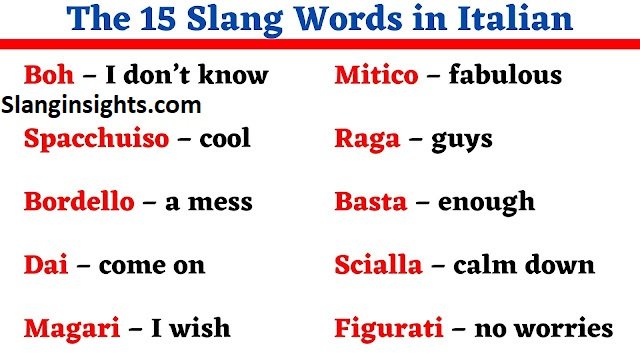
- “Dai!” — Come on! / No way! (depending on context, this one word carries a thousand meanings)
- “Figurati” — Don’t worry about it / No problem (very warm, very Italian)
- “Boh” — I dunno / Whatever (the most Italian shrug in word form)
- “In bocca al lupo” — Good luck (literally “into the wolf’s mouth” — and the correct response is “Crepi il lupo!” which means “May the wolf die!”)
- “Roba da matti” — Crazy stuff / This is insane
FAQ’s
What are Italian slang words?
Italian slang words are informal expressions used in everyday speech, often by native speakers to sound more natural and casual.
Are Italian slang words different by region?
Yes, slang can vary a lot between northern and southern Italy, with some words used only in specific cities or areas.
Is it okay to use Italian slang as a learner?
Yes, but it’s best to learn standard Italian first and then slowly add slang for casual conversations.
What is the most common Italian slang word?
“Boh” (I don’t know) and “figo” (cool) are among the most commonly used slang words in Italy.
Do Italians use slang in formal situations?
No, slang is mostly used in informal conversations with friends or people of the same age group.
Conclusion
Italian slang words add personality, emotion, and cultural depth to everyday conversations. While standard Italian is important for grammar and formal communication, slang helps learners understand how people actually speak in real life.
Words like “figo,” “boh,” and “che palle” are widely used among friends and in casual settings, making conversations more expressive and natural.
Learning slang also gives you insight into Italian culture, humor, and attitudes. Many expressions are tied to regional identity, so understanding them can help you connect better with locals when traveling across Italy.
However, it is important to use slang carefully, as some terms may be informal or even rude depending on the context.
For language learners, the best approach is to first build a strong foundation in standard Italian and then gradually introduce slang into daily practice.
Watching Italian movies, listening to music, and talking with native speakers can help you pick up these expressions naturally.
Overall, mastering Italian slang makes your speech sound more fluent, confident, and authentic. It bridges the gap between textbook learning and real-life communication, allowing you to truly sound like a native speaker in everyday situations.