Korean Slang Words Common Phrases, Meanings, and Real-Life Examples
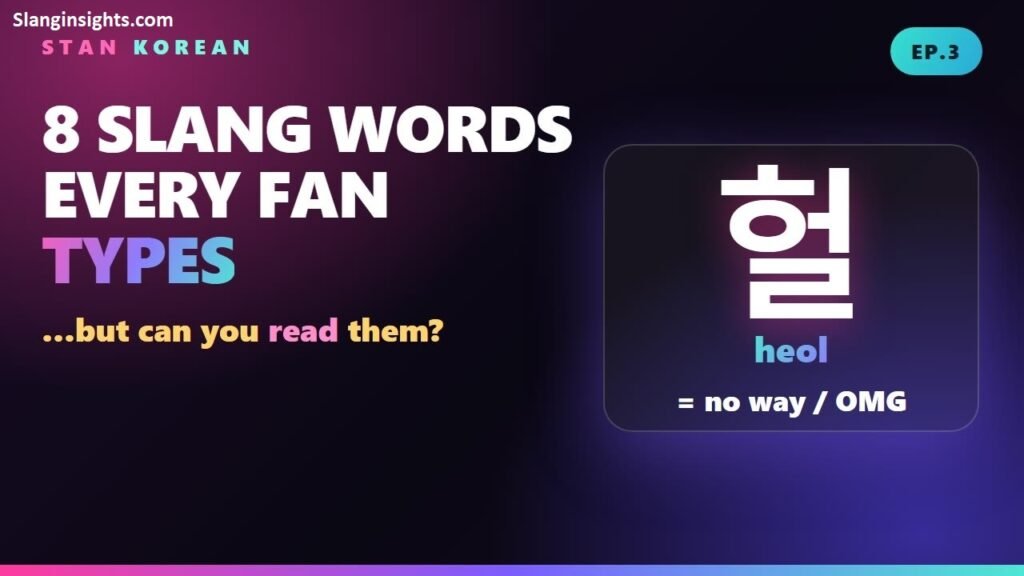
Korean slang words are informal expressions commonly used in everyday conversations, text messages, social media, and among younger generations.
These words help speakers communicate casually and often reflect modern trends and pop culture.
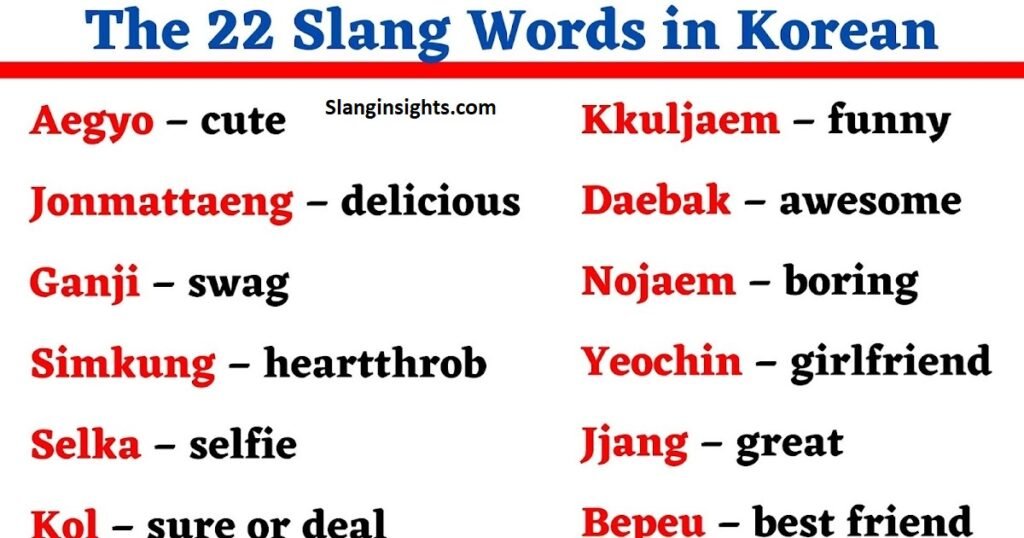
Popular Korean slang includes Daebak (awesome), Aegyo (cute behavior), Fighting (good luck), JMT (really delicious), Selca (selfie), No Jam (boring), and Maknae (youngest member of a group).
K-drama fans and K-pop followers frequently encounter these terms. Learning Korean slang can improve your understanding of native speakers and make conversations sound more natural.
However, slang should be used carefully, as some expressions are only appropriate in casual settings.
Table of Contents
Quick Table
| Korean Slang | Meaning in English | Usage Example |
|---|---|---|
| Daebak (대박) | Awesome, amazing | “That movie was daebak!” |
| Aegyo (애교) | Cute behavior | “She is famous for her aegyo.” |
| Fighting (파이팅) | Good luck, you can do it | “Fighting on your exam!” |
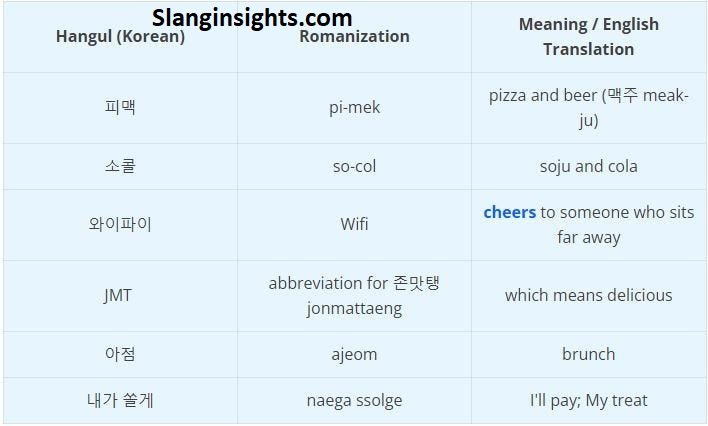
| JMT (존맛) | Really delicious | “This ramen is JMT!” |
| Selca (셀카) | Selfie | “Let’s take a selca together.” |
| No Jam (노잼) | Boring, not fun | “The show was no jam.” |
| Maknae (막내) | Youngest member | “He is the maknae of the group.” |
| TMI (티엠아이) | Too much information | “That’s TMI!” |
| Honey Tip (꿀팁) | Useful tip or trick | “Thanks for the honey tip.” |
| Simkung (심쿵) | Heart-fluttering feeling | “His smile gave me simkung.” |
| Mansour (만수르) | Very rich person | “He spends money like Mansour.” |
| GG (지지) | Giving up or defeat | “I can’t solve it, GG.” |
| Umchina (엄친아) | Perfect overachiever | “Everyone compares him to an umchina.” |
| Inssa (인싸) | Popular, social person | “She is an inssa at school.” |
| Outssa (아싸) | Introverted or outsider | “He prefers being an outssa.” |
How I Learned Korean Slang the Hard Way
You’re watching Reply 1988 or some idol variety show, and you can kinda-sorta follow along — and then someone says something like “헐, 대박이야!” and the subtitle just reads “Wow, amazing!” and you think:
that translation is technically correct, but it’s missing something. Something that sounds like a whole personality.
That was me about a year into studying Korean. I could order food, introduce myself, and read Hangul at a decent pace. But casual conversation? I sounded like a textbook. A very formal, very boring textbook.
So I did what any reasonable language nerd does — I went down a rabbit hole. I started rewatching scenes, pausing every few seconds, typing weird syllables into Naver Dictionary. I started lurking on Korean Twitter. I installed TikTok and followed creators who just talked to the camera. Slowly, the slang started making sense.
Here’s everything I learned — the words that actually come up, how they feel when native speakers use them, and the embarrassing mistakes I made trying to use them myself.
The words you’ll actually hear (not the ones in textbooks)
Korean slang moves fast. New words get coined by celebrities, gamers, and social media users — and sometimes die out just as quickly. But there’s a solid core of expressions that have stuck around and are genuinely useful to know.
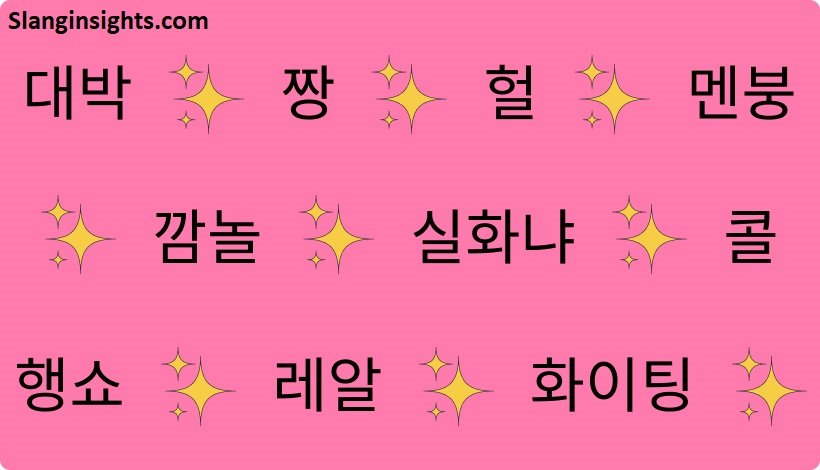
대박
Daebak
Amazing, jackpot, wow — the Swiss Army knife of Korean exclamations. Used for anything from “omg this food is incredible” to “I can’t believe that just happened.”
“이 치킨 진짜 대박이야.” — This chicken is literally insane.
헐
Heol
The Korean equivalent of “whoa” or “oh my god.” It’s pure reaction — surprise, disbelief, sometimes mild horror. Texting culture made this one everywhere.
“헐, 진짜?” — No way, really?
맞아
Maja
Literally “that’s right.” Sounds simple, but native speakers drop this constantly as a conversational response — like “yeah, exactly” or “I know right?”
“맞아맞아!” — Exactly, totally!
짱
Jjang
Top tier. The best. Used like “the GOAT” or just to say something is really cool. You’ll hear this from people who grew up in the 90s/2000s, and it’s making a comeback with younger speakers.
“이 노래 짱이야.” — This song goes so hard.
진짜
Jinjja
“Really” or “for real.” This one’s technically standard Korean but the way it’s used in casual speech — stretched out, emphasized — makes it feel totally slang-adjacent.
“진짜 미쳤다.” — I’m literally losing my mind (in the best way).
아무튼
Amutun
“Anyway.” You’d think this is boring, but it’s actually incredibly useful when you want to pivot a conversation, brush something off, or just move on. Very natural filler.
“아무튼, 오늘 뭐해?” — Anyway, what are you up to today?
킹받아
King-bada
Annoys me so much / I’m so triggered. A mashup of the English word “king” (exaggerated scale) and 열받아 (to be heated/angry). A very Gen Z Korean creation.
“이 광고 진짜 킹받아.” — This ad literally makes my blood boil.
갓생
Gat-saeng
“God-life” — the kind of productive, well-organized, healthy life you’re constantly trying to live. If someone says they’re living a 갓생, they’re waking up early, hitting the gym, meal prepping, being their best self.
“요즘 갓생 살려고 노력 중이야.” — Trying to actually get my life together lately.
눈바디
Nun-body
Checking out someone’s physique visually. Combines 눈 (eyes) with “body.” You’ll see this in fitness communities and social media posts where people share gym progress.
“눈바디로 봐도 많이 달라졌네.” — Even just looking at you, you’ve changed a lot.
꾸안꾸
Kkuan-kku
Short for 꾸민 듯 안 꾸민 듯 — “looks effortless but is actually put together.” The fashion and beauty equivalent of “no-makeup makeup.” Very popular in K-beauty spaces.
“오늘 꾸안꾸 느낌이 진짜 잘 살았다.” — You really nailed the effortless look today.
나만 없어 고양이
Na-man eopsseo goyangi
“Everyone has a cat except me.” Became a meme/expression for FOMO or feeling left out when everyone else has something you don’t. Often shortened to just 나만없어.
“나만없어, 남친.” — Everyone has a boyfriend but me.
TMI
T-M-I
Same as English — too much information. Borrowed and used exactly the same way, often in self-deprecating contexts. (“Sorry, that was a total TMI.”)
“TMI인데, 어제 진짜 많이 울었어.” — TMI but I cried a lot yesterday.
How I actually learned these — the honest method
I tried a bunch of things before finding what actually worked. Anki flashcards for slang felt weird and clinical. Slang lists on blogs were helpful but often outdated.
What really moved the needle was consuming Korean content that wasn’t made for learners.
YouTube variety shows with Korean subtitles — not English subs. Shows like Running Man, Knowing Bros, or any idol interview with Korean closed captions lets you see how words are actually spelled when spoken fast and casually
Korean Twitter / X — This is where slang is born and dies. If a new word exists, it’s trending there first. I spent maybe 15 minutes a day just scrolling, screenshot-ing words I didn’t know.
Naver Dictionary + Namuwiki — Naver for quick definitions, Namuwiki (Korean Wikipedia-ish) for context and etymology. If a slang word has a pop culture origin, Namuwiki will tell you.
Language exchange apps — HelloTalk and Tandem are both genuinely good. I’d ask my Korean partners to use casual speech with me, not formal Korean. The correction feature in HelloTalk is especially helpful when you write something weird.
TOPIK study communities on Discord — These servers have native speakers who are learning English while you’re learning Korean. The informal chat channels are full of casual, real Korean that textbooks skip entirely.
The apps I use most often right now:
Naver DictionaryHelloTalkTandemYouTube (Korean CC)NamuwikiTwitter/X 🇰🇷The mistakes I made (so you don’t have to)
Using slang in the wrong context
I once used 헐 in a message to someone I’d just met — a native speaker I was hoping would become a language partner. It came off as weirdly casual too fast. Korean relationships have very clear levels of formality based on age and closeness. Slang is for friends, not strangers.
Fix: gauge the relationship first. If someone is using formal speech with you (존댓말), match that until they shift.
Assuming slang is age-neutral
I used 짱 with someone in their 30s and they laughed — not unkindly, but it was clearly dated to them, like I’d said “groovy.” Slang ages. Words like 갓생 and 킹받아 skew younger (late teens, 20s). Words like 대박 and 진짜 are pretty universal.
Fix: pay attention to who’s using what. If you’re watching content by people your age, the language will roughly match.
Direct translating from the English concept
I once tried to say “no cap” in Korean — because I thought 진짜 was the same thing. It’s close but not quite.
The nuance is different. 진짜 means “really/truly,” while “no cap” specifically signals you’re being serious after something that might sound exaggerated. Korean has different ways to express that.
Fix: learn slang in context, not as direct translations. Understand the feeling of the word, not just the definition.
A few newer words worth bookmarking
Language doesn’t sit still. These are words that have picked up steam in the last couple of years in Korean digital culture:
레전드
Re-jeon-deu
Legend — borrowed from English but used even more enthusiastically. Something is 레전드 if it’s historically iconic, unforgettable, or the best in its category.
현타
Hyun-ta
Short for 현실 타격감 — the feeling when reality hits you and you suddenly feel empty or disillusioned. Like a post-fun crash. Very relatable, very widely used.
핵인싸
Haek-in-ssa
The most socially plugged-in person in the room. 핵 means “nuclear/extreme,” 인싸 comes from “insider.” Basically: main character energy, the life of the party.
아싸
A-ssa
The opposite of 인싸 — someone who’s an outsider or loner. It’s used semi-ironically and affectionately now, especially among introverts who just own it.
A quick tip on pronunciation
A lot of Korean slang is shortened or squished together — syllables that should be distinct get blended when spoken fast. Don’t panic if you can’t parse something on first listen.
Slowing YouTube videos to 0.75x speed (just click the settings icon) helps a lot when you’re trying to figure out where one word ends and another begins.
Why this stuff matters beyond just “sounding cool”
There’s a practical reason to learn Korean slang that goes beyond impressing K-drama fans. When you understand informal speech, you understand the culture more deeply.
A lot of Korean slang reflects very specific shared anxieties and aspirations — the idea of 갓생 wouldn’t exist without the intense productivity pressure many young Koreans feel.
현타 captures something that doesn’t translate cleanly into other languages. The slang is a window.
Plus, honestly? When you use it correctly — with the right person, in the right moment — the reaction you get from a Korean speaker is genuinely priceless.
There’s a kind of delight when they realize you actually understand their language, not just the polished version of it.
FAQ’s
What are Korean slang words?
Korean slang words are informal expressions used in casual conversations, text messages, social media, and among younger generations. They help speakers communicate in a more natural and trendy way.
Why should I learn Korean slang?
Learning Korean slang improves your understanding of K-dramas, K-pop lyrics, and everyday conversations with native Korean speakers. It also helps you sound more fluent and culturally aware.
What does “Daebak” mean in Korean?
“Daebak” (대박) means “awesome,” “amazing,” or “incredible.” It is one of the most popular Korean slang expressions and is used to show excitement or admiration.
Is Korean slang appropriate in formal situations?
No. Most Korean slang words are meant for casual settings with friends, family, or online interactions. Formal conversations usually require standard Korean language.
Which Korean slang words are most commonly used?
Some common Korean slang words include Daebak, Aegyo, Fighting, Selca, JMT, No Jam, TMI, Simkung, and Inssa.
Conclusion
Korean slang words are an exciting part of modern Korean culture and language.
These informal expressions are widely used by young people, K-pop fans, and social media users, making them essential for anyone interested in learning Korean.
Popular terms such as Daebak, Aegyo, Fighting, and JMT add personality and emotion to everyday conversations.
Understanding these words can help you enjoy K-dramas, music, and online content with greater confidence and appreciation.
In addition, learning Korean slang provides insight into contemporary trends and how native speakers communicate in relaxed settings.
While slang is useful for casual conversations, it is important to recognize when formal language is more appropriate.
By combining standard Korean with commonly used slang expressions, learners can develop a more natural speaking style and connect better with Korean culture.
Whether you are a beginner or a longtime fan of Korean entertainment, mastering Korean slang words is a fun and practical way to enhance your language skills.