Florida Slang Words The Complete Dictionary of Florida Slang and Street Talk

Florida slang words reflect the state’s unique culture, beaches, and diverse communities.
Popular terms include “jit” (a young person), “snowbird” (someone who spends winters in Florida), “no-see-ums” (tiny biting insects), and “the 305” (Miami area code).
Locals may say “brick” when the weather feels unusually cold or “mad” to mean a lot of something. Phrases like “on the water”, “beach day”, and “gator country” are also common.
Florida slang combines Southern expressions, Caribbean influences, and modern urban language, making it colorful and easy to recognize throughout the Sunshine State.
Table of Contents
Quick Table
| Florida Slang Word | Meaning |
|---|---|
| Jit | A young person or kid |
| Snowbird | Someone who spends winters in Florida |
| No-See-Ums | Tiny biting insects |
| The 305 | Nickname for the Miami area |
| Brick | Surprisingly cold weather |
| Mad | A lot of something |
| Gator Country | Areas where alligators are common |
| Beach Day | A day spent relaxing at the beach |
| On the Water | Boating, fishing, or enjoying waterfront activities |
| Tourist Season | Time of year when many visitors arrive |
| Swamp Puppy | Humorous term for an alligator |
| Flip-Flop Weather | Warm weather suitable for sandals |
| Hurricane Party | Gathering before or during a storm |
| Conch | A person from the Florida Keys |
| Sun Pass | Florida’s electronic toll payment system |
| Mouse House | Nickname for Disney World |
| Sandbar Hangout | Relaxing at a shallow offshore area |
| Lovebug Season | Time when lovebugs are abundant |
| Gulf Side | Referring to Florida’s Gulf Coast |
| The Sunshine State | Florida’s popular nickname |
My First Experience with Florida Slang
The first time someone told me to “watch out for the snowbirds on US-1,” I genuinely looked up at the sky.
I was visiting Fort Lauderdale for a week in January, staying with a college friend who’d moved there after grad school, and I had absolutely no idea what she meant.
She laughed for a solid thirty seconds.
That was my introduction to Florida slang — a language unto itself that mixes Southern drawl, Cuban Spanish, Caribbean vibes, and a whole lot of “only-here” energy that no dictionary prepared me for.
After spending a lot of time in the Sunshine State — trips to Miami, Tampa, Jacksonville, and a memorable road trip through the Panhandle — I’ve picked up enough to write this out for anyone else who’s felt like an outsider at a cookout near the Intercoastal.
The Snowbird Situation (And Other Seasonal Slang)
Let’s start where I started: snowbirds.
A snowbird is someone — usually a retiree from the Northeast or Midwest — who flocks to Florida every winter to escape the cold. They’re not bad people.
But they do slow down traffic, crowd the early-bird dinner spots, and disappear every April like clockwork.
Locals say things like “snowbird season is here” the same way people say “hurricane season is here” — with a mix of resigned acceptance and mild dread.
Connected to this is “season” — which in Florida doesn’t mean spring, summer, fall, or winter. It means tourist season or snowbird season, roughly November through April. “Is it season yet?” is a real question people ask.
Then there’s “off-season” — which is when it gets brutally hot and humid, tourist numbers drop, and actual Floridians have their state back.
Some locals genuinely love off-season. The beaches are quieter, the restaurants aren’t packed, and you can actually get a table at brunch.
The Classics Every Florida Visitor Hears First
“Heading to the beach” sounds universal, but in Florida it often comes with a specific directional — “going to the coast” might mean the Gulf Coast (calmer, greener water) or the Atlantic side (bluer, bigger waves). Locals know the difference and lowkey judge you if you don’t.
“The ‘Glades” — short for the Everglades. You don’t say “I’m going to the Everglades National Park.” You say “heading out to the ‘Glades.” It’s one of those shorthand terms that immediately signals whether you’ve spent any real time here.
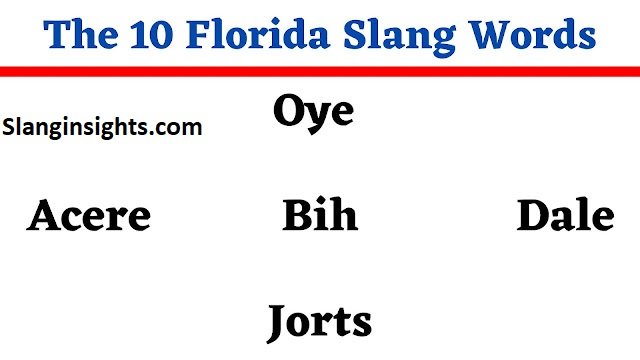
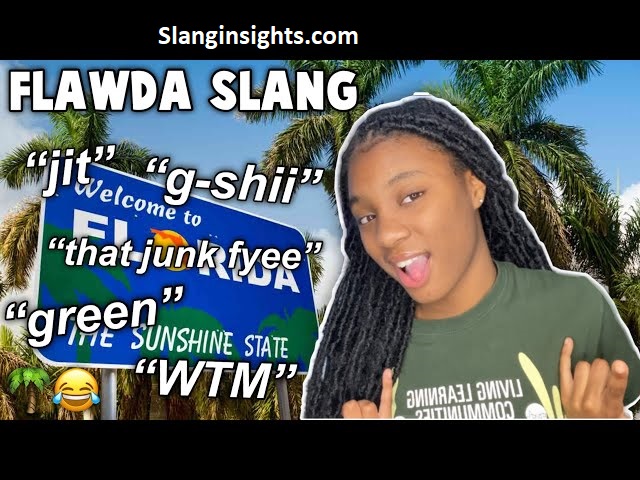
“Jit” — this one caught me completely off guard. In Florida (especially South Florida), “jit” means a young kid or youngster, sometimes used affectionately, sometimes not.
“That little jit was running around the parking lot” is a thing you’ll actually hear. Comes from African American Vernacular English and has deep roots in Miami slang specifically.
“Floridian” — obviously a demonym, but in Florida it’s almost a badge of honor. A real Floridian (i.e., someone born and raised here, not a transplant) will tell you within five minutes of meeting you.
It’s like a secret society. They’ve survived the humidity, the bugs, the hurricanes, and the roads. They’ve earned it.
Miami Slang That’s Crossed Into the Mainstream
Miami is basically its own linguistic universe. Spanish and English have fused here in a way that’s completely natural and genuinely beautiful if you listen to it.
“Mira” — technically Spanish for “look,” but in Miami slang it’s used as an interjection, almost like “hey” or “listen.” “Mira, let me tell you something” is peak Miami energy. You don’t have to be Cuban or Latino to use it here — the city has absorbed it.
“Bobo” — in standard Spanish it means “fool” or “silly,” but in South Florida it floats around as light-hearted teasing. Calling your friend a bobo is not an insult, it’s practically a term of endearment.
“Dale” — if you’ve listened to any Pitbull song ever, you know this one. “Dale” (pronounced dah-lay) means “go for it,” “let’s do it,” “okay,” or just general enthusiasm.
It’s become so embedded in Miami culture that non-Spanish speakers use it constantly. Someone says “you want to grab Cuban food?” You say “Dale.”
“Cafecito break” — this isn’t slang exactly, but it’s a cultural institution. In Miami, taking a quick break for a tiny cup of strong Cuban coffee is just part of the day. Offices do it. Friends do it. It’s the social glue of South Florida. If someone invites you for a cafecito, you go. No excuses.

Central Florida and the Theme Park Belt
Spend any time near Orlando and you’ll hear a totally different flavor of Florida-speak.
“The mouse” — everyone knows exactly what this means. Disney World. “Are you going to the mouse this weekend?” is a sentence Central Floridians say without irony.
Annual passholders (called “passholders” or “APs”) have their own whole subculture. They hop parks on a Tuesday night like it’s nothing.
“The 408” — local Orlando residents know their roads by number, not name. “Take the 408” just means the East-West Expressway. Tourists famously get confused because Florida expressways have both names and numbers and locals usually use whichever one is least helpful to newcomers.
“Ye Locals” — you’ll see this on signs in Old Town Kissimmee or Celebration. It’s tourist-facing Florida kitsch, but locals use it ironically to describe anything that’s for “real” residents versus visitors.
North Florida and Panhandle Slang (Yes, It’s Basically the South)
People forget that Florida’s northern border touches Georgia and Alabama. Once you get above Gainesville, the vibe shifts dramatically. It’s slower. More rural. More Southern in the truest sense.
“Fixin’ to” — this is classic Southern American English, but you’ll hear it in Tallahassee, Pensacola, and Panama City without blinking. “I’m fixin’ to head to the Publix” is a completely normal sentence up there.
“The Panhandle” — locals in that area are fiercely proud of being from “the Panhandle.” It’s geographically the strip of Florida that extends west toward Alabama. The beaches there (Destin, 30A, Seaside) are famously gorgeous — crystal white sand and emerald green water — and the locals want you to know they’re different from Miami or Orlando.
“Bless your heart” — technically a pan-Southern phrase, but North Floridians wield it with precision. It can mean genuine sympathy. It can also be the politest possible way of calling someone an idiot. Context is everything.
Weather Slang (Because Weather Is a Full Personality Here)
Florida weather is not normal. It rains every afternoon from June through September. It’s 90°F in October. Hurricanes are a real annual possibility. So naturally, Floridians have developed their own weather vocabulary.
“Liquid sunshine” — a quick, heavy rain shower that’s gone in twenty minutes. Florida gets these almost every afternoon in summer. Tourists freak out. Locals don’t even move their beach chairs.
“SoFlo summer” — refers to that brutal combo of heat + humidity that turns South Florida into a sauna from May through October. Locals say it with a kind of survivor’s pride.
“Cone of concern” — technically a meteorological term, but every Floridian knows it during hurricane season. The NHC (National Hurricane Center, based in Miami) releases storm track forecasts inside a cone shape. Once local news stations start showing “the cone,” Floridians know to check their hurricane kits. You’ll hear people say “we’re in the cone” with a casual delivery that would terrify anyone from Ohio.
“Hurricane party” — this is controversial because emergency managers hate it, but it’s a real thing. Some Floridians throw parties when a hurricane’s coming — if it’s a Category 1 or 2 and they’re not in an evacuation zone. Locals who’ve been through a few storms know when to take it seriously and when a little community bonding helps ease the anxiety.
Mistakes Tourists (And New Residents) Make
Here’s the thing nobody warns you about — Florida slang doesn’t come with a manual, and using it wrong is instantly noticeable.
Saying “I-4 the highway.” Locals say “Eye-Four” or just “the 4.” When you call it a “highway” out loud, you mark yourself as an outsider immediately. Same with “the turnpike” — it’s just “the Turnpike” with reverence.
Calling someone a “snowbird” to their face. Even if they are one. This is not a compliment. Use it only when talking about the phenomenon in general.
Assuming Miami slang works statewide. “Dale” in Pensacola might get you a blank look. Florida is enormous — it’s 65,000 square miles — and the cultures genuinely vary by region.
Complaining about the heat to a local. They know. They’ve always known. They’ve made peace with it. When you say “it’s so HOT here,” the Floridian in front of you is thinking “then why did you come in July?” Just… don’t.
A Few More Gems Worth Knowing
- “Publix sub” — a sandwich from the Publix grocery store deli. It’s sacred. Don’t argue about it.
- “The 305” — Miami area code, used as a symbol of Miami pride. Similar to how New Yorkers might say “718.”
- “Cracker” — this one’s tricky. In Florida, “Florida Cracker” refers specifically to old-school Florida pioneers and their descendants, often cattle ranchers from Central and North Florida. It’s a regional identity marker, not an insult in this context. There’s even “Cracker cattle” — a heritage breed. Context matters a lot here.
- “No-see-ums” — tiny biting insects (technically biting midges) that are invisible to the eye but make their presence very, very known near water at dusk. Every Floridian has a story.
- “Gator bait” — used affectionately for University of Florida Gators fans, but also just a general Florida reference. Tourists love saying it. Locals think it’s a little corny.
Why Florida Slang Actually Matters
Here’s what I’ve come to understand after all my time down there: Florida slang isn’t just fun vocabulary.
It’s a reflection of a genuinely unique place — a state that’s geographically Southern but culturally not quite, where Caribbean and Latin cultures have mixed with retirees from New York and college kids from everywhere, where the weather is a shared experience that bonds everyone.
When someone in Hialeah says “dale” or a fishing guide in Homosassa says “the ‘Glades,” they’re talking in the shorthand of their world. Learning that language — even a little — is how you stop being a tourist and start actually experiencing Florida.
FAQ’s
What are Florida slang words?
Florida slang words are informal expressions commonly used by locals. They reflect the state’s beach culture, diverse communities, and Southern influences.
What does “jit” mean in Florida?
“Jit” is a popular Florida term used to describe a kid, teenager, or young person. It is especially common in South Florida.
Why are Florida slang words unique?
Florida slang combines influences from Southern culture, Caribbean communities, Latin American traditions, and modern urban language, creating distinctive expressions.
What is a “snowbird” in Florida?
A snowbird is someone, often from northern states or Canada, who spends the winter months in Florida to enjoy the warmer climate.
Do different parts of Florida use different slang?
Yes. South Florida, the Florida Keys, and northern Florida each have their own local expressions and accents, so slang can vary across the state.
Conclusion
Florida slang words are a fun reflection of the Sunshine State’s vibrant culture and diverse population.
From popular terms like “jit” and “snowbird” to unique expressions such as “no-see-ums” and “gator country,” these words capture the laid-back lifestyle that Florida is famous for.
Whether you are a resident, a visitor, or simply curious about regional American expressions, learning Florida slang can help you better understand local conversations and traditions.
Many Florida phrases are inspired by the state’s beaches, wildlife, and multicultural communities. South Florida, in particular, has contributed many modern slang terms that have spread beyond state borders.
As language continues to evolve, new expressions are constantly emerging, making Florida slang both dynamic and entertaining.
By familiarizing yourself with these words and phrases, you can sound more like a local and gain a deeper appreciation for the unique identity of Florida.
Whether you’re planning a trip or just expanding your vocabulary, Florida slang offers a colorful glimpse into life in the Sunshine State.