French Slang Words Common Phrases, Meanings, and Real-Life Examples
French Slang Words If you want to sound like a true French native, start with the basics — mec (guy), meuf (woman/girlfriend), and gosse (kid) are everyday staples.
Call your best friend your pote or copain, and when something is great, say it’s ouf, trop bien, or simply au top. Feeling tired? You’re crevé. Bored? Totally blasé.
When a situation is awkward or uncomfortable, the French say it’s chelou (shady/weird) or bizarre. If something is easy, it’s fastoche or tranquille. Money is called thune or fric, and when you’re broke, you’re fauché.
To agree with someone, drop a casual ouais instead of oui, or go even more laid-back with mouais when you’re only half-convinced. Something incredible is dingue or incroyable, while something bad or uncool is nul or pourri.
A lie is a baratin, and someone who talks too much is a bavard. If someone is being annoying, they’re chiant or gonflant, and you might tell them to stop being a casse-pieds (literally “foot-breaker,” meaning a pain in the neck).
French Gen Z lives on words like wesh (hey/yo), osef (short for on s’en fout — we don’t care), trop stylé (super cool), and c’est relou (it’s annoying — a verlan twist on lourd).
Verlan itself is a whole world — verlan flips syllables, turning l’envers into verlan, femme into meuf, fou into ouf, and louche into chelou. Things that are cool are grave or carrément, and when you fully agree, you say carrément or clairement.
Table of Contents
Quick Table
| French Slang Word | Meaning in English | Common Usage |
|---|---|---|
| Mec | Guy, dude | Used to refer to a man or friend |
| Meuf | Girl, woman | Informal way to talk about a female |
| Boulot | Work, job | Talking about employment or daily work |
| Fric | Money, cash | Casual term for money |
| Ouf | Crazy, amazing | Used for something shocking or impressive |
| Kiffer | To love, enjoy | Expressing strong liking for something |
| Bouffer | To eat | Informal alternative to “eat” |
| Relou | Annoying, irritating | Describing a person or situation that is bothersome |
The Day I Realized Textbook French Wasn’t Enough
I still remember the look on my host family’s face when I confidently told them I had spent the afternoon at the market and that everything was “très bien.” They smiled politely. But I could tell — I sounded like a phrasebook had learned to walk.
That was my first week in Lyon, France, during a study exchange. I’d studied French for four years. Four.
Years. And yet the moment real people started talking to each other — not at me, but to each other — I understood maybe 40% of it. The rest was a blur of fast sounds and words no textbook had ever shown me.
So I did what any stubborn learner does: I started writing things down. I asked my host sister to explain what she meant. I watched French YouTube, French TikTok, French reality TV with subtitles. And slowly, I started to get it.
Here’s what I learned — and what I wish someone had told me before I boarded that flight.
Why Textbook French Will Leave You Lost
Standard French is beautiful, formal, and almost completely useless in casual conversation.
The French you learn in school is like being taught to drive using a 1985 manual on a race track. You have the basics, but you’re going to stall. A lot.
Real French — the stuff people use with friends, in group chats, in cafés — is loaded with slang, shorthand, verlan (reversed syllable words), and expressions that make zero sense if you try to translate them literally.
Once I accepted that gap existed, I stopped being embarrassed about it and started learning around it.
The Slang Words That Changed Everything
Let me walk you through the ones that genuinely made my daily life easier — and a few that got me into mild social trouble before I understood them properly.
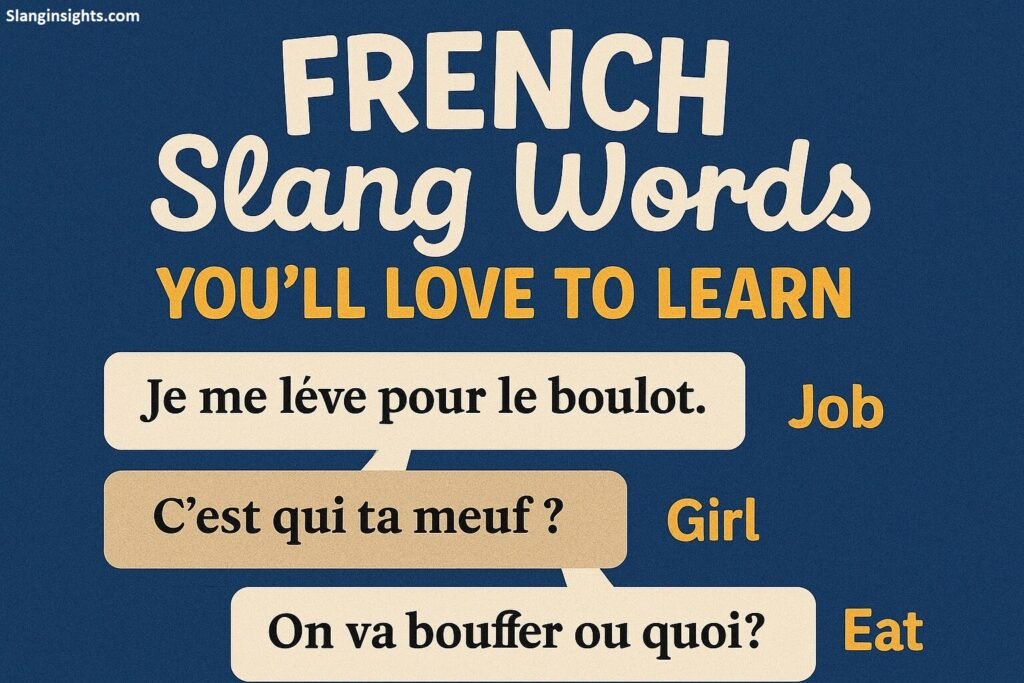
Meuf — Woman / Girl
This one is verlan — a style of French slang where syllables are flipped. “Femme” (woman) becomes “meuf.” It’s one of the most commonly used words among younger French speakers.
I heard it approximately 300 times before I figured out what it meant. Once I did, suddenly half the conversations I’d been following turned into complete sentences.
You’ll hear: “C’est une meuf sympa” — She’s a nice girl.
Not offensive in casual contexts, but read the room — it’s informal.
Mec — Guy / Dude
The male counterpart. If “meuf” is girl, “mec” is guy. Simple, but essential.
“C’est qui ce mec?” — Who’s that guy?
I used this one early and it landed well. People seemed genuinely surprised (in a good way) that I knew it.
Ouf — Crazy / Intense / Wow
Here’s verlan again. “Fou” (crazy) flipped becomes “ouf.” But it’s evolved — now it means something more like “intense,” “wild,” or just a general expression of amazement or exasperation.
“C’était ouf ce film” — That movie was insane/wild.
My host sister used this constantly. Once I started using it, she looked at me differently. In a good way.
Chelou — Sketchy / Weird / Shady
Another verlan classic. “Louche” (shady/sketchy) becomes “chelou.” This is one of those words that sounds exactly like what it means once you know it.
“Ce type est vraiment chelou” — That guy is really sketchy.
I used this the wrong way once when I meant to compliment something unusual as “unique” and accidentally called it shady. Lesson learned: context matters enormously with slang.
C’est pas mal — It’s not bad (but actually means it’s pretty good)
This one isn’t pure slang but it will trip you up if you take it literally. In French culture, saying something is “not bad” is actually a quiet compliment. It’s understatement culture.
If someone tastes your food and says “c’est pas mal,” don’t be offended. They liked it. They just won’t tell you directly.
Kiffer — To really like / To love something
This is an Arabic-influenced word that has been fully absorbed into French youth culture. It means to love or enjoy something deeply.
“Je kiffe ce morceau” — I love this track. “Tu kiffes quoi comme musique?” — What kind of music are you into?
Using this one in conversation made people genuinely light up. It felt like I was speaking their French, not just French.
Bolos — Loser / Lame person
Used a lot among younger people. Calling someone a “bolos” means they’re uncool, a bit of a pushover, or socially awkward.
Honestly, I’d avoid using this one until you really know the group you’re in. I heard it a lot but only used it when I was sure the context was lighthearted banter.
Ça le fait — It works / That does it / That’s good
A phrase that comes up constantly. Literally “it does it,” but the real meaning is closer to “that works,” “that’s acceptable,” or “yeah, that’ll do.”
“T’as un stylo? — Oui. — Ah, ça le fait!” — You got a pen? Yeah. — Nice, that works!
Flécher — No, wait… Flemme — Laziness / Can’t be bothered
“J’ai la flemme” is one of the most useful expressions I picked up. It means you just don’t feel like doing something. You’re too lazy, too tired, just… not feeling it.
“J’ai la flemme d’y aller” — I can’t be bothered to go.
This came up so often. It’s the French equivalent of “I’m not feeling it” and it’s completely socially acceptable.
Nickel — Perfect / Spotless / Excellent
Another one that surprised me. “Nickel” doesn’t mean the coin — in slang it means something is perfect, flawless, or in great condition.
“T’as fait un boulot nickel” — You did a perfect job.
I loved this one because it sounded cool even before I knew what it meant.
The Verlan Rabbit Hole
Once you understand verlan, you start seeing it everywhere — and it genuinely helps you decode conversations.
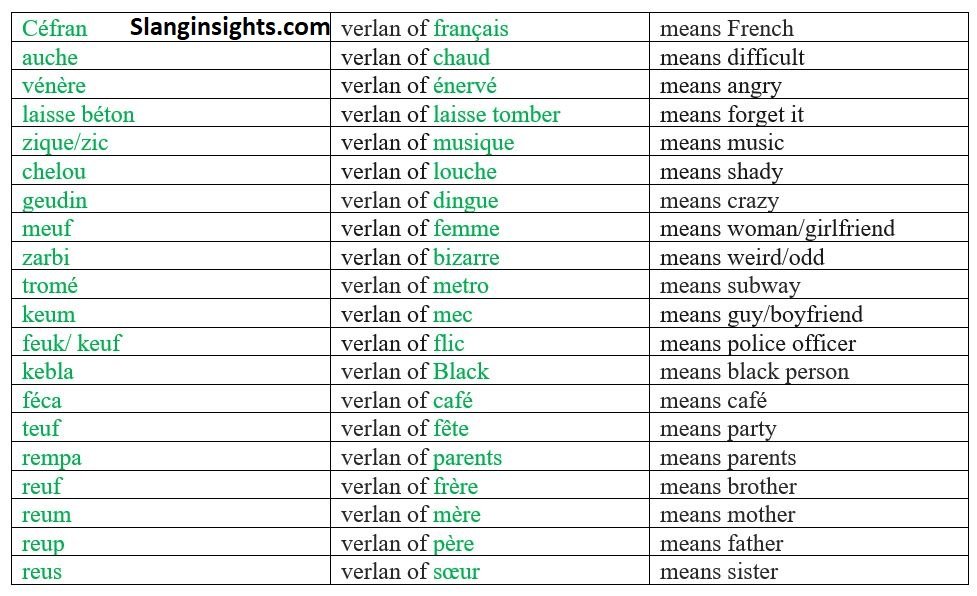
Some quick verlan you’ll hear:
- Laisse béton → from “laisse tomber” (let it go / forget it)
- Zarbi → from “bizarre” (weird)
- Teuf → from “fête” (party)
- Reum → from “mère” (mother)
- Reup → from “père” (father)
My personal method: when I heard a word I didn’t recognize, I’d try to flip it in my head. If the flipped version sounded like a real French word, that was probably it.
It worked more often than I expected.
Apps and Resources That Actually Helped
If you’re learning this stuff without being physically in France, a few tools genuinely made a difference for me:
Babbel and Duolingo are fine for basics but they will not teach you slang. At all.
What worked better:
- TV5Monde and French Netflix shows (Emily in Paris is cute but not authentic — try Lupin, Validé, or Plan Coeur)
- French TikTok and YouTube — search for French vloggers or podcast-style creators. “Français avec Pierre” helped with structure, but real slang came from watching everyday content
- HelloTalk — language exchange app where you chat with native speakers. This is where I tested words before using them in real life
- Wordreference.com forums — weirdly detailed discussions about whether specific slang is outdated or still used. Surprisingly accurate
Mistakes I Made (So You Don’t Have To)
Using slang too formally. I once used “chelou” in a somewhat professional context and got a mild raised eyebrow. Slang has a register. Save it for casual settings.
Overthinking pronunciation. French slang is often fast and swallowed. Stop trying to enunciate every syllable like you’re in an oral exam. Loosen up.
Assuming slang travels across generations. My host family’s teenage daughter and her 40-year-old parents had very different ideas of what was “current.” Ask who taught you a word before using it with a different age group.
Translating literally. “J’ai la flemme” sounds lazy when translated. But socially, it’s a totally normal thing to say. Don’t apply English social norms to French expressions.
A Note on Regional Differences
Lyon slang isn’t always the same as Paris slang — and neither is the same as what you’d hear in Marseille or among French-speaking communities in Belgium or Quebec.
Some words I learned in Lyon got blank looks when I used them in Paris. A few Parisian expressions made my Lyon friends raise an eyebrow. It’s not a dealbreaker — French people generally enjoy when foreigners try — but it’s worth knowing that “French slang” isn’t one unified thing.
The more you listen to different French content from different regions, the more natural your ear gets.
FAQ’s
What are the most common French slang words for beginners?
Start with everyday essentials like ouais (yeah), mec (guy), meuf (girl), sympa (nice), and bref (anyway). These appear constantly in casual conversation and will instantly make you sound more natural when speaking French.
What is verlan and how does it work?
Verlan is a form of French slang where syllables in a word are reversed or swapped. For example, femme becomes meuf, fou becomes ouf, and bizarre becomes zarbi. It originated in French suburbs in the 1970s–80s and is now widely used across all age groups, especially in music and youth culture.
Is French slang the same in France, Belgium, and Canada?
Not exactly. While many slang words are shared, each region has its own flavour. Québécois French has unique expressions like tiguidou (all good) and char (car), while Belgian French has its own local terms. The slang covered in this guide is primarily metropolitan French, as spoken in France.
Can I use French slang in formal settings?
No — slang is strictly for casual, informal situations with friends, family, or peers. Using words like chiant or fric in a professional or academic setting would come across as rude or unprofessional. Always read the room before dropping slang.
How do French Gen Z speakers talk differently from older generations?
French Gen Z borrows heavily from verlan, Arabic-influenced words (wesh, kiffer), and English (cool, stylé). They also create entirely new expressions through social media and music. Words like osef, trop stylé, and chanmé are hallmarks of younger French speakers today.
Conclusion
Mastering French slang words is one of the most rewarding steps you can take on your language-learning journey.
Grammar and vocabulary from textbooks will get you through a classroom, but slang is what gets you through a real conversation — at a Parisian café, a friend’s birthday party, or a late-night teuf in the 11th arrondissement.
From classic everyday expressions like ouais, sympa, and bref, to the fascinating world of verlan with words like meuf, ouf, and chelou, French slang is rich, creative, and constantly evolving.
Gen Z has added a whole new layer with words like wesh, osef, and trop stylé, keeping the language fresh and dynamic.
The key to using slang naturally is context. Listen to how native speakers use these words in French films, music, podcasts, and YouTube videos. Don’t force it — let the expressions come to you organically over time.
Start with five or ten words you actually like, use them consistently, and build from there.
Whether you’re a beginner dipping your toes in or an advanced learner polishing your fluency, these 100 French slang words give you a genuine window into how French people actually speak.
So next time someone asks ça va?, don’t just say bien — say ça roule, smile, and watch their face light up.