Texas Slang Words The Complete Dictionary of Texas Slang and Local Sayings
Texas slang words are a colorful part of the state’s culture and everyday conversations. Many expressions reflect Southern traditions, cowboy heritage, and the friendly nature Texans are known for.
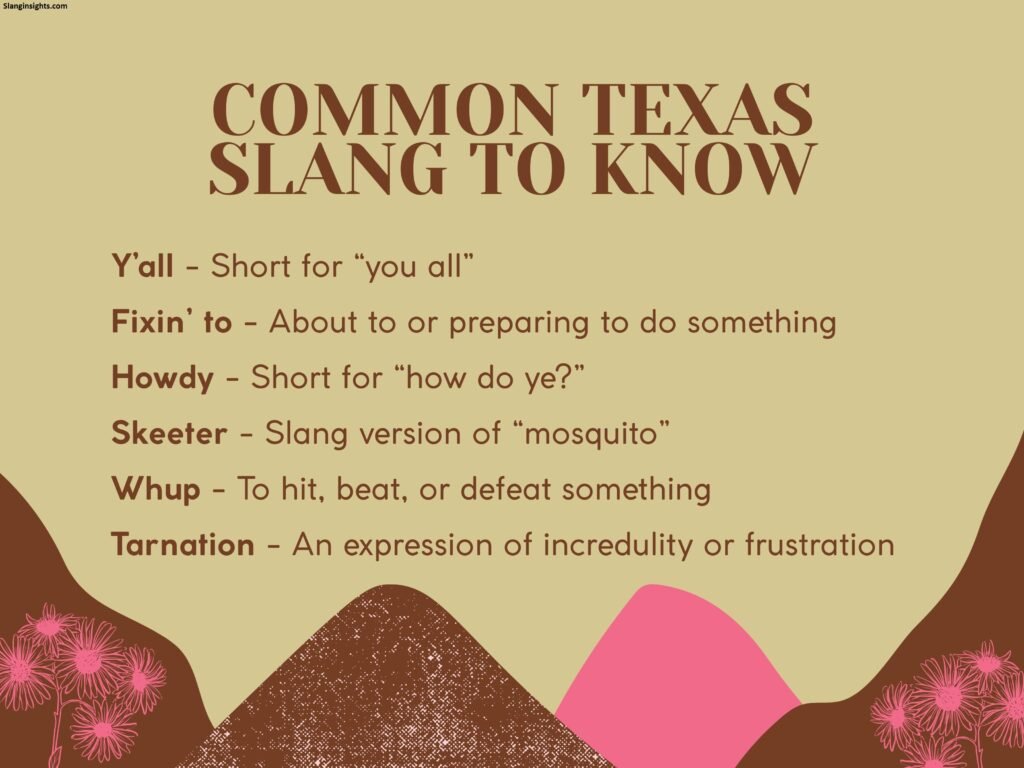
Popular terms include “y’all” (you all), “fixin’ to” (about to do something), “howdy” (hello), and “reckon” (to think or suppose). Texans may also say “all hat and no cattle” to describe someone who talks big without backing it up.
Learning Texas slang words can help visitors understand local speech and connect with people more easily. These phrases add personality and charm to conversations across the Lone Star State.
Table of Contents
Quick Table
| Texas Slang Word | Meaning | Example |
|---|---|---|
| Y’all | You all | “Are y’all coming tonight?” |
| Fixin’ To | About to do something | “I’m fixin’ to leave.” |
| Howdy | Hello | “Howdy, partner!” |
| Reckon | Think or suppose | “I reckon it’ll rain later.” |
| All Hat and No Cattle | Someone who talks big without substance | “He’s all hat and no cattle.” |
| Ain’t | Is not, are not, have not | “It ain’t my fault.” |
| Hollar | Shout or call out | “Give me a hollar when you arrive.” |
| Caddywampus | Crooked or out of place | “That picture frame is caddywampus.” |
What Is Texas Slang Words?
The first time I pulled up to a gas station outside of San Antonio and the cashier told me to “fix myself a plate” after pointing to absolutely nothing, I stood there like a complete idiot for a solid ten seconds.
I’d just moved from Chicago. I thought I spoke English. I did not, apparently, speak Texas.
That moment kicked off a months-long education in one of the most colorful, expressive, and genuinely loveable regional dialects in the entire country. Texas slang isn’t just a list of funny words — it’s a whole culture wrapped up in language.
Once you get it, you’ll start hearing it everywhere, and honestly, you might never go back to plain American English again.
The Basics You Absolutely Need First
“Y’all” (and “All Y’all”)
Everyone knows y’all. It’s the second-person plural pronoun that the English language desperately needed and never had — until the South gave it to us. But what a lot of outsiders don’t realize is that Texans also use all y’all when they really mean every single one of you.
“Y’all want some brisket?” = Are some of you interested in brisket?
“All y’all need to sit down” = Every last person in this room, right now, please be seated.
It’s a distinction that matters. Mess it up and you’ll get a look.
“Fixin’ to”
This one tripped me up for weeks. “I’m fixin’ to head out” doesn’t mean you’re repairing anything. It means you’re about to do something. It’s a statement of imminent intention.
“She’s fixin’ to call you back.” “We’re fixin’ to eat — you hungry?”
Once you hear it enough times, it clicks. And then you start saying it yourself without even noticing.
“Bless Your Heart”
Do not — I repeat, do not — think this is a compliment.
In Texas, “bless your heart” is the polite, church-approved way of saying you’ve done or said something profoundly stupid, and the speaker pities you for it. It’s the velvet glove over an iron fist.
“He tried to barbecue a brisket in the oven. Bless his heart.”
That said, context matters. Sometimes it’s genuinely sweet. You’ll learn to read the room.
The Texan Way of Sizing Things Up
Texans are descriptive people. They don’t just say something is big or far away — they paint you a picture.
“It’s a Fur Piece”
Means it’s far away. A considerable distance. How far? Depends on the speaker. Could be twenty minutes. Could be three hours. “Fur piece” is wonderfully vague and somehow totally acceptable.
“Bigger Than Dallas”
Used to describe anything massive, impressive, or over-the-top. “That belt buckle is bigger than Dallas.” You’ll see a lot of things in Texas that fit this description.
“All Hat, No Cattle”
This one is pure gold. It describes someone who talks a big game but has nothing to back it up. All flash, no substance. You’ll start applying this to people in your everyday life almost immediately.
“He acts like he runs the place but he ain’t done a lick of work. All hat, no cattle.”
Weather, Nature, and Getting Around
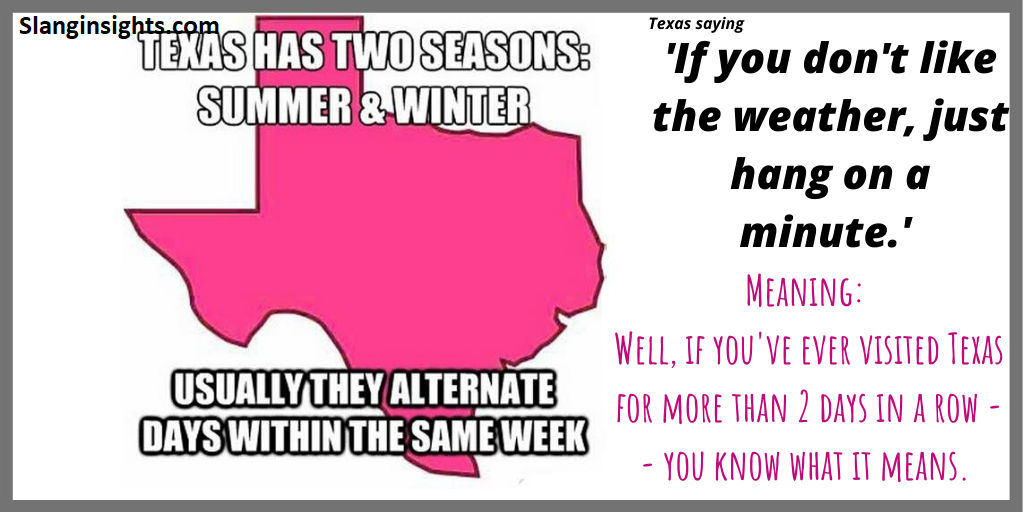
Texas has its own relationship with weather. It’s a big state with big weather, and the slang reflects that.
“It’s a Blue Norther”
A Blue Norther is a fast-moving cold front that drops temperatures dramatically — sometimes 30 to 40 degrees in just a few hours. Texans don’t mess around when one is coming. Stock up, stay in, and don’t be surprised when your shorts-and-t-shirt morning turns into a freezing-cold evening.
“Dry as a Bone” / “Slicker Than Owl Grease”
The first means extremely dry — used for weather, food, humor, pretty much anything. The second means very slippery or smooth. Both are used constantly, often within the same conversation about an icy road during a rare Texas winter storm.
“The Back Forty”
Refers to land out back — usually the far reaches of someone’s property. “He’s out in the back forty” means someone’s working (or wandering) somewhere on their land well away from the house.
The Social Slang You’ll Hear at Every Cookout
Texas social life runs on food, football, and good manners. The slang that follows reflects all three.
“Come Hell or High Water”
Means no matter what obstacles come up, something will happen. Texans are committed people. “We’re having this cookout come hell or high water” means rain, shine, or natural disaster, the brisket will be smoked.
“That Dog Won’t Hunt”
Probably my favorite Texas expression. It means an idea, plan, or excuse simply won’t work. It’s not going to fly. You use it to shut something down politely.
“You think you can sweet-talk your way out of this? That dog won’t hunt.”
“Cattywampus”
Something that’s crooked, off-kilter, or generally out of alignment. “That fence post is all cattywampus” means it’s leaning at a weird angle. You can apply it literally or figuratively — plans, situations, and people can all be cattywampus.
“Pitch a Fit”
To throw a tantrum or make a big fuss about something. Children pitch fits. Adults also pitch fits when the Cowboys lose or when someone puts sauce on proper barbecue.
Food Slang, Because Texas Takes Eating Seriously
“Mash” vs “Smash”
In Central Texas diners, asking for “mash” often means mashed potatoes, but “smash” means a smash burger. Don’t mix them up at the counter unless you enjoy surprised looks.
“Frito Pie”
Not exactly slang but worth mentioning — this is a legitimate meal in Texas. Fritos, chili, cheese, onions, sometimes jalapeños. Often served in the Frito bag itself. If someone invites you to a Frito pie, say yes. This is not a drill.
“Coke”
In Texas, “Coke” doesn’t mean Coca-Cola specifically — it means any carbonated soft drink. “What kind of Coke you want?” will be followed by a list of options including Sprite, Dr Pepper, and yes, actual Coke. This throws Yankees completely sideways every single time.
Terms of Endearment (Real Ones)
Texans are famously warm and direct about affection.
“Darlin'”
Used constantly, across genders and ages. Your waitress will call you darlin’. Your coworker’s grandmother will call you darlin’. It’s genuine and not creepy. Just accept it graciously.
“Sugar”
Same vibe as darlin’, slightly sweeter. Often used by older women. If a woman over 60 calls you sugar, you are doing something right.
“Hon” or “Honey”
The workhorse endearment. Casual, warm, often attached to a request. “Can you grab that for me, hon?” is just how some Texans communicate. Go with it.
Mistakes I Made That You Don’t Have To
Thinking “over yonder” was a joke. It’s not. It means over there, in that general direction. When someone points and says “it’s just over yonder past the water tower,” they are giving you real, sincere directions. Follow them.
Rushing the conversation. Texas small talk is not a prelude to the actual conversation. It IS the conversation. If someone asks how your family’s doing, they want to know. Slow down.
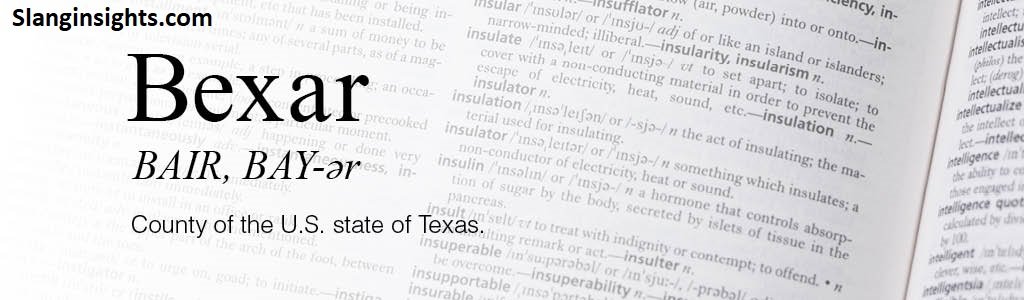
Pronouncing “Bowie” wrong. It’s BOO-ee, not BOH-wee. Same with New Braunfels (NEW BRAWN-fels, not NEW BRAWN-felz). And Manchaca is MAN-shack. Just trust locals on pronunciation — Texas geography is its own dialect.
Saying “you guys.” You have y’all now. Use it. “You guys” makes you sound like you just got off a flight from Newark. Which, in my case, I had.
Why Texas Slang Actually Matters
Here’s the thing nobody tells you about regional slang: it’s not just quirky vocabulary. It’s a window into what people value.
Texans value hospitality — so their language is warm and inclusive. They value hard work and authenticity — so their slang calls out phonies (“all hat, no cattle”) and celebrates people who follow through (“come hell or high water”).
They value humor — so their expressions are often wonderfully absurd (“slicker than owl grease,” “that dog won’t hunt”).
Learning the slang isn’t about fitting in or performing. It’s about actually understanding the people around you. When an old rancher in Amarillo tells you something’s “cattywampus,” he’s not being folksy for your amusement.
That’s just how he talks. And if you can meet him there, the conversation gets a whole lot better.
A Few More to Keep in Your Back Pocket
- “Might could” — a softer might, as in “I might could help you with that”
- “Reckon” — think or suppose (“I reckon it’ll rain tonight”)
- “Ornery” — stubborn, disagreeable, or just difficult
- “Hankerin'” — a craving (“I’ve got a hankerin’ for some kolaches”)
- “Lick” — a small amount (“He didn’t do a lick of work”)
- “Holler” — to call out or get in touch (“Holler at me when you’re ready”)
- “Plumb” — completely, totally (“She was plumb worn out”)
- “Right quick” — very soon, hurry up (“I’ll be there right quick”)
FAQ’s
What are Texas slang words?
Texas slang words are informal expressions commonly used in Texas. They reflect the state’s Southern culture, cowboy traditions, and unique way of speaking.
What does “y’all” mean in Texas?
“Y’all” is short for “you all” and is used to address two or more people. It is one of the most recognizable Texas expressions.
What does “fixin’ to” mean?
“Fixin’ to” means someone is about to do something. For example, “I’m fixin’ to head home” means “I’m about to go home.”
Are Texas slang words still used today?
Yes. Many Texans use these expressions daily, and some terms have become popular across the United States through movies, television, and social media.
Why should I learn Texas slang words?
Learning Texas slang can help you understand local conversations, communicate more naturally with Texans, and appreciate the culture and history of the Lone Star State.
Conclusion
Texas slang words are more than just funny expressions—they are a reflection of the state’s rich culture, history, and friendly spirit.
From common phrases like “y’all” and “howdy” to colorful sayings such as “all hat and no cattle,” these words add personality and warmth to everyday conversations.
Whether you are planning a trip to Texas, moving there, or simply curious about regional language, understanding these expressions can make communication easier and more enjoyable.
Many Texas slang terms have deep roots in Southern traditions and cowboy culture, which makes them unique and memorable.
Over time, several of these phrases have spread beyond Texas and are now recognized throughout the country. Still, they remain an important part of Texan identity.
By learning Texas slang words, you gain more than just vocabulary—you get a glimpse into the lifestyle and values of the Lone Star State. So, the next time someone says “Howdy, y’all,” you’ll know exactly what they mean and feel right at home.