Slang Alcohol Modern, Classic, and Regional Terms

Slang Alcohol Alcohol is often referred to by many slang terms in casual conversations, social media, and popular culture. Common slang words for alcohol include booze, hooch, sauce, liquid courage, firewater, and brew.
These terms can describe alcohol in general or specific types of alcoholic drinks.
For example, “booze” is a widely used informal term for any alcoholic beverage, while “hooch” often refers to homemade or low-quality liquor.
Slang for alcohol varies by region, age group, and social setting, making it an interesting part of language and culture. Understanding these terms can help you better follow everyday conversations and online discussions.
Table of Contents
Quick Table
| Slang Term | Meaning | Common Usage |
|---|---|---|
| Booze | Any alcoholic drink | General conversation |
| Hooch | Homemade or strong liquor | Informal slang |
| Sauce | Alcohol in general | Modern slang |
| Brew | Beer or alcoholic beverage | Casual use |
| Liquid Courage | Alcohol that boosts confidence | Social situations |
| Firewater | Strong alcoholic liquor | Traditional slang |
| Juice | Alcoholic drink | Youth slang |
| Spirits | Distilled alcoholic beverages | Formal and informal use |
| Moonshine | Illegally made liquor | Rural and historical contexts |
| Drink | Informal reference to alcohol | Everyday speech |
What Is slang alcohol?
I remember the first time someone offered me a “cold one” at a backyard barbecue. I was maybe nineteen, standing there with a plastic cup in my hand, nodding like I totally knew what was happening.
I did not. I mean, obviously it was a beer — context clues — but nobody had ever handed me a glossary for this stuff.
And that’s kind of the thing about alcohol slang. Nobody teaches it to you. You just absorb it slowly, through bar conversations, movies, group chats, and the occasional moment of total confusion at a party where everyone else seems to be speaking a slightly different language.
So let’s break it down the way I wish someone had broken it down for me — casually, honestly, and with a few stories I probably shouldn’t tell.
How Alcohol Got Its Many Nicknames (The Short Version)
Booze has been around forever. So has the creative human instinct to avoid saying the actual word for it.
Whether it was to dodge disapproving parents, skirt Prohibition-era cops, or just sound cool at a bar, people have been inventing code words for drinks since basically always.
Some slang is regional. Some is generational. Some is specific to a single college campus and nowhere else on earth.
And some of it — like “sauce” or “liquid courage” — has become so mainstream that you’ll hear it on prime-time TV without anyone blinking.
The Classic Terms (The Ones You Probably Already Know)
Let’s start with the basics, because even seasoned drinkers sometimes don’t know where certain terms actually came from.
Booze — This one’s everywhere. It likely traces back to a Dutch word, buizen, meaning to drink excessively. Now it’s just the casual catch-all for any kind of alcohol. “Is there any booze at this thing?” means literally any drinkable alcohol.
Hooch — Has a slightly sketchy, backwoods energy to it. Originally came from Hoochinoo, a distilled spirit made by an Alaskan indigenous group. During Prohibition, it got attached to any illegally made liquor. These days, it’s used affectionately — or sometimes to imply something is low quality.
The sauce — “He’s been hitting the sauce again” has this specific implication that the drinking is habitual. It’s almost always used to describe someone’s relationship with alcohol more than a specific drink.
Liquid courage — Not a specific drink, but a vibe. It’s what you call alcohol when someone needs it to do something scary — give a speech, talk to their crush, confront their landlord. We’ve all been there.
A cold one — Almost always beer. You’d never really say “grab me a cold one” and mean tequila. It has a relaxed, suburban-dad energy and I mean that as a total compliment.
Beer Slang: Because Beer Deserves Its Own Section
Beer has an entire secondary vocabulary that feels almost like a subculture of its own.
Brewski — Casual, slightly goofy, mostly American. Nobody says this unironically after age 25, but it still exists.
Suds — Refers to the foam on beer, and by extension, beer itself. “Want some suds?” has a particular Friday-afternoon energy.
Pint — Technically a measurement, but in a pub context it means a glass of beer. In the UK especially, you don’t order “a beer” — you order a pint. The distinction matters.
Tinny — Australian slang for a can of beer. If you’ve spent any time watching Australian content online, you’ve heard this one.
Frothy — Also Australian, but spreading. Means beer, sometimes specifically a cold one. Sounds exactly like what it means.
Session beer / Sessionable — This one’s more craft beer culture. A “session” beer is low alcohol content, designed so you can drink several over a long stretch (a “session”) without getting completely wrecked.
Spirits and Hard Liquor Nicknames
Firewater — Old-school term for strong spirits, especially whiskey. Originally used (often disparagingly) to describe spirits traded with Native Americans. These days it’s used more loosely, but worth knowing the history.
Rotgut — Cheap, low-quality alcohol. The kind that gives you a headache before you’ve even finished the glass. Rotgut is what you buy when you’re nineteen and broke.
The hard stuff — Anything that isn’t beer or wine. If someone says “I’m sticking to beer tonight, not touching the hard stuff,” they mean spirits — whiskey, vodka, rum, tequila, gin.
Nightcap — A drink you have right before bed. Usually something small — a whiskey, a glass of port, maybe a digestif. Has an old-fashioned, cozy feel to it.
Dram — A small measure of whisky (especially Scotch). You’ll hear this one a lot in whisky culture. “Just a wee dram” means a small pour, usually to taste or savor rather than pound.
Cocktail and Wine Culture Has Its Own Whole Thing
Bubbly — Almost always means champagne, or sometimes prosecco if you’re being casual about it. “Pop the bubbly” is practically a universal phrase for celebration at this point.
Vino — Wine, borrowed from Italian and Spanish. “Let’s grab some vino” sounds fancier than “let’s grab some wine” without actually being fancier. Marketing genius, honestly.
Plonk — British slang for cheap, unremarkable wine. If someone describes what you brought to their dinner party as “a decent plonk,” take that with mixed feelings.
Sip — Used as a noun for a cocktail or drink, especially in bar/nightlife culture. “What’s your go-to sip?” has become a completely normal sentence.
Craft cocktail — Not really slang, but important to know: this means a hand-mixed, often elaborate cocktail made with quality ingredients. Ordering one signals you’re not just there to get drunk fast.
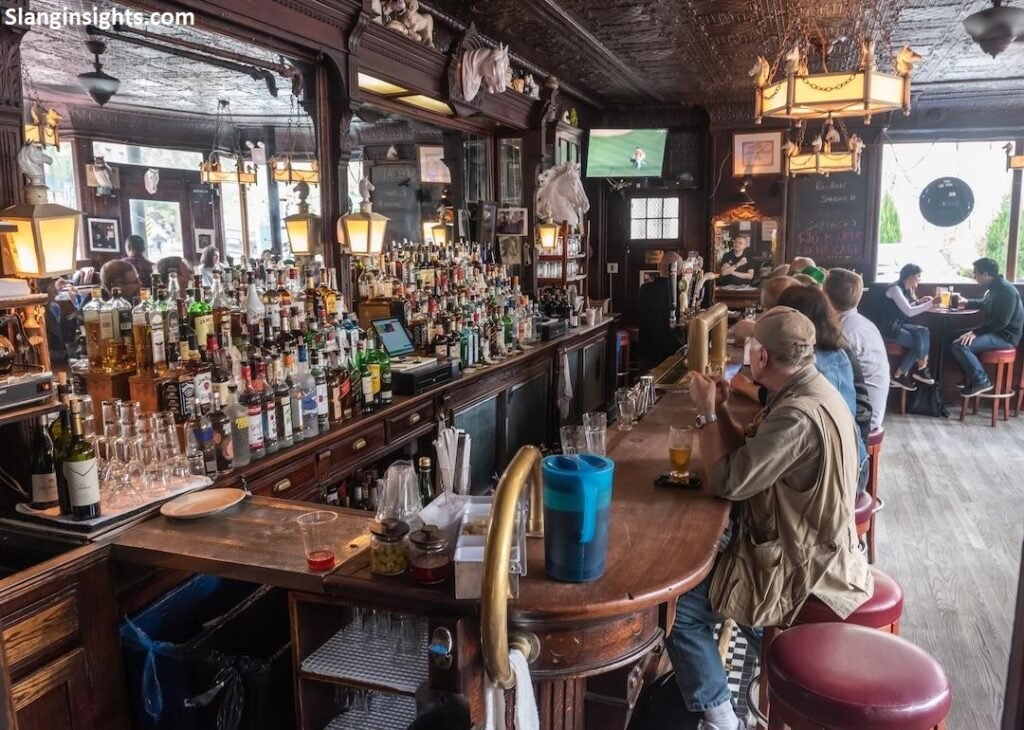
Party and Drinking Culture Slang
This is where things get a little more chaotic and a lot more generational.
Pre-game — Drinking before going out, usually at someone’s place to save money on bar prices. This is a whole ritual. There’s a science to the pre-game.
Nightcap (again, but different context) — When you’re heading home and someone suggests “one more” at a bar near the exit. This is a trap. A loving, warm, friendly trap.
Two-drink minimum — Originally a real bar policy, now used casually to mean the baseline you’re committing to for an evening.
A round — When you buy drinks for your whole group. “I’ll get the next round” is one of the most important social contracts in drinking culture. Don’t break it.
On the rocks — With ice. “Whiskey on the rocks” means whiskey poured over ice cubes. Some people feel very strongly about this. Let them.
Neat — Without ice, without mixers. Just the spirit, in a glass, at room temperature. The purist’s order.
A chaser — Something you drink immediately after a shot to soften the taste. Usually juice, beer, or soda. Necessary for certain shots. Don’t let anyone tell you otherwise.
Regional Slang Worth Knowing
Tinnie (Australia) — Again, a can of beer. Very common.
Bevvy (UK) — Short for beverage, but almost always means alcohol. “Fancy a bevvy?” is the British equivalent of “Want a drink?”
Jar (Ireland/UK) — A pint of beer. “Going for a few jars” means going to the pub for a couple of beers.
Slab (Australia) — A case of 24 beers. “Grab a slab on your way” is a perfectly normal sentence at an Australian gathering.
Mickey (Canada) — A small bottle of spirits, roughly 375ml. This is very specifically a Canadian term and it’ll confuse people in other countries.
Mistakes I’ve Made Learning This Stuff (So You Don’t Have To)
The first time someone in a pub asked if I wanted a “half,” I thought they were asking if I wanted to split something. They were asking if I wanted half a pint of beer. These are different things.
I once described a wine as “plonk” not realizing it was a bottle the host was actually proud of. Read the room. Save the dismissive wine vocabulary for conversations with close friends.
I’ve also ordered a drink “neat” when I actually wanted it on the rocks. Turns out I’m someone who likes ice in their whiskey and that’s fine, regardless of what anyone says on Reddit.
The lesson is: slang is contextual. What flies in an Irish pub might not land in a craft cocktail bar in Brooklyn. Pay attention to where you are and who you’re talking to.
A Note on Responsible Context
None of this slang knowledge is super useful if you’re not also aware of when “one more” stops being fun and starts being a problem.
The vocabulary of drinking culture is often designed to normalize and lighten the whole thing — which can be great for social lubrication and not so great when it masks habits that are getting out of hand.
Knowing the lingo doesn’t mean you have to use it every weekend. Some of the people who know every term on this list have also decided they’re better off without alcohol.
That’s a conversation worth having with yourself from time to time, regardless of how well you know the vocabulary.
FAQ’s
What is the most common slang term for alcohol?
The most common slang term for alcohol is “booze.” It is widely used in everyday conversations to refer to alcoholic beverages of all kinds.
Why do people use slang words for alcohol?
People use slang for alcohol to make conversations more casual, humorous, or culturally relevant. Slang terms can also reflect regional traditions and social trends.
Is “sauce” a slang word for alcohol?
Yes, “sauce” is a popular slang term for alcohol. It is often used informally, especially among younger generations.
What does “liquid courage” mean?
“Liquid courage” refers to alcohol consumed to reduce nervousness or increase confidence in social situations.
Does alcohol slang vary by country?
Yes, alcohol slang differs from country to country. For example, terms commonly used in the United States may be unfamiliar in the United Kingdom, Australia, or other regions.
Conclusion
Slang for alcohol has been a part of everyday language for generations, evolving alongside culture, music, entertainment, and social trends.
From classic terms like booze and hooch to modern expressions such as sauce and juice, these words add personality and color to conversations about drinking.
Some slang terms are widely recognized across English-speaking countries, while others are unique to specific regions or communities.
Understanding alcohol slang can help you better interpret casual conversations, social media posts, movies, and song lyrics.
It also offers insight into how language adapts over time to reflect changing attitudes and lifestyles.
While many slang terms are used humorously or informally, it’s important to recognize their context, as meanings can vary depending on location and culture.
Whether you’re expanding your vocabulary, researching language trends, or simply curious about popular expressions, learning slang for alcohol is an interesting way to explore modern communication.
As new generations create fresh terminology, the list of alcohol-related slang continues to grow, making it a fascinating and ever-changing part of the English language.