Toronto Slang Words Essential Canadian Urban Vocabulary for Beginners
Toronto Slang Words street language is a vibrant mix of cultures, blending Caribbean, South Asian, and hip-hop influences into something uniquely its own.
If someone calls you their ting, you’re their person — romantic or otherwise. Wasteman describes someone with no ambition, while mandem refers to your crew. To link means to meet up, and when plans are solid, they’re blessed.
Calling something peak means it’s unfortunate or rough. A greezy move is suspicious or shady. When something is lit, it’s exciting, and if you’re moving mad, you’re acting reckless. Toronto slang isn’t just words — it’s an identity.
Table of Contents
Quick Table
| Slang Word | Meaning | Example Usage |
|---|---|---|
| Ting | A person or thing | “She’s my ting” |
| Mandem | Your crew/friends | “Rolling with the mandem” |
| Wasteman | Useless/lazy person | “Don’t be a wasteman” |
| Link | To meet up | “Let’s link later” |
| Wagwan | What’s going on? | “Wagwan, fam?” |
| Bare | A lot of / very | “There’s bare people here” |
| Peak | Unfortunate / rough | “That’s peak, bro” |
| Drip | Stylish outfit | “His drip is cold” |
My First Encounter with Toronto Slang
The first time I visited Toronto, I thought I was reasonably fluent in English.
I’d traveled a lot, I’d lived in a few different cities — I figured I’d be fine. Then a guy at a Scarborough food court looked at me and said, “Yo, that’s peak, wallahi. Man’s deadass about to link with my ting after this.”
I just stared at him like he’d spoken Klingon.
That was my introduction to Toronto slang — or as the locals call it, the Toronto ting.
And honestly? Learning it was one of the most entertaining and slightly embarrassing experiences I’ve had as someone who spends a lot of time writing about culture and language online.
This guide isn’t a dictionary. It’s what I actually learned, from real conversations, from messing up, from getting laughed at (good-naturedly), and from slowly starting to understand what people around me were actually saying.
Why Toronto Slang Hits Different
Toronto is genuinely one of the most multicultural cities on the planet — and the slang reflects that.
You’ll hear Caribbean Patois, Jamaican influences, South Asian expressions, Somali slang, and good old Canadian English all colliding into something totally unique.
A lot of what’s now recognized globally as “Toronto slang” traces back to the city’s Black communities, particularly in areas like Rexdale, Malvern, Scarborough, and Jane & Finch.
Drake put a lot of it on the map internationally (whether people credit him or not), but these words were being used long before anyone called it “Toronto slang” online.
Understanding that context matters. It’s not just cool words. It’s language that came from real communities.
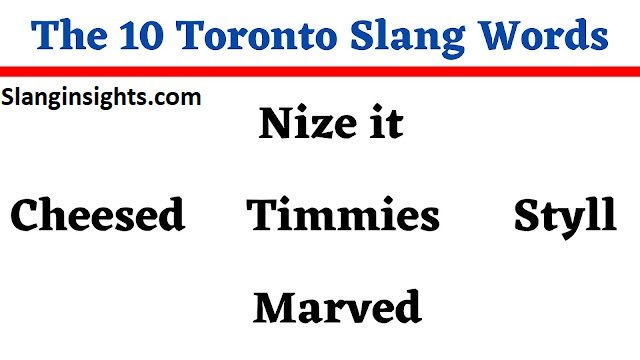
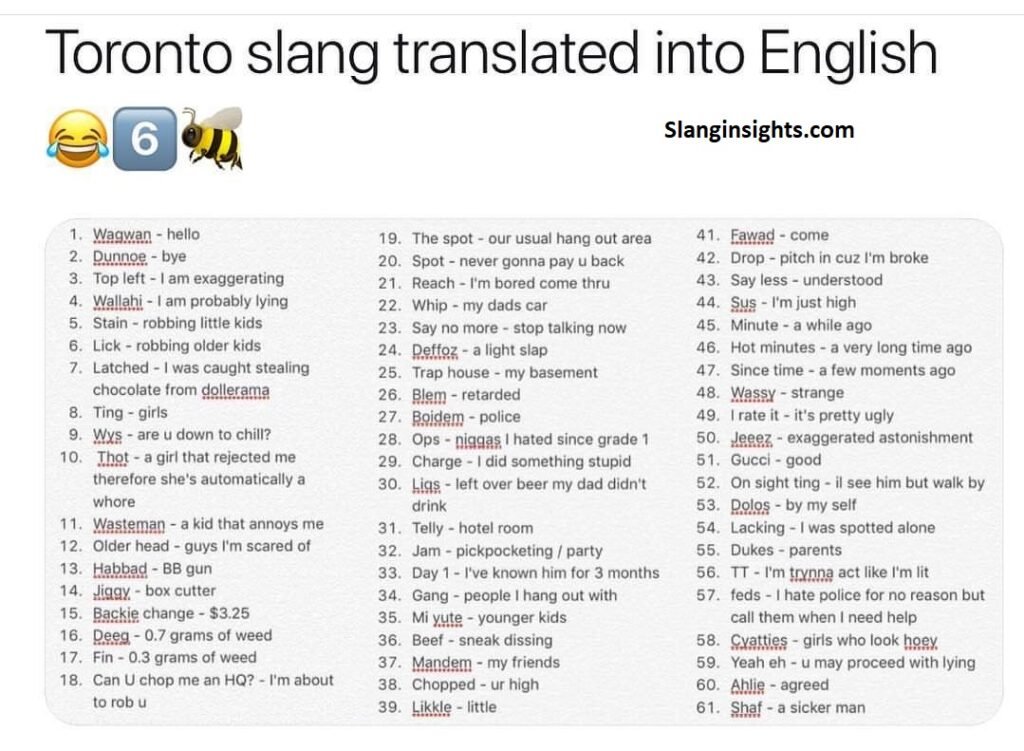
The Essential Toronto Slang Words (With Real Context)
Ting
This is probably the first word you’ll hear and the one that confused me the longest. “Ting” basically means thing — but it’s used for everything.
- A person you’re seeing romantically: “She’s my ting.”
- A situation: “The whole ting went sideways.”
- An object: “Grab that ting over there.”
When I first heard it, I thought it was a typo being spoken out loud. Now I use it constantly and I’m not even sorry.
Peak
“Peak” means something is unfortunate, rough, or just plain bad. Think of it as the Toronto way of saying “that sucks” — but somehow more expressive.
“I failed my driving test again.” “Bro, that’s peak.”
Don’t confuse it with the regular English use of “peak” (like peak performance). In Toronto speak, peak is almost always negative. I made this mistake at a coffee shop. Someone said my latte situation looked peak and I took it as a compliment. It was not.
Pepper
This one threw me completely. In Toronto slang, “pepper” or “peppered” means to be embarrassed or to embarrass someone else.
“He got peppered in front of the whole class.”
You might also hear “pepper someone” meaning to call them out or roast them. If someone says they’re going to pepper you, prepare to be gently (or not so gently) humiliated.
Waste
Not what you think. In Toronto, calling someone “waste” or a “waste man” means they’re useless, untrustworthy, or just not worth your time. It’s a dismissal more than an insult — like, this person doesn’t even register as worth getting angry at.
“Don’t bother inviting him — he’s a waste man.
Wallahi
This one comes from Arabic/Somali communities and has been fully absorbed into everyday Toronto speech. It means “I swear to God” — used to emphasize truth or sincerity.
“Wallahi, I didn’t even eat his food.”
You’ll hear this one across all ages and backgrounds in Toronto. It’s one of the more interesting examples of how multicultural Toronto slang actually is.
Linking
To “link” with someone means to meet up with them, hang out, or connect. Simple, but I kept trying to interpret it literally and got confused.
“We should link this weekend.” “I’m linking with the boys later.”
It can also mean meeting a romantic interest, depending on context. As with everything in slang, tone and context are your best friends.
Dun Know
This phrase means “of course” or “obviously” — like something goes without saying. It’s used to agree strongly or to confirm something that should be obvious.
“You coming to the game?” “Dun know.”
I first heard this and thought someone was saying “done know” and I had no idea what they’d finished knowing. Slang is humbling.
Drip
You’ve probably seen this one go mainstream, but Toronto was using it before it became a global fashion term. “Drip” refers to someone’s style, outfit, or overall aesthetic. If your drip is on point, you look good. Simple.
“Bro came through with the drip today.”
Ahlie
This is one of the most distinctly Toronto phrases. “Ahlie” (sometimes spelled “ah lie?” or “ahlie?”) is used as a question meaning “isn’t it?” or “right?” It’s tacked on to the end of a statement to seek agreement.
“That movie was peak, ahlie?” “We should link tomorrow, ahlie?”
It comes from Caribbean English and has become deeply embedded in Toronto conversation. Once you start hearing it, you’ll notice it constantly.
Mans
“Mans” (almost always with an ‘s’) is used to refer to oneself or another person. It’s a third-person way to talk about yourself, which feels grammatically chaotic until it doesn’t.
“Mans is tired today.” (Meaning: I am tired today.) “Mans came through with the food.” (Meaning: He came with the food.)
I used this wrong at least four times before it clicked. Once I said “man is going to be late” and someone corrected me with “it’s MANS bro” and I genuinely felt the growth in that moment.
Violating / Violation
If someone is “violating,” they’ve crossed a line — gone too far, said something out of pocket, or done something disrespectful.
“Bro, you can’t say that — that’s a violation.” “He was violating the whole night, someone had to say something.”

Ting Ting
Yes, “ting” gets doubled. “Ting ting” specifically often refers to a person — usually a girl — someone has romantic interest in. It adds a bit of affection to the already flexible “ting.”
“You see his ting ting? They’ve been linking for months.”
No Cap
Okay, this one went global — but it started heavy in Toronto and Atlanta rap cultures. “No cap” means no lie, I’m being serious, this is the truth.
“That was the best jerk chicken I’ve ever had, no cap.”
Its opposite, “cap,” means a lie or someone who’s lying.
Gyallis
A “gyallis” (sometimes spelled “gallis”) is a charmer — someone who’s really good with the opposite sex, someone who dates around and has multiple people interested in them. It’s not always negative; sometimes it’s said with admiration.
“He’s a gyallis, you know what you’re getting into.”
Common Mistakes Outsiders Make
Overusing it immediately. Please don’t walk into a Toronto barbershop after reading this article and immediately start saying “wallahi” and “ahlie.” People will notice. Ease in naturally.
Mixing up peak (bad) with peak (English for maximum). The context usually saves you, but just be aware — in Toronto, if someone calls something peak, they’re not complimenting it.
Treating it like a monolith. Toronto slang changes by neighborhood, age group, and even crew. What’s normal in Scarborough might land differently downtown. Don’t assume everyone uses every term.
Getting the tone wrong. A lot of Toronto slang has warmth to it when used right. “Mans” and “ting” are casual. “Waste man” is a real cut. Know the weight of what you’re saying.
Where You’ll Actually Hear This
If you’re in Toronto or planning to visit and want to get an ear for how this sounds in context, go to:
- Scarborough — you’ll hear the real thing constantly, especially around malls and community spaces
- Kensington Market and nearby areas — younger crowds, eclectic mix
- Barbershops — honestly, barbershops are where Canadian slang lives and breathes
- Toronto rap/music scene — artists like Pressa, Houdini, and older tracks from the 6ix catalogue will give you context through music
You can also follow Toronto-based creators on TikTok and YouTube who casually use this language. It helps the context click faster than any list ever will.
It’s More Than Just Slang
What I came to appreciate is that Toronto slang isn’t just a quirky local dialect. It’s the living proof of what happens when dozens of cultures share a city and influence each other daily.
The fact that Arabic words, Jamaican Patois, and Canadian English can combine into something that teens in Rexdale use without even thinking about it — that’s actually remarkable.
Learning it, even imperfectly, made me a better listener and a more curious person in that city. I stopped assuming I understood what people meant and started actually paying attention.
And yeah, I still mess up sometimes. Someone used “wagwan” in a sentence last week and I responded like it was a location (“oh, in Wagwan?”) and I will be accepting my embarrassment with grace.
The language is alive. That’s the whole point.
FAQ’s
What is Toronto slang called?
Toronto slang is often referred to as “Toronto Wap” or “road man” slang, heavily influenced by Jamaican patois, African, and hip-hop culture.
Where did Toronto slang come from?
It evolved from the city’s diverse immigrant communities, particularly Caribbean and South Asian cultures, blended with local hip-hop and rap influences.
Is Toronto slang the same as Canadian slang?
No. Toronto slang is unique to the city and differs significantly from general Canadian slang, though some words have crossed over into mainstream Canadian culture.
Did Drake popularize Toronto slang?
Absolutely. Drake brought global attention to Toronto slang through his music, making words like “ting,” “mandem,” and “wasteman” recognizable worldwide.
Is Toronto slang still evolving?
Yes. Like any living language, Toronto slang continuously evolves with new words emerging from the city’s youth, music scene, and social media culture.
Conclusion
Toronto slang is more than just a collection of cool words — it is a living, breathing reflection of one of the most multicultural cities in the world.
Born from the streets of Scarborough, Brampton, and the 6ix itself, these expressions carry the voices of Caribbean immigrants, South Asian communities, African cultures, and homegrown hip-hop artists who shaped the city’s identity over decades.
What makes Toronto slang truly special is its ability to bring people together.
Whether you are a longtime resident or a newcomer trying to find your footing, learning the local language is one of the fastest ways to connect with the city’s spirit.
Words like “mandem,” “wagwan,” and “ting” are not just slang — they are cultural bridges that reflect Toronto’s unique blend of backgrounds and experiences.
As Toronto continues to grow and diversify, its slang will keep evolving, absorbing new influences and shedding older ones.
Artists, content creators, and everyday people on social media play a huge role in spreading and shaping these expressions far beyond the city’s borders.
Whether you are visiting Toronto, creating content about it, or simply curious about its culture, understanding the slang gives you a deeper appreciation of what makes this city so vibrant, bold, and authentically its own.